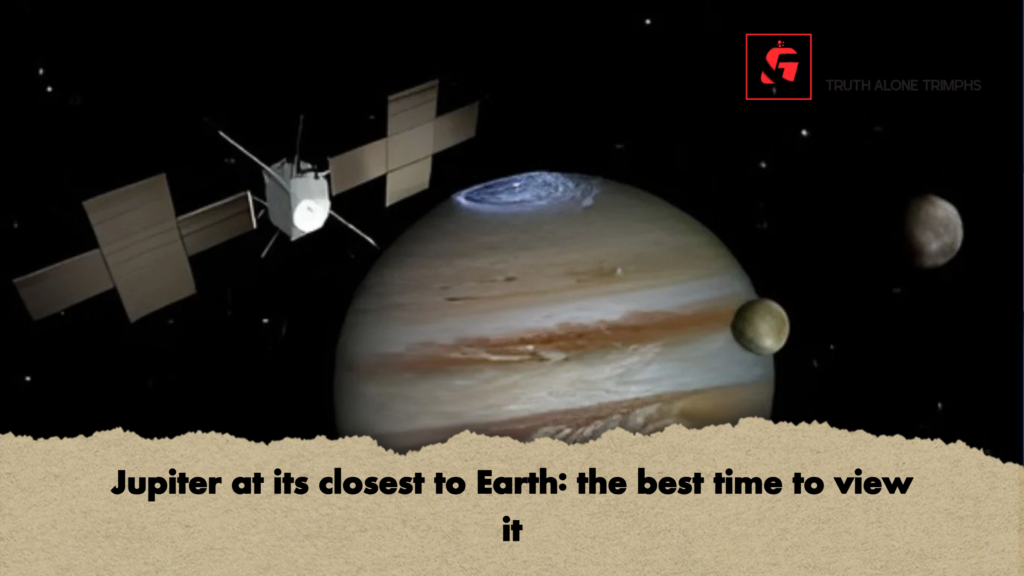
The largest planet in our solar system, Jupiter, is set to make its closest approach to Earth this week, offering a spectacular opportunity for astronomers and stargazers alike. The giant gas planet will be clearly visible in the night sky, appearing brighter than most stars, according to a report by The Guardian.
Jupiter will form a slightly irregular triangle with the two brightest stars of the Gemini constellation, Castor and Pollux, making it easier for observers to locate. Despite being much farther from Earth than Venus, Jupiter’s cloud-covered surface reflects a significant amount of sunlight, making it exceptionally luminous. With a diameter more than 11 times that of Earth, Jupiter dominates the sky when visible. This celestial event can be observed from both the Northern and Southern Hemispheres.
At its closest, Jupiter will be approximately 633 million kilometres from Earth. For context, sunlight takes about 43 minutes to reach Jupiter from the Sun, and the reflected sunlight from Jupiter takes roughly 35 minutes to reach our planet.
Stargazers are advised to look toward the eastern sky on the night of 9 January, when Jupiter will be visible to the naked eye. For those equipped with binoculars, Jupiter’s four largest moons—Io, Europa, Ganymede, and Callisto—can be observed. Using a small telescope or binoculars with 10× magnification or greater may even allow viewers to discern the planet’s cloud bands, providing a closer glimpse of its dynamic atmosphere.
Jupiter at a Glance
| Feature | Details |
|---|---|
| Closest Approach Date | 9 January |
| Distance from Earth | ~633 million km |
| Visibility | Northern & Southern Hemispheres |
| Apparent Brightness | Very high, easily seen with the naked eye |
| Diameter | 11+ times Earth’s diameter |
| Notable Moons Visible | Io, Europa, Ganymede, Callisto |
| Recommended Equipment | Naked eye, binoculars, small telescope (≥10×) |
Astronomers recommend observing from a location with minimal light pollution for the best view. This rare opportunity allows both amateur and professional astronomers to witness Jupiter at one of its closest points to Earth, offering an enchanting spectacle of the solar system’s largest planet.
Whether viewed with the naked eye or through a telescope, Jupiter’s brilliance promises to be a highlight of the January night sky.