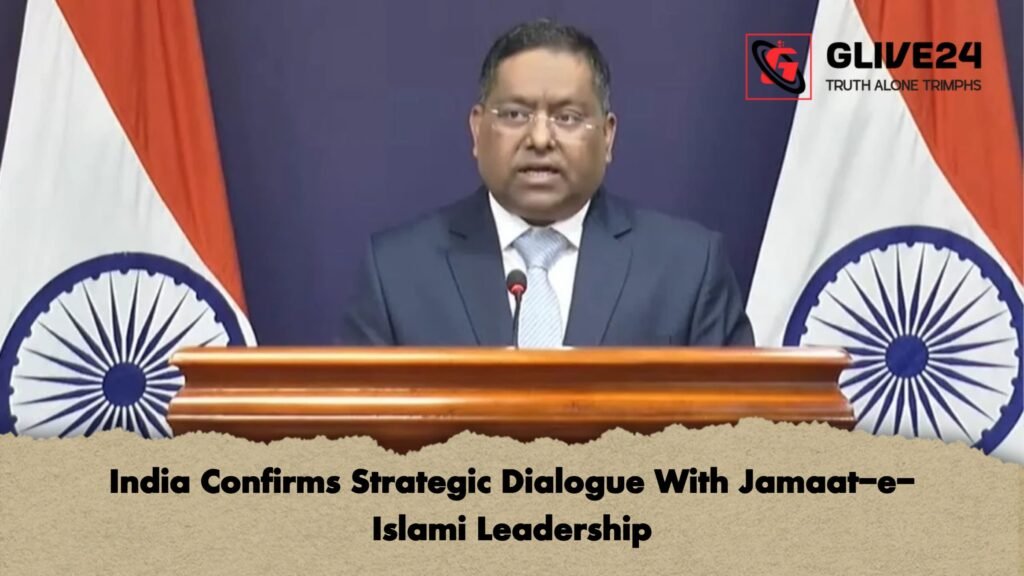
The Indian government has officially acknowledged a high-level diplomatic engagement with Bangladesh Jamaat-e-Islami, marking a significant and pragmatic pivot in New Delhi’s traditional foreign policy stance toward Dhaka. The confirmation was delivered by the Ministry of External Affairs (MEA) following recent disclosures by the party’s Amir, Dr Shafiqur Rahman, regarding a previously undisclosed meeting.
Table of Contents
Official Stance on Political Outreach
During a weekly press briefing on Friday, 16 January 2026, MEA spokesperson Randhir Jaiswal was questioned by journalists about the validity of Dr Rahman’s claims. Jaiswal did not deny the encounter, instead situating it within the broader framework of India’s diplomatic responsibilities.
“India shares a deep and multifaceted bilateral bond with Bangladesh,” Jaiswal remarked. “It is standard practice for our High Commission officials in Dhaka to engage in dialogue with a wide array of stakeholders and political entities. The meeting in question is a reflection of that routine diplomatic outreach.”
Discretion vs. Transparency
The disclosure of this meeting originally surfaced on 1 January during a Reuters interview with Dr Shafiqur Rahman. The Amir revealed that while representatives from Western nations and the European Union often meet him publicly, the Indian diplomat had specifically requested that their discussion remain confidential.
Dr Rahman explained that he decided to honour that request until the shifting political climate necessitated clarity. He stressed the importance of a “fresh start” between the party and India, noting: “We must be open with one another. Improving our bilateral relations is no longer an option—it is a necessity.”
Comparative Diplomatic Outreach in Dhaka
The following table contextualises the recent engagements between the Jamaat-e-Islami leadership and various international diplomatic missions:
| Diplomatic Entity | Nature of Engagement | Primary Concern |
| India | Discrete / Strategic | Regional Security & Stability |
| United States | Public / Formal | Democratic Standards & Rights |
| United Kingdom | Transparent / Consultative | Governance & Rule of Law |
| European Union | Formal / Investigative | Election Integrity |
Realpolitik and Regional Stability
Analysts view this development as a masterful stroke of realpolitik by the Indian government. Historically, New Delhi has maintained a staunchly close relationship with the Awami League, often viewing Jamaat-e-Islami with suspicion due to the party’s historical and ideological leanings. However, with the Bangladeshi political landscape evolving, India appears determined to “future-proof” its interests by establishing communication channels with all significant political players.
By acknowledging this meeting, India is signalling that it is prepared to engage with any group that may hold influence in a post-election scenario. This broader engagement is seen as vital for maintaining border security, protecting trans-shipment agreements, and ensuring that the geopolitical influence of other regional powers remains balanced.
This newfound transparency suggests that the “red lines” of South Asian diplomacy are being redrawn in favour of stability and mutual interest.