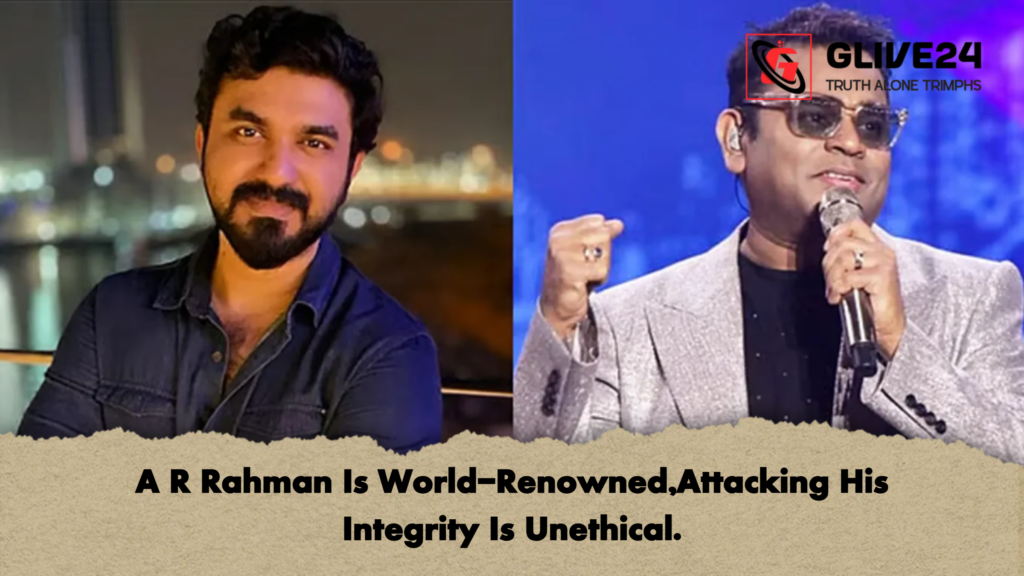
A recent comment by Oscar-winning Indian composer and musician A R Rahman has triggered a wave of debate across social media, sparking intense discussion within India’s cultural and artistic circles. While opinions have remained sharply divided, the globally acclaimed composer has responded with characteristic restraint, offering clarification without engaging in the increasingly personal criticism directed at him.
As the online controversy continued to grow, prominent Malayalam composer Kailas Menon publicly voiced his support for Rahman. In a widely shared Instagram post, Menon argued that much of the reaction to Rahman’s remarks had crossed the line between legitimate criticism and outright hostility. According to Menon, the tone and language used against Rahman amounted not to disagreement, but to hate speech and character assassination.
In a note titled “Disagree, but Do Not Disrespect”, Menon stressed that those attacking Rahman for expressing his feelings were overlooking a fundamental principle: the right to free expression. He pointed out that Rahman had merely articulated his personal experience and emotions, something no one else is entitled to invalidate. While disagreement is natural in a pluralistic society, Menon wrote, attempting to silence an artist or ridicule his lived experiences undermines the very essence of free discourse.
Menon further observed that the backlash against Rahman had escalated beyond reasoned debate. Public mockery of Rahman’s recent work, questioning his personal beliefs, or dismissing his experiences as a “victim narrative” could not be categorised as constructive criticism. Instead, such responses reflected a deeper intolerance towards dissenting voices, even when those voices belong to internationally respected cultural figures.
Highlighting Rahman’s stature, Menon reminded readers that the composer is far from an “incidental voice” in Indian culture. Over several decades, Rahman has played a defining role in shaping Tamil music, Indian cinema and the global perception of South Asian soundscapes. Differences of opinion over films or statements are inevitable, Menon noted, but public humiliation or attacks on an artist’s integrity are never justified. Freedom of speech, he added, must apply equally to critics and creators alike.
Against this backdrop, Rahman himself addressed the controversy on Sunday, 18 January, by sharing a video message on Instagram. In it, he clarified that his intention had never been to offend or hurt anyone. Music, Rahman said, has always been a means of connecting cultures, celebrating diversity and fostering mutual respect. Describing India as his inspiration, teacher and home, he reiterated that his lifelong aim has been to uplift, honour and serve through music.
To contextualise Rahman’s enduring influence, the following table outlines some key milestones from his career:
| Area of Contribution | Key Highlights |
|---|---|
| Film Music | Scores for over 200 Indian and international films |
| Global Awards | Two Academy Awards, two Grammy Awards |
| National Honours | Padma Shri and Padma Bhushan |
| Cultural Impact | Bridged Indian music with global audiences |
As the debate continues, the episode has reignited a broader conversation about the boundaries between criticism and contempt. For many within the artistic community, the message remains clear: disagreement is healthy, but questioning the integrity of a world-renowned artist like A R Rahman is neither fair nor productive.