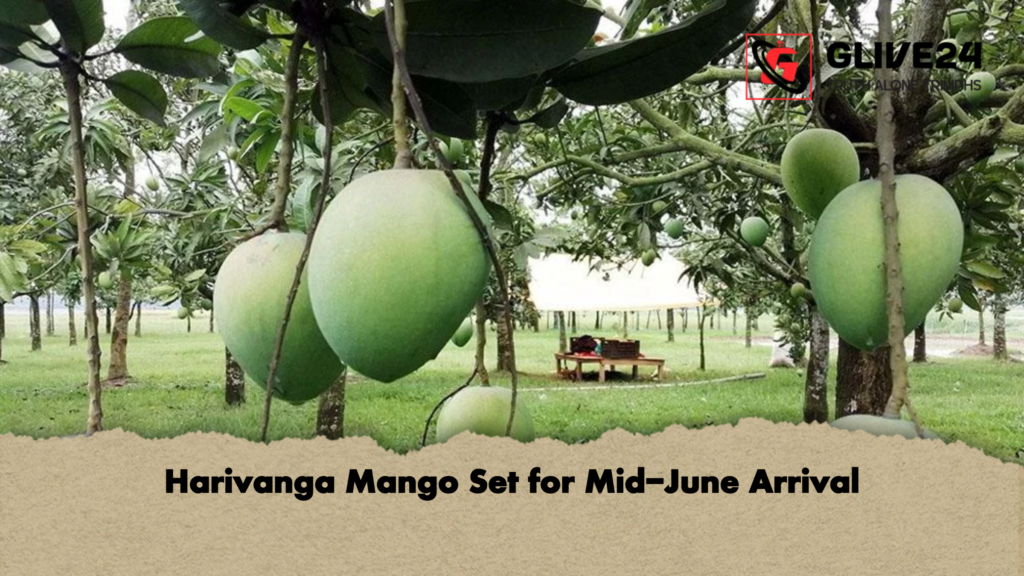
The famed Harivanga mango of Rangpur, renowned for its fibreless texture and sweet flavour, is expected to reach the market from mid-June, provided favourable weather conditions prevail. The variety has generated significant interest among growers, traders and agricultural authorities across the northern region of Bangladesh.
According to data from the Department of Agricultural Extension, mango cultivation this year in Rangpur district covers approximately 3,500 hectares of land. Of this, more than 2,000 hectares are dedicated to Harivanga mango orchards. Average yield is estimated at 10 to 12 metric tonnes per hectare, with total production value projected between BDT 2.2 billion and BDT 2.5 billion.
Harivanga Mango Cultivation Overview
| Category | Figure |
|---|---|
| Total mango cultivation area | ~3,500 hectares |
| Harivanga cultivation area | 2,000+ hectares |
| Estimated yield per hectare | 10–12 metric tonnes |
| Projected market value | BDT 220–250 crore |
Officials indicate that production is likely to be higher than last year due to the crop being in an “on year” cycle, a phenomenon in which mango trees produce heavier yields following a comparatively lower-output year. As a result, orchards across the region have seen significantly increased fruit formation this season.
Cultivation has expanded beyond Rangpur to neighbouring areas including Badarganj and Taraganj, as well as parts of Nilphamari—Saidpur, Sadar—and Dinajpur districts such as Parbatipur, Khansama and Chirirbandar. Both private and commercial orchards have reported intensified care practices to maintain fruit quality.
Recent rainfall has supported fruit growth and improved juiciness, although some orchards experienced minor losses due to hailstorms and strong winds. Agricultural authorities, however, confirmed that overall production has not been significantly affected.
The Podaganj area under Mithapukur upazila remains the primary production and wholesale hub for Harivanga mangoes. Its Khorgachha Union is home to the Podaganj market, one of the largest wholesale mango trading centres in the country. Traders from multiple districts have already begun establishing contact with growers in preparation for the upcoming season.
Local farmer Tarikuzzaman Sagar, who cultivates mangoes on more than 12 acres of land, reported that while some fruit was lost due to recent hail and storms, he expects a satisfactory yield if weather conditions remain stable. Trader Abdul Malek noted that wholesale buyers from Dhaka, Chattogram and Sylhet have already initiated advance negotiations, with expectations of strong demand and favourable pricing this season.
However, concerns remain among some farmers regarding potential adverse weather conditions. Storage limitations also continue to pose a major challenge, as Harivanga mangoes are highly perishable and require rapid distribution.
Key Trade and Market Concerns
| Aspect | Situation |
|---|---|
| Storage facility | Limited cold storage availability |
| Transport system | Requires faster logistics |
| Market infrastructure | Lack of permanent sheds in key markets |
| Export activity | Growing interest in Southeast Asia |
According to our representatives, including the president of the Rangpur chapter of a civic rights organisation, Harivanga mangoes are now being exported to countries such as Malaysia and Singapore. Direct sales via social media and e-commerce platforms have also increased in recent years, enabling farmers to sell directly from orchards.
Agricultural officials confirmed that continuous advisory support is being provided to farmers to ensure disease control and quality maintenance. The Additional Director of the Rangpur Department of Agricultural Extension stated that the current on-year cycle has resulted in significantly higher fruit setting across orchards.
The District Commissioner of Rangpur described Harivanga mango as a key regional brand whose recognition has expanded beyond national boundaries following its geographical indication status. He added that favourable weather conditions this season are expected to contribute positively to the regional economy.