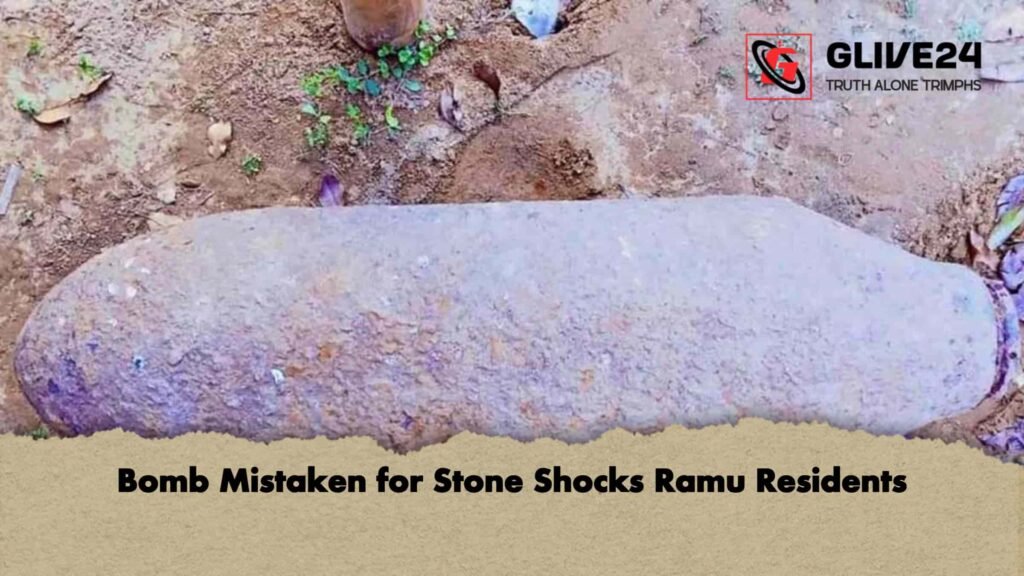
A startling and deeply unsettling discovery has emerged from Ramu upazila in Cox’s Bazar district, where local residents unknowingly used what they believed to be an ordinary stone for daily chores—only to later learn that it was a bomb-like object, potentially dating back to the Second World War.
The incident occurred in the Tanchakhali area of Lot Ukhiairghona village under Kawarkhop Union. For an extended period, villagers had regarded a large, heavy metallic object lying in the open as nothing more than a naturally occurring rock. Its size and stability made it convenient for household use, and several residents reportedly used it as a base for washing clothes. No one suspected that the seemingly inert object could pose a serious threat to life and property.
The matter came to light on the morning of 24 January, when some locals noticed unusual features in the object that raised suspicion. They promptly informed the police. Officers from Ramu Police Station arrived at the scene without delay, cordoned off the area, and moved residents to a safe distance as a precautionary measure. After securing the site, the object was carefully relocated to a safer location to minimise any immediate risk.
Preliminary assessments by police and administrative officials suggest that the item may be an unexploded or abandoned bomb from the Second World War. Historians and local researchers note that during the 1940s the Cox’s Bazar coastal belt, including Ramu and surrounding areas, held strategic military importance. Japanese forces and Allied troops were active in the broader region, making it plausible that unexploded ordnance was left behind during that period.
Given the seriousness of the situation, the army’s bomb disposal unit has been called in to conduct a detailed technical examination. Specialists are analysing the object’s structure, metallic composition, and internal condition to determine whether any explosive material remains active. Should the device be found live, it will be neutralised or destroyed in a controlled operation to ensure public safety. If, however, it is confirmed to be completely inert, authorities may consider preserving it as a historical artefact reflecting the region’s wartime past.
Local administrators have reiterated a clear warning to the public: any unidentified metallic or bomb-like object should never be touched, moved, or used. Even minimal negligence, they stressed, could lead to catastrophic consequences.
Summary of Initial Findings
| Item | Details |
|---|---|
| Location | Tanchakhali, Lot Ukhiairghona, Ramu |
| Date of Discovery | 24 January |
| Object Description | Bomb-shaped metallic object |
| Suspected Era | Second World War |
| Authorities Involved | Police and Army |
| Possible Outcome | Neutralisation or historical preservation |
Beyond its shock value, the incident has underscored the critical importance of public awareness and safety vigilance. In Ramu, residents have been reminded—perhaps more starkly than ever—that remnants of history can be far more dangerous than they appear, and that what seems like an ordinary stone may conceal a deadly legacy.