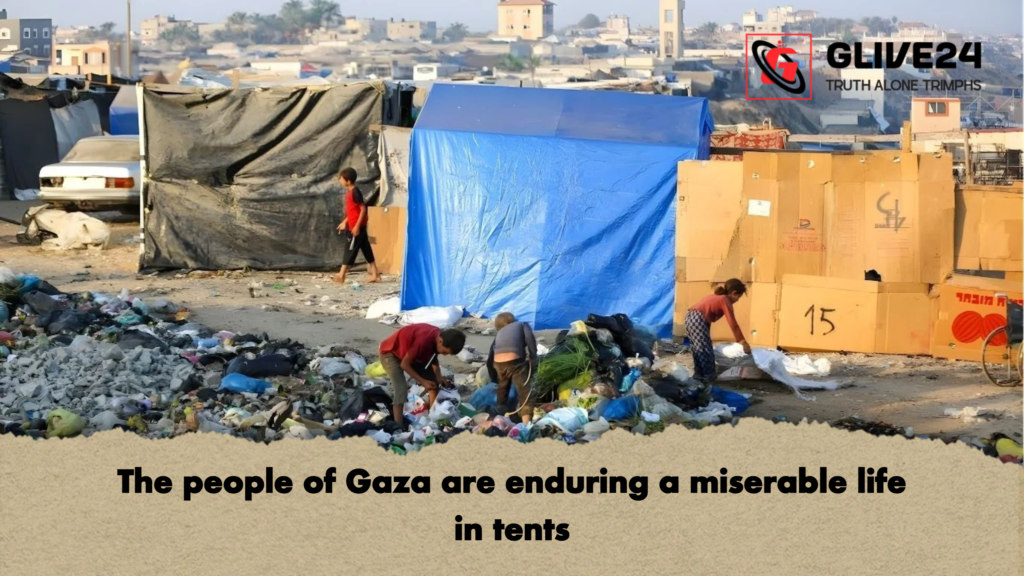
Despite a ceasefire in Gaza, the humanitarian crisis in the territory persists unabated. Over the past two years, repeated Israeli military assaults have devastated the majority of buildings in the Gaza Strip. Thousands of residents, having lost their homes, are now forcibly displaced, compelled to live in makeshift tents under appalling and unsanitary conditions. In these precarious shelters, where even minimal living standards are unattainable, inhabitants are increasingly succumbing to respiratory illnesses, gastrointestinal problems, and other serious health conditions.
Since the onset of the conflict, the Abu Amr family has been displaced more than seventeen times. Each relocation has further compressed their living conditions. Currently, with no alternatives, the family has pitched a tent beside a garbage dump in Gaza’s Rimal district. Here, they struggle daily against pollution, disease, and the harsh realities of an inhumane environment.
Sixty-four-year-old Abu Amr explains, “In Gaza, we live amidst two wars—one of bombs, and another of rubbish. I suffer from asthma and always keep my inhaler nearby. At night, I place it under my pillow. The stench from the waste often blocks my airways, forcing me to use it several times.”
His daughter-in-law, Suraiya Abu Amr, a mother of five, adds: “Maintaining even basic hygiene in this tent is almost impossible. Severe water shortages mean we frequently suffer from stomach ailments.” She recalls that before the Israeli attacks, their life in Beit al-Lahiya was organised and hygienic. “Being forced to relocate to Gaza City, living in such a nightmare, is something I never imagined,” she says.
The scale of devastation across Gaza is staggering:
| Impact of Israeli Attacks | Figures |
|---|---|
| Palestinian fatalities | 70,000+ |
| Children killed since ceasefire | 400+ |
| Damage to water infrastructure | 85% of wells destroyed |
| Length of damaged water pipes | 150,000 metres |
| Accumulated waste in Gaza Strip | 700,000 tons |
| Waste in Gaza City alone | 350,000+ tons |
Forty-year-old resident Selim reports, “Living beside a landfill leaves us utterly demoralised. My children suffer both from heat and cold, and the stench makes eating impossible. Sometimes vomit occurs when they try.” During storms, sewage water often floods into the tent, contaminating clothing and bedding salvaged from Beit al-Lahiya. Selim adds, “We sometimes have no choice but to pray in soiled clothes.”
Children bear the brunt of this crisis. Thirteen-year-old Rahaf says, “Due to the lack of cleanliness, my hair is falling out, and my skin is infected.” Medical professionals warn that the combination of uncollected waste, contaminated water, and scarce clean drinking water is rapidly increasing the incidence of disease.
Dr Ahmed Al-Rabei, head of the Pulmonology Department at Al-Shifa Medical Complex, states: “The public health situation in Gaza is dire. We are witnessing widespread bacterial and viral infections at levels never seen prior to the conflict.” Municipal authorities confirm that essential water and sanitation infrastructure has been largely destroyed, leaving residents without safe water or waste management systems.