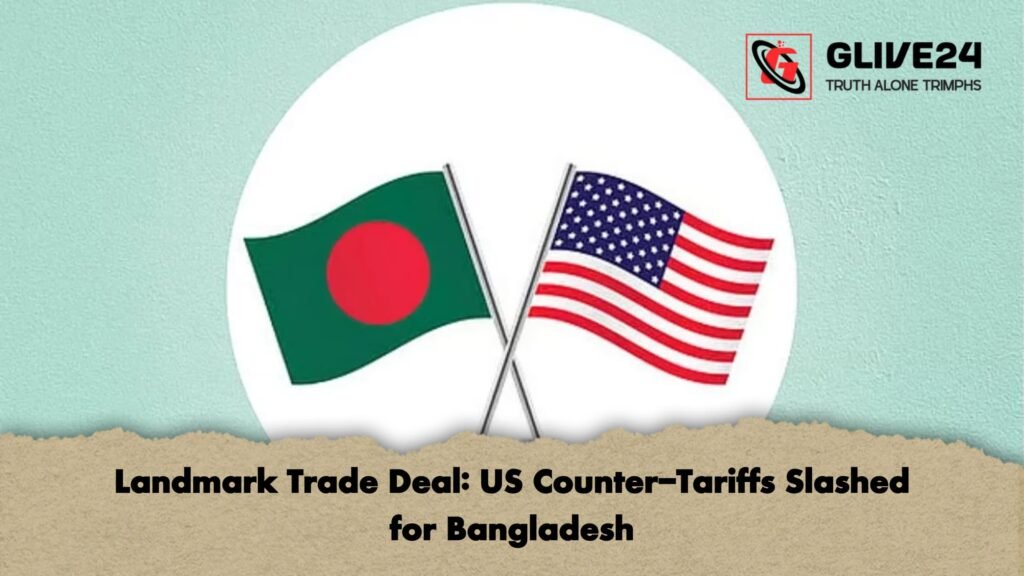
In a significant diplomatic and economic breakthrough, Bangladesh and the United States officially signed a comprehensive trade agreement on Monday at 10:00 pm (BST). The deal, finalised in Washington D.C., marks a pivotal shift in bilateral relations, resulting in an immediate 1% reduction in the retaliatory counter-tariffs previously imposed by the U.S. government on Bangladeshi exports.
Table of Contents
Shifting Tariffs and Strategic Exemptions
Under the newly signed accord, the counter-tariff rate on Bangladeshi goods has been lowered from 20% to 19%. While the headline reduction appears modest, the agreement includes a transformative “Raw Material Exemption” clause. Effective immediately, any garments manufactured in Bangladesh using American-grown cotton or synthetic fibres will be entirely exempt from counter-tariffs.
This creates a powerful incentive for Bangladeshi garment manufacturers to pivot their supply chains toward U.S. raw materials, effectively allowing them to export finished apparel back to the American market at significantly more competitive prices.
The Evolution of U.S. Counter-Tariffs on Bangladesh (2025–2026)
| Date | Event / Adjustment | Counter-Tariff Rate |
| 2 April 2025 | Initial rate proposed by President Trump | 37% |
| 7 July 2025 | Rate reduced following three-month deferral | 35% |
| 2 August 2025 | Negotiated reduction prior to implementation | 20% |
| 7 August 2025 | Counter-tariffs formally come into effect | 20% |
| 9 February 2026 | New Trade Agreement Signed | 19%* |
*Note: 0% counter-tariff applies to garments made with U.S. raw materials.
High-Level Virtual Signing
The agreement was signed by Bangladesh’s Trade Adviser, Sheikh Bashiruddin, and the United States Trade Representative (USTR), Jamieson Greer. Despite the gravity of the occasion, the primary Bangladeshi signatories participated virtually from Dhaka, alongside National Security Adviser Khalilur Rahman, Commerce Secretary Mahbubur Rahman, and Lutfey Siddiqi, the Special Assistant to the Chief Adviser.
A physical five-member delegation, led by Khadiza Nazneen, Additional Secretary of the WTO Wing, was present in Washington to facilitate the ceremony and handle the technical formalities.
Industry Optimism vs. Expert Caution
Leading exporters have hailed the deal as a masterstroke for the Readymade Garment (RMG) sector. A.K. Azad, Managing Director of Ha-Meem Group—one of the largest exporters to the U.S.—expressed immense satisfaction.
“This is wonderful news for the industry. We already import a substantial volume of American cotton; this deal provides us with a clear roadmap to increase those imports and leverage the duty-free benefits. It will undoubtedly boost our export volumes significantly,” Azad noted.
However, not all reactions have been celebratory. Dr Mustafizur Rahman, Distinguished Fellow at the Centre for Policy Dialogue (CPD), raised concerns regarding the transparency and timing of the pact. He questioned the long-term commitments Bangladesh may have conceded in exchange for these tariff breaks, noting that the details of the “conditionalities” remain undisclosed. He cautioned that the burden of meeting these potentially rigorous requirements would fall upon the next elected government.
The Trade Balance Context
The U.S.-Bangladesh trade relationship currently stands at approximately $8 billion. Bangladesh enjoys a favourable trade surplus, exporting roughly $6 billion in goods (primarily apparel) while importing $2 billion in American products, including aircraft parts, LNG, and agricultural commodities like wheat and soybeans. This new agreement is seen as a strategic move to narrow that trade gap by encouraging higher imports of U.S. cotton and corn.
The Ministry of Commerce is expected to hold a formal press briefing tomorrow at 2:30 pm to disclose the finer technical details of the agreement.