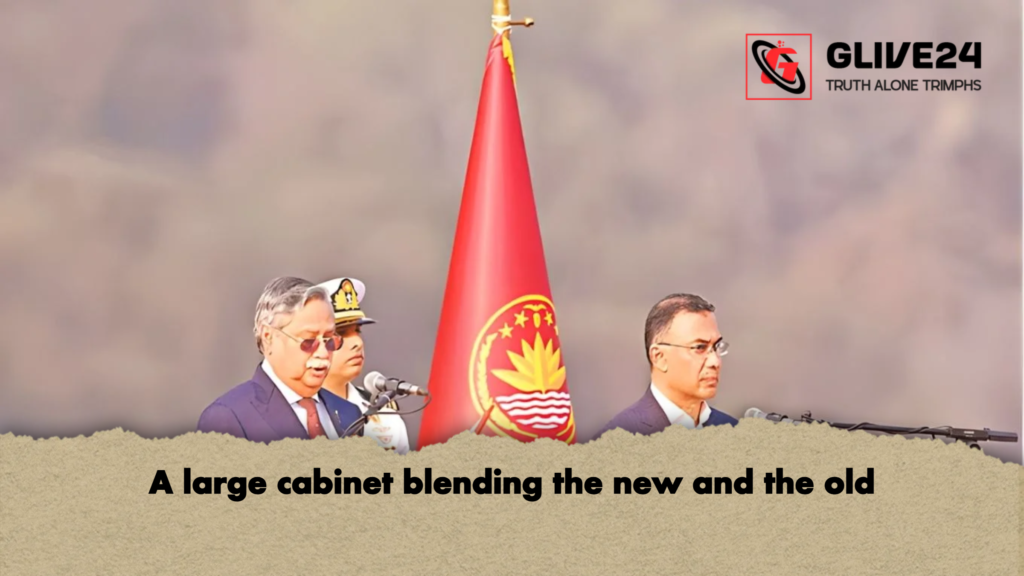
After two decades out of power, the Bangladesh Nationalist Party (BNP) has embarked on a new chapter in national governance. Chairman Tarique Rahman was sworn in as the country’s Prime Minister and simultaneously unveiled a 50-member cabinet, blending senior party stalwarts with mid-level leaders and a significant cohort of newcomers.
The swearing-in ceremony took place yesterday, Tuesday, at the South Plaza of the National Parliament, where President Md. Sahabuddin administered the oaths. This formalised the long-anticipated launch of the new government.
Analysis of the cabinet reveals a deliberate generational mix. While several members assume ministerial or deputy ministerial positions for the first time in their parliamentary careers, others carry substantial political experience. The cabinet is notable for the prominence of fresh faces, although some seasoned leaders have also been appointed to key roles.
Table of Contents
Senior Leadership
Among the BNP’s senior figures, Secretary General Mirza Fakhrul Islam Alamgir, Standing Committee members Ameer Khasru Mahmud Chowdhury, Salahuddin Ahmed, Iqbal Hasan Mahmud, and Major (Ret.) Hafiz Uddin Ahmed were sworn in as ministers, as widely expected.
However, senior Standing Committee members Khandakar Mosharraf Hossain and Abdul Moyeen Khan are absent from the cabinet. Reports suggest Mosharraf may be appointed President and Khan as Speaker of Parliament, likely explaining their exclusion.
Several other Standing Committee members, including Mirza Abbas, Goyeshwar Chandra Roy, Nazrul Islam Khan, and Selima Rahman, are also not included in ministerial positions. Nevertheless, ten—including Abbas and Nazrul—have been appointed as advisers with ministerial or deputy ministerial rank.
Technocrats and Advisors
Prominent advisers include Ruhul Kabir Rizvi, former Secretary Md. Ismail Zabiullah, and Professor Rashed Al Mahmud Titumir, an economist from Dhaka University. Deputy ministerial advisers include Humayun Kabir, Brig. Gen. (Ret.) Shamsul Islam, Dr. Zahedur Rahman, Mahdi Amin, and Rehan Asif Asad. Notably, Shamsul Islam served as Chief Security Officer to the BNP Chairman, while Rehan Asif Asad is a technology expert and son of Dr. Asaduzzaman, founder of the Barendra Multipurpose Project.
The most discussed addition to the cabinet is Khalilur Rahman, former National Security Advisor under Professor Muhammad Yunus’ interim government. Breaking convention, he has been appointed as Foreign Minister, signalling a closer alignment with BNP leadership.
Cabinet Composition
The cabinet comprises 25 full ministers and 24 deputy ministers. Among the full ministers, nine have prior ministerial experience, nine are first-time MPs turned ministers, and seven are former MPs without previous ministerial experience. All 24 deputy ministers are first-time appointees, 21 of whom are newly elected MPs.
Summary Table: Cabinet Composition
| Category | Full Ministers | Deputy Ministers | Total | Notes |
|---|---|---|---|---|
| Experienced Ministers | 9 | 3 | 12 | Previously held ministerial posts |
| First-time MPs as Ministers | 9 | 21 | 30 | Entering cabinet on first election |
| Former MPs, non-ministers | 7 | – | 7 | Prior parliamentary experience |
| Technocrats | 1 | 1 | 2 | Expert appointments outside party elections |
Notable New Faces
Prime Minister Tarique Rahman himself is an elected newcomer. Other first-time ministers include EZM Zahid Hossain, Khalilur Rahman (technocrat), Abdul Awal Mintu, Mizanur Rahman (Minu), Khandakar Abdul Moktadir, Ariful Haque Chowdhury, Zahir Uddin Swapon, Mohammad Amin ur Rashid (technocrat), Afroza Khanum (Rita), Shahid Uddin Chowdhury (Anni), Md. Asaduzzaman, Zakaria Taher (Sumon), Dipen Dewan, Fakir Mahbub Anam (Swapon), Sardar Sakhawat Hossain (Bakul), and Sheikh Robiul Alam.
The swearing-in ceremony was publicly held at the National Parliament’s South Plaza, witnessed by a large crowd. Supporters expressed optimism about the new government’s potential under Tarique Rahman’s leadership.
Political analysts note that the cabinet’s effectiveness will depend on the balance of experience and fresh energy, the allocation of ministerial portfolios, policy-making, and implementation on the ground.