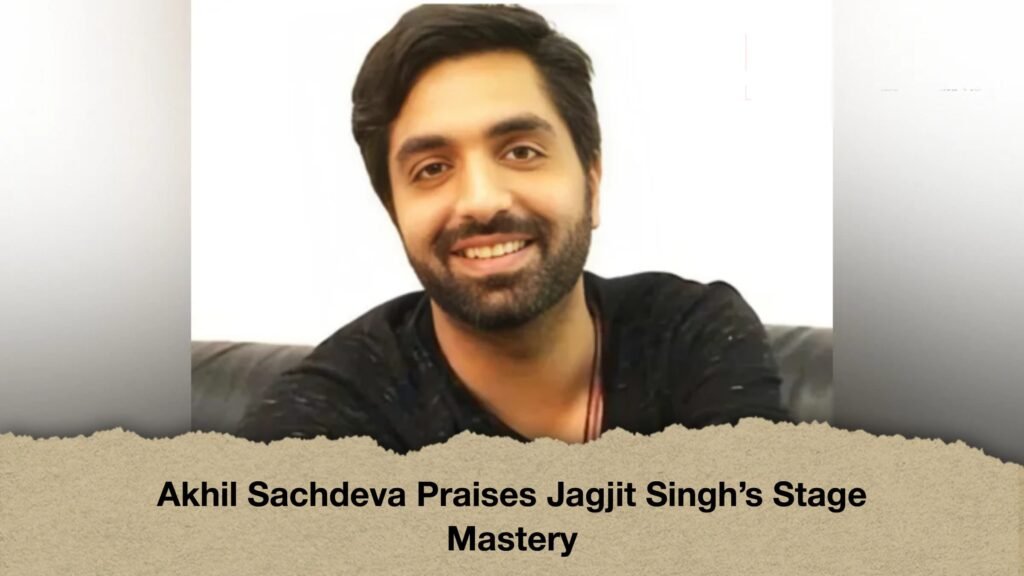
Singer and composer Akhil Sachdeva, who is associated with the upcoming film Awarapan 2, has praised legendary ghazal singer Jagjit Singh for his exceptional command over live audiences. Akhil believes Singh possessed a rare ability to hold listeners’ attention and influence their emotions through his music, gestures and stage presence.
Speaking in a recent interview, Akhil reflected on his own musical journey, his experiences of performing live and the relationship between an artist and an audience. While discussing the challenges and responsibilities of performing on stage, he referred to Jagjit Singh as an outstanding example of a musician who could establish an immediate connection with listeners.
According to Akhil, Jagjit Singh’s ability to control the atmosphere during a performance was remarkable. He recalled that when Singh closed his hand, the audience could fall silent, while opening it could trigger applause across the venue. For Akhil, such a response demonstrated a level of communication between performer and audience that is rarely achieved.
Akhil’s comments highlight an important distinction between singing a song and delivering a complete live performance. A technically accomplished vocalist may impress an audience, but creating a shared emotional experience requires timing, expression and an understanding of the people in front of the stage. Singh was widely admired for precisely that quality, with his restrained style and expressive delivery allowing his performances to feel intimate even in larger settings.
Akhil, who has spent years performing before live audiences himself, regards stage performances as an important part of his career. Alongside his work in film music, he has continued to perform directly for listeners, gaining experience in understanding how audiences respond to different songs and musical moments.
The singer also spoke about the universal nature of music. In his view, music is not restricted by a particular language. When an artist performs with sincerity, the emotion conveyed through the song can cross linguistic boundaries and reach listeners on a deeper level. For Akhil, creating that emotional connection is one of the most meaningful aspects of being a musician.
Reflecting on his own career, Akhil said he has been associated with music for around 15 years. During this period, performing live has played a significant role in shaping his artistic outlook. He considers it a major achievement when his work is able to inspire another musician, influence someone from a younger generation or simply create an emotional response among listeners.
Akhil is currently drawing attention for his contribution to the music of Awarapan 2. He is associated with the song ‘Piya Ghar Aaya – Homecoming’, which forms part of the soundtrack of the sequel to the 2007 film Awarapan. Emraan Hashmi returns as Shivam Pandit in the new instalment, continuing the connection with the original film.
The 2007 Awarapan did not become a major commercial success at the time of its theatrical release, but its music gradually developed a strong following. The soundtrack, along with the film’s performances, continued to attract attention after its release and helped the film acquire a lasting place among sections of Hindi cinema audiences.
That musical legacy has contributed to interest surrounding Awarapan 2, particularly among listeners familiar with the original soundtrack. Akhil’s comments about Jagjit Singh also place his own approach to live performance within a broader tradition in which the relationship between a singer and an audience is central to the experience of music.
Jagjit Singh remains one of the most influential figures in modern ghazal music, known for bringing the genre to a wide contemporary audience through a style that combined lyrical depth with accessible musical arrangements. His influence has extended beyond individual songs, with generations of singers and musicians continuing to study his approach to expression and live performance.
For Akhil, Singh’s stage presence represents a particularly valuable lesson. His remarks suggest that the lasting impact of a singer is not determined solely by vocal ability or the popularity of individual songs. The ability to make an audience listen, feel and respond collectively can become an equally significant part of an artist’s legacy.
It is this connection between performer and listener that Akhil appears to admire most in Jagjit Singh — a quality that continues to make the legendary singer’s live performances a reference point for musicians even years after his death.