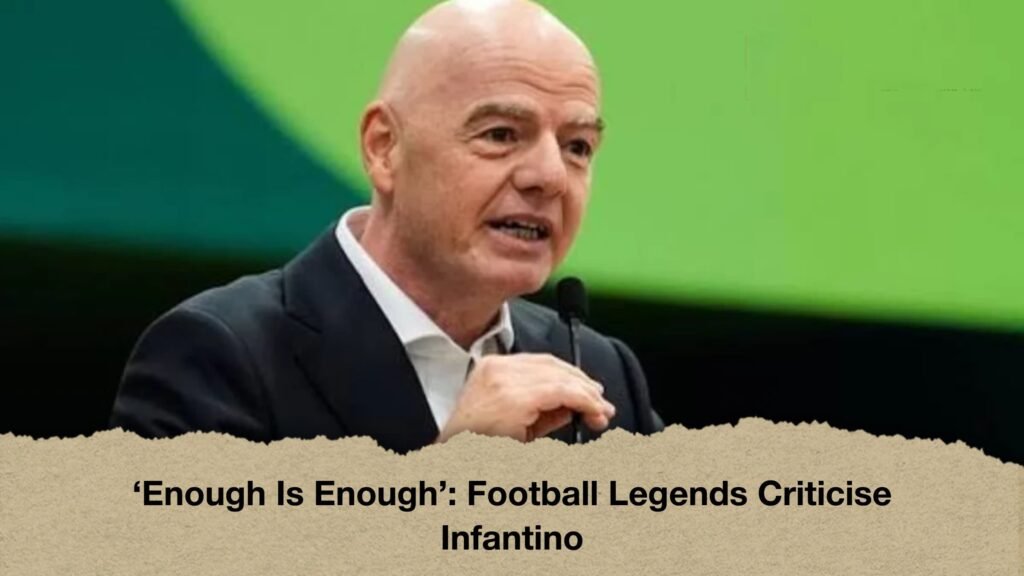
FIFA president Gianni Infantino is facing renewed criticism after a group of prominent former footballers accused the organisation’s current leadership of taking the sport away from its core values.
The criticism follows the disclosure of a controversial proposal involving the sale of parts of the World Cup to private investors. Although the plan was subsequently abandoned, the controversy has continued to raise questions about FIFA’s leadership and the direction in which the global game is heading.
Among those voicing their concerns is former Manchester United and Arsenal defender Mikaël Silvestre, a member of FIFA’s Players’ Voice Panel. The former France international, who won the Champions League with Manchester United, shared the joint statement on social media and called for the beginning of a ‘new era’ at FIFA.
Former England defender Lucy Bronze and former France international Emmanuel Petit, a member of France’s 1998 World Cup-winning squad, also shared statements expressing similar concerns.
The intervention is particularly notable because some of FIFA’s official ‘Legends’ have previously supported a number of Infantino’s major initiatives. These have included proposals to reshape the international football calendar, most notably the idea of staging the men’s World Cup every two years.
The biennial World Cup proposal generated considerable debate across football. Supporters argued that a more frequent tournament could provide additional opportunities for national teams and increase revenue, while critics raised concerns about player workload, the crowded international calendar and the potential impact on the traditional structure of international football.
Against that background, criticism from former high-profile players carries added significance. According to The Times, the decision by at least one figure associated with FIFA’s Legends programme to directly question Infantino’s leadership represents a notable development.
In their joint statement, the former players said they shared the concerns felt by millions of supporters around the world. They argued that, under FIFA’s current leadership, football had moved away from the principles that had traditionally defined the sport.
The statement said recent developments had left them with no choice but to speak publicly. Its strongest message was blunt: ‘Enough is enough.’
The former players also stressed that there were people within FIFA who wanted to restore trust in the organisation. Rather than simply criticising the current leadership, they called for structural changes to the way football is governed.
A central demand was for players and supporters to have a genuine and direct voice in decisions affecting the sport. They argued that those who play and follow football should have a meaningful role in determining how the game is managed.
The dispute highlights a wider tension surrounding modern football. FIFA operates a global sporting organisation with enormous commercial interests, while players and supporters remain central to the sport’s identity. Decisions involving competitions, international calendars, commercial partnerships and the distribution of revenue can therefore have consequences far beyond FIFA’s administrative structure.
Infantino, who has led FIFA since 2016, has overseen several major changes and ambitious proposals during his presidency. Some have received support from football officials and former players, while others have faced strong opposition from parts of the football community.
The latest statement adds another prominent group of voices to that debate. With former international stars calling for greater transparency, structural reform and stronger involvement from players and supporters, pressure on FIFA’s leadership is likely to remain a subject of discussion within the football world.