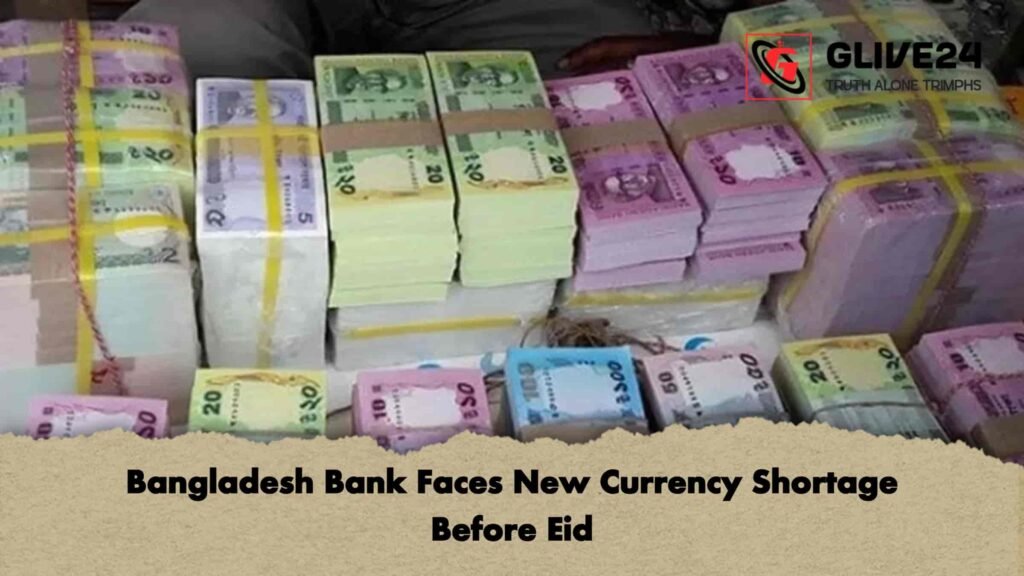
The demand for physical banknotes in Bangladesh traditionally surges during the festival of Eid-ul-Adha. For the upcoming season, Bangladesh Bank’s Currency Management Department has placed a requisition for 16,000 crore BDT in new banknotes from the Security Printing Corporation (Bangladesh) Ltd, also known as the Mint. However, the Mint has reported that it can only provide 8,000 crore BDT—exactly half of the requested amount—due to an acute shortage of specialized paper and ink.
Table of Contents
Strategic Shifts and the Supply Gap
The current shortage is largely attributed to a significant policy shift following the change of government in August 2024. The central bank initiated a project to redesign all denominations of the national currency simultaneously, replacing the previous notes that featured the portrait of Sheikh Mujibur Rahman.
While 15,800 crore BDT in older-design notes are currently sitting in a semi-prepared state at the Security Printing Corporation, the central bank has decided not to release them into circulation. Bringing entirely new designs to the market typically requires a lead time of 10 to 18 months. Consequently, the decision to halt the issuance of old designs while the new ones are still in production has created a substantial discrepancy between supply and demand.
Currency Distribution and Financial Statistics
It is essential to distinguish between a “liquidity crisis” and a “printed currency shortage.” While the banking sector holds total savings of approximately 24 lakh crore BDT, the requirement for physical printed notes in the economy ranges from 320,000 crore to 360,000 crore BDT.
| Financial Category | Estimated Value (Crore BDT) |
| Total National Savings | 2,400,000 |
| Market Demand for Physical Currency | 320,000 – 360,000 |
| Notes Held in Commercial Bank Vaults | 16,000 – 20,000 |
| Notes in Central Bank & Sonali Bank Chests | 14,000 – 18,000 |
| Pre-Eid Demand for New Notes | 16,000 |
| Current Mint Supply Capacity | 8,000 |
Impact on the “Clean Note Policy”
The central bank’s “Clean Note Policy,” established in November, mandates that banks withdraw soiled, torn, or defaced notes from the public and replace them with high-quality currency. However, bankers report that because the central bank cannot provide sufficient “fresh” notes, soiled currency remains in circulation.
Arif Hossain Khan, Executive Director and Spokesperson of Bangladesh Bank, confirmed that the transition to new designs has caused temporary delays. He noted that while the central bank usually incinerates defective notes, the current shortage has hindered the replacement process. To expedite production, the authorities have arranged to import paper and ink via air freight at an increased cost, though these materials will not be processed into notes in time for the Eid deadline.
Challenges for the General Public
Since November 2023, the central bank has stopped allowing the general public to exchange notes directly at its counters, delegating this task entirely to commercial banks. Despite clear instructions, many banks remain reluctant to exchange small denominations or damaged notes. As no new notes have been released during the previous two Eid festivals, the upcoming distribution of 8,000 crore BDT is expected to provide only partial relief to the currency market.