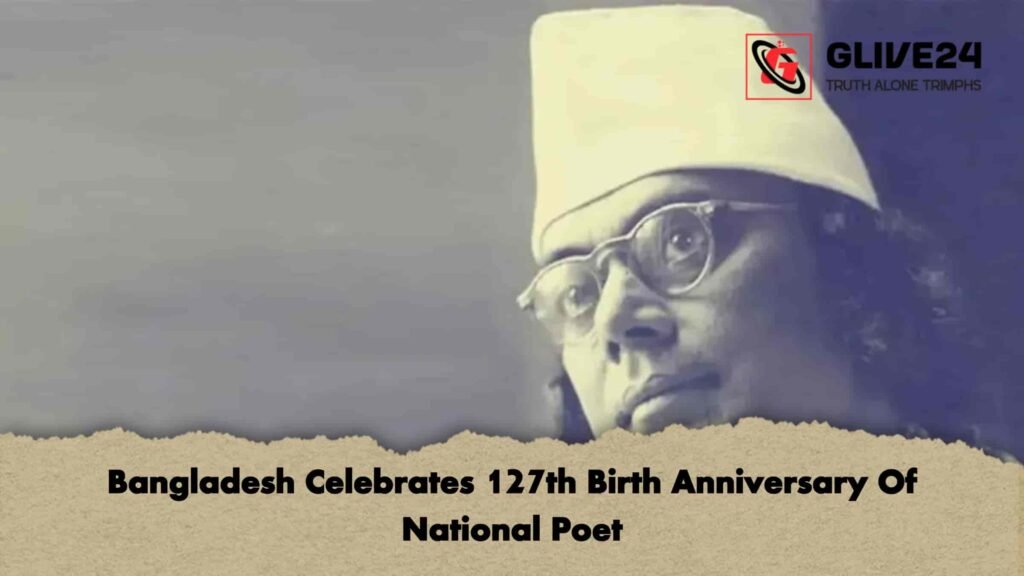
Bangladesh has commenced the national celebration of the 127th birth anniversary of its national poet, Kazi Nazrul Islam. This year’s event holds historic significance as it marks the first time the anniversary has been observed with state-sponsored formalities since the government officially confirmed his legislative status as the National Poet of Bangladesh.
Popularly known as the “Rebel Poet” (Bidrohi Kobi), Nazrul is widely revered for introducing a distinct language of progressive thought, romance, and political defiance into Bengali literature, inspiring generations to challenge institutional exploitation and social discrimination.
Chronological Milestones and Creative Impact
Nazrul’s life was defined by extreme economic hardship, major structural transitions, and a vast array of professional occupations. Despite losing access to institutional education in his youth due to the untimely death of his father, he went on to compose approximately 3,500 songs, establishing the largest individual musical catalog in the history of the Bengali language.
The verified historical milestones and creative metrics of Kazi Nazrul Islam are detailed in the table below:
| Life Phase / Statistical Metric | Professional Role / Milestone | Historical Context & Literary Legacy |
| Early Childhood Education | Maktab Pupil & Folk Playwright | Began composing theatrical scripts for local Leto troupes. |
| Adolescence & Youth | Baker’s Assistant, Soldier, Journalist | Supported his family from age 10; deployed with the army. |
| Defining Masterpieces | “Bidrohi” and “Kamal Pasha” | Established anti-imperialist views and international awareness. |
| Musical Catalogue Size | Approximately 3,500 Compositions | Formed the core of Nazrul Geeti, introducing unique ragas. |
| Political Imprisonment | Author of “Rajbandir Jabanbandi” | Incarcerated multiple times by the British colonial government. |
| 1942 Health Collapse | Loss of Speech and Mental Faculties | Afflicted by an incurable neurological condition at age 43. |
| 1972 State Repatriation | Relocation to Independent Bangladesh | Brought to Dhaka from India by Bangabandhu Sheikh Mujibur Rahman. |
Literary Rebellion and Social Defiance
Born on 11 Jyeshtha 1306 of the Bengali calendar (24 May 1899) in Churulia, a village in the Burdwan district of West Bengal, India, Nazrul was forced into adulthood at the age of ten following his father’s death. To sustain his impoverished family, he worked as a caretaker at a local mausoleum, a mosque mu’azzin, and a bread shop assistant, before eventually volunteering for military service in the British Indian Army during the First World War.
His literary breakthrough came with the publication of his masterpiece, “Bidrohi” (The Rebel), in which he articulated an uncompromising stance against tyranny. In the text, he proclaimed:
“I am the sudden, trembling earthquake in a terrified world. / I seize the hood of the snake-king Vasuki, / I snatch the fiery wings of the celestial messenger Gabriel! / I am the divine child, I am restless, / I am arrogant, and with my teeth, I tear the hem of Mother Earth’s robes.”
His subsequent work, “Kamal Pasha”, highlighted his deep understanding of contemporary international geopolitics, critiquing the domestic Khilafat Movement against the backdrop of modern Turkish political history.
Secularism, Humanism, and the Tragic Eclipse
Nazrul’s expansive creative body focused on themes of universal love, gender equality, and humanism. He used his platform to vehemently criticize religious fundamentalism, social bigotry, and the systemic marginalisation of women. His strong anti-imperialist writings frequently drew the ire of the British Raj, resulting in multiple terms of imprisonment, during which he penned the political treatise “Rajbandir Jabanbandi” (The Deposition of a Royal Prisoner).
In 1942, at the peak of his creative powers, Nazrul was struck down by a sudden, devastating neurological illness. The condition caused a total loss of speech and mental stability, reducing the fierce intellectual to a vulnerable, child-like state. This sudden decline tragically fulfilled an earlier apprehension voiced by his literary contemporary, Rabindranath Tagore.
Following the independence of Bangladesh, the nation’s founder, Bangabandhu Sheikh Mujibur Rahman, officially relocated Nazrul and his family from India to Dhaka in 1972, granting him national citizenship and the formal title of National Poet. Nazrul spent his remaining years under specialized medical care at the PG Hospital (now BSMMU) in Dhaka. Following a prolonged illness, he passed away on 29 August 1976 and was buried with full state honors adjacent to the Dhaka University Central Mosque.