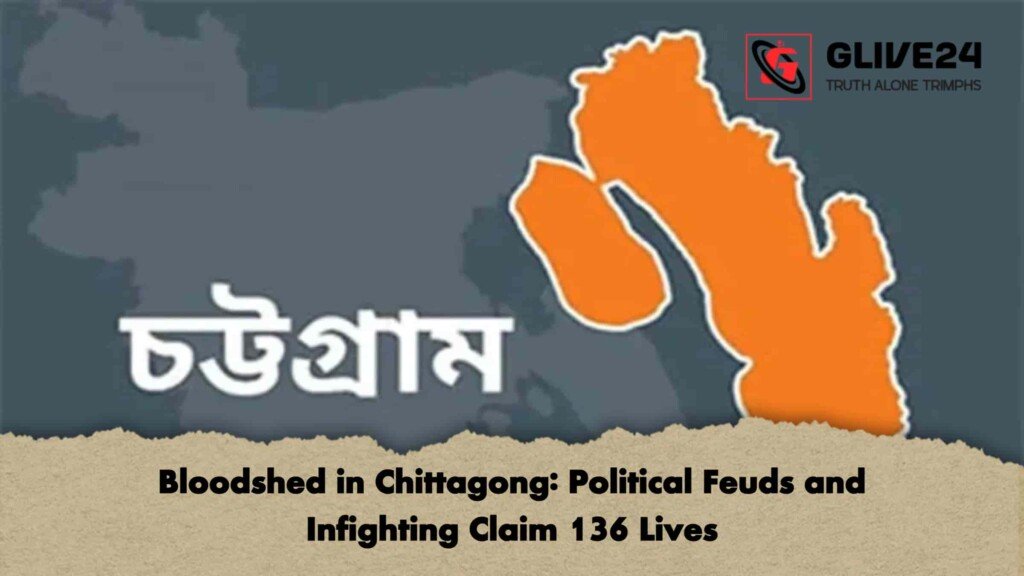
A chilling wave of violence has swept across the Chittagong region over the past 23 months, leaving at least 136 people dead. In a startling revelation that underscores the deep-seated volatility within the local political landscape, 55 of the victims were leaders or activists belonging to the Bangladesh Nationalist Party (BNP) and its various affiliate organisations. Rather than falling victim to external political adversaries, a significant number of these casualties stem from internal factionalism, territorial dominance, and bitter grassroots rivalries within the party itself. This surge in fatalities has implicated hundreds of registered BNP leaders, who now find themselves named as accused perpetrators in numerous murder cases.
The human cost of this lawlessness is typified by the tragic fate of Nasir Uddin, the organisational secretary of the Sitalpur Upazila Krishak Dal. On the night of 26 March last year, Nasir ventured out to Barbakund in Sitakunda to purchase new festival clothes for his two daughters and disabled son. He never returned home. In a brutal assault executed in front of his children, Nasir was beaten and his throat was slit.
While his widow, Momena Khatun, initially filed a case naming eight individuals—all members of the BNP’s associate wings—the pursuit of justice was swiftly derailed. Following the arrest of four key suspects, including Muradpur Union Yuva Dal General Secretary Mohammad Russel and Upazila Yuva Dal member Anwar Hossain, Momena was subjected to intense intimidation. Senior BNP figures allegedly pressured and threatened her life, forcing her to sign a compromise bond in court to secure the suspects’ release. Today, she laments, the killers walk free with absolute impunity.
Table of Contents
Regional Distribution of Homicides in Chittagong
The violence has not been uniformly distributed across Chittagong’s three primary organisational sectors: the City Corporation, North District, and South District. It is the North District, specifically five volatile upazilas, that has emerged as the deadliest zone for political infighting.
| Sub-District / Area | Total Homicides Recorded | BNP-Affiliated Victims | Primary Catalysts of Violence |
|---|---|---|---|
| Sitakunda | 36 | 8 | Intra-party feuds, land disputes, mob lynchings |
| Mirserai | 27 | 9 | Territorial control, trade fair dominance, factory looting |
| Raozan | 26 | 19 | Intense factionalism, social media disputes, assassinations |
| Rangunia & Fatikchheri | 15 | 8 | Sand extraction disputes, turf wars |
| Chittagong City & South District | 16 | 8 | Territorial dominance, slum supremacy |
| Patiya | 10 | 0 | Family feuds, land disputes, robberies |
| Anwara | 6 | 0 | Financial disputes, domestic malice, drug trade |
| Karnafuli | 5 | 0 | Non-political domestic disputes |
Sitakunda: The Epicentre of Territorial Conflict
With 36 recorded homicides, Sitakunda Upazila registers the highest murder toll among the 16 sub-districts of Chittagong. Internal BNP friction accounted for eight of these deaths, while the breakdown of law and order also saw five individuals killed in mob lynchings, 14 perish over land disputes, and four women lose their lives to domestic violence.
The lawlessness in the region has spared neither law enforcement nor local businesses. In the remote terrains of Jungle Salimpur, Motaleb Hossain Bhuiyan, a Deputy Assistant Director of the Rapid Action Battalion (RAB), was murdered during an ambush by local miscreants. The subsequent investigation led to charges being pressed predominantly against BNP-affiliated activists.
Territorial control over lucrative, unregulated sectors has driven much of the bloodshed. Last year, Mohammad Masud, a local BNP leader, was assassinated in the Chinnamul area over the control of the local construction materials trade. Allegations surfaced that a rival BNP leader, Kamrul Hassan (alias Ridoy), abducted and murdered Masud alongside his associates. During the same period, a BNP supporter named Abul Kalam was beaten to death and his body hung from a tree; terrified of reprisals, his family declined to file a police case. More recently, on 11 March this year, a dispute between Yuva Dal leader Shahabuddin and BNP leader Alim in Guptakhali culminated in the murder of a young activist named Sajib.
Raozan: A Deadly Hotbed for Party Activists
While Sitakunda holds the highest overall body count, Raozan Upazila stands out for the sheer concentration of political killings, with 19 of its 26 victims belonging to the BNP. The brutality of these killings highlights the ruthless nature of the local factions. Yuva Dal worker Manik Abdullah was murdered by 15 masked gunmen who forced a firearm into his mouth and pulled the trigger whilst he was eating dinner.
Even digital dissent has proven fatal. Komor Uddin Jitu, another Yuva Dal worker, was stabbed to death following a Facebook post criticizing senior party leaders over the organisation of an Iftar event. Public executions have also taken place; Abdul Hakim, a party worker, was shot dead in broad daylight on a busy highway in Hathazari after his vehicle was intercepted.
The violence has been exacerbated by the involvement of notorious criminal elements. Rayhan, a high-profile criminal with eight murder cases against him, who was seen campaigning openly alongside BNP candidates ahead of the national elections, was implicated in the murders of Yuva Dal workers Md Alamgir and Md Selim. Additionally, on 13 June, Masudul Haq Chowdhury, the Senior Joint Convenor of the neighbouring Rangunia Upazila Yuva Dal, was shot dead in the crowded Choumuhoni market, with his family directly blaming local BNP rivals.
Unrest Across Mirserai, Fatikchheri, and Rangunia
In Mirserai, 27 homicides were documented over a 21-month period. Following the political transitions of late 2024, Yuva Dal leader Rafiq Uddin was beaten to death at the Mirserai Economic Zone. While one faction labelled it a targeted political assassination, rivals claimed he was lynched by an angry crowd while attempting to loot a local factory.
Control over local commercial events has also sparked deadly clashes. A Yuva Dal worker named Munna was hacked to death during a turf war over the administration of an industrial and trade fair, while similar intra-party clashes in Baraiyarhat led to the hacking deaths of Javed Hossain and Tahmid Ullah.
Further north, in Fatikchheri and Rangunia, at least 10 murders occurred. In Rangunia’s Shantir Hat, Yuva Dal worker Ramzan Ali was stabbed to death by rivals. In Fatikchheri, illegal sand mining operations became a flashpoint when Md Shahid and Dulaet Hossain Dulal were beaten to death after attempting to obstruct unauthorised sand extraction from local riverbeds.
Chittagong City and the South District
In contrast to the politically charged environment of the north, the homicides in the southern sub-districts and Chittagong city reveal different structural issues.
In Patiya, where 10 deaths occurred, the motives were overwhelmingly non-political, driven instead by domestic malice, narcotics, and robbery. The most publicised case involved the murder of five-year-old Md Jaihan, who was killed due to an ongoing family property feud. Similarly, in Anwara Upazila, six murders were recorded, mostly tied to financial disputes and drug syndicates. The sole political casualty was Mohammad Manik, a member of the now-banned Awami League’s youth front, the Jubo League, who was stabbed to death over a financial dispute.
Within Chittagong city itself, five murders took place. These included the assassination of Nur Alam, a BNP slum-unit leader, who was killed during a turf war in the Double Mooring area, and the death of Yuva Dal activist Jobayer, who succumbed to injuries sustained during a violent clash between rival party factions in Chandgaon.
In response to the escalating violence and allegations of political meddling, the Chittagong Metropolitan Police Commissioner, Shawkat Ali, maintained that law enforcement remains impartial.
“A criminal has no political identity,” the Commissioner stated. “Regardless of their party affiliation, we endeavour to bring them to justice. We frequently face lobbying and external pressure to release suspects, but we steadfastly reject such interference.”