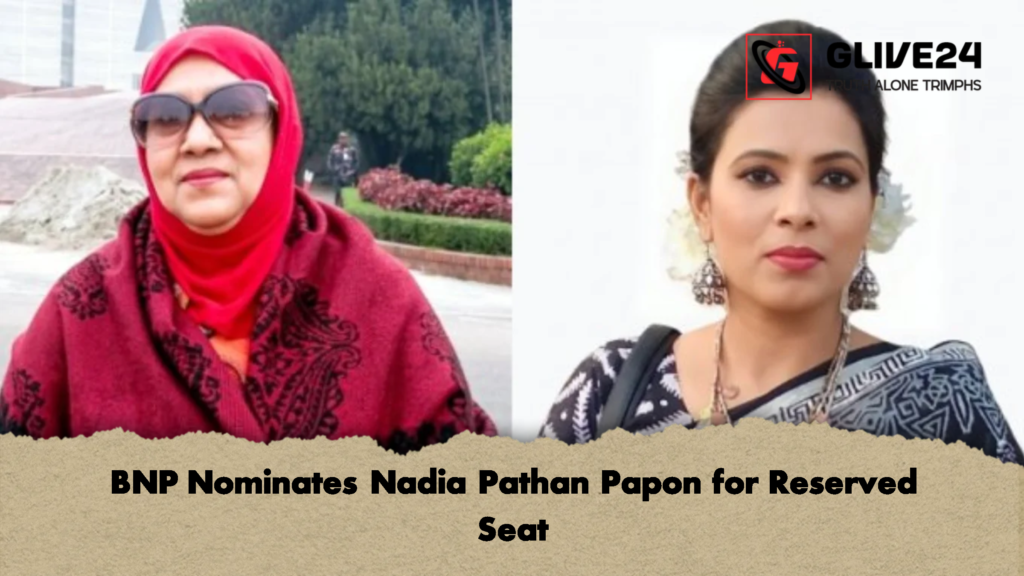
In a development that has ignited fervent debate across social media and regional political circles, Nadia Pathan Papon has been officially nominated by the Bangladesh Nationalist Party (BNP) for a reserved women’s seat in the National Parliament. The nomination has drawn significant scrutiny due to the candidate’s immediate family ties to the Awami League (now a proscribed organisation), creating a fascinating study in the complexities of Bangladeshi dynastic politics.
Table of Contents
A Tale of Divergent Political Identities
Nadia Pathan Papon, a native of the Bijoynagar sub-district, was featured as the 32nd entry on a list of 36 nominees released by the BNP central office on Monday, 20th April 2026. While her personal political journey is rooted in student activism for the BNP, her lineage is inextricably linked to the previous administration.
She is the daughter of the late Anwar Hossain and Syeda Nakhlu Akhter. The latter is a formidable figure in regional Awami League history, having served as the President of the Bijoynagar Upazila Mohila Awami League and as an elected Vice-Chairman of the Upazila Parishad under the Awami League banner.
Academic and Political Credentials
Despite her mother’s high-ranking status in the rival camp, Nadia’s political trajectory has been consistently aligned with the BNP for over two decades. Her supporters point to her academic and activist background as evidence of her steadfast commitment to the party’s ideology.
| Milestone / Category | Details |
| Early Activism | Joined Chandura Union Chhatra Dal in 2000 |
| Academic Background | Daudpur High School (SSC), Kazi Mohammad Shafiqul Islam College (HSC) |
| Higher Education | Dhaka Badrunnessa Government Women’s College |
| Student Leadership | Served as General Secretary of Chhatra Dal (Badrunnessa College) |
| Central Role | Former member of the Chhatra Dal Central Committee |
| Current Position | Member, BNP Dhaka Metropolitan South Branch |
Facebook Post Sparks Regional Controversy
The nomination became a viral sensation following a congratulatory post by Jahangir Mridha, the General Secretary of the local Upazila Awami League. In a post that many viewed as both an olive branch and a subtle critique of political fluidity, Mridha highlighted the irony of the situation.
“There is no such thing as a final word in politics,” Mridha wrote. He detailed Syeda Nakhlu Akhter’s extensive resume within the Awami League—ranging from District Krishok League Vice-President to District Council member—before congratulating her daughter on her parliamentary nomination. He concluded by noting that the people of Bijoynagar are “fortunate” to have such diverse representation in the capital, urging locals to rise above party lines to celebrate a “child of the soil.”
Resilience Amidst Political Persecution
Addressing the online discourse regarding her family background, Nadia Pathan Papon remained defiant and focused on her legislative future. Speaking to the media, she brushed aside the “dynastic” critiques, pointing instead to her physical and legal sacrifices over the past seventeen years.
“During the seventeen years of the Awami League regime, I was on the streets facing police lathi-charges, tear gas, and countless fabricated cases,” Nadia remarked. “Where were these critics when I was being assaulted by the police or Chhatra League activists? Our leadership has scrutinised my record and granted this nomination based on my loyalty and struggle.”
Future Objectives: The 31-Point Agenda
Nadia emphasised that her primary objective is now to strengthen the position of the party’s leadership and work towards the implementation of the BNP’s 31-point state reform agenda. She asserted that dwelling on family affiliations is a distraction from the urgent task of national reconstruction.
As the 2026 parliamentary session approaches, Nadia Pathan Papon stands as a unique figure: a BNP loyalist born from the heart of the Awami League establishment, now tasked with representing women’s interests in a transformed political landscape. The reaction in Bijoynagar remains mixed, with some praising her for carving her own path, while others remain wary of the old-guard connections that continue to haunt the New Bangladesh.