The campaign for the first phase of the West Bengal Legislative Assembly elections concluded on Tuesday at 6:00 p.m., in accordance with the Election Commission’s scheduled guidelines. Polling for this phase will be held on Thursday.
In this initial phase, voting will take place across 152 constituencies spanning 16 districts of both northern and southern West Bengal. Polling will begin at 7:00 a.m. and continue uninterrupted until 6:00 p.m.
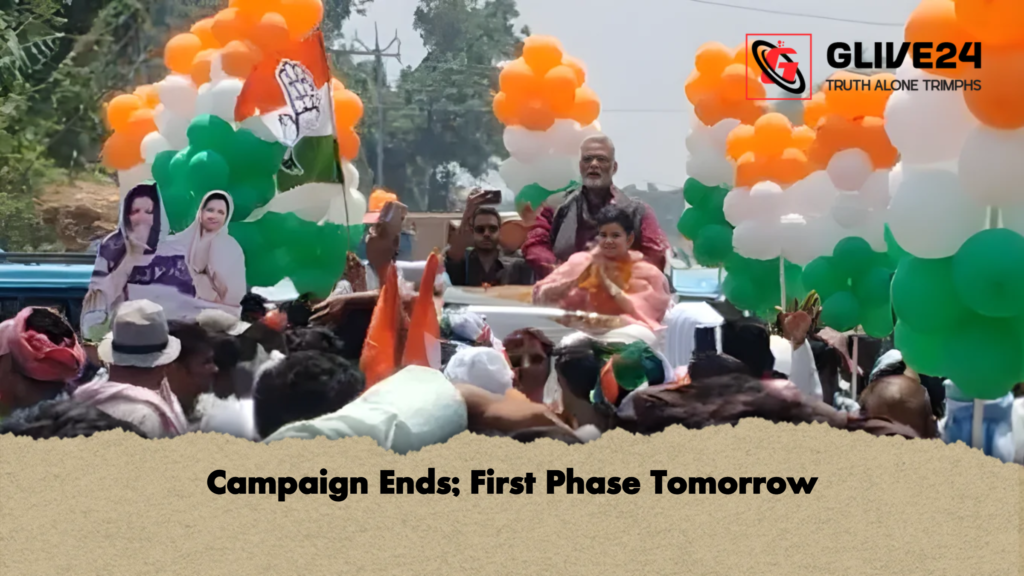
On the final day of campaigning, political activity remained highly visible across multiple constituencies. In Asansol South, a roadshow was conducted in support of Bharatiya Janata Party (BJP) candidate Agnimitra Paul, attended by Delhi Chief Minister Rekha Gupta. In Kulti, Union Home Minister Amit Shah participated in an election rally supporting BJP candidate Poddar. In Nandigram, BJP candidate Suvendu Adhikari carried out last-minute outreach with party workers and supporters. Chief Minister Mamata Banerjee also engaged in four separate election programmes on the final day of campaigning.
However, the final day was also marked by isolated incidents. In Dantan in West Midnapore district, BJP candidate Ajit Kumar Jana was allegedly attacked. He reportedly sustained injuries, including a fractured arm, and was admitted to Medinipur Medical College and Hospital. His vehicle and several motorcycles were damaged, and multiple supporters were also injured. Allegations have been raised against miscreants linked to the Trinamool Congress in connection with the incident.
In Murshidabad’s Naoda constituency, tension arose during campaigning for Aam Janta Unnayan Party candidate Humayun Kabir. Allegations were made that police obstructed his campaign activities, leading to a confrontation between the candidate and law enforcement officials.
Separately, in Nandigram, police arrested Trinamool Congress leader Habibul Rahman, also known as Nantu, on allegations of influencing voters. He serves as the head of Mohammadpur Panchayat in Nandigram.
Approximately 360 million voters are eligible to vote in this phase. This includes around 184 million male voters, 175 million female voters, and 465 voters from the third gender category.
A total of 1,478 candidates will contest in this phase. The major political parties involved include the Trinamool Congress, Bharatiya Janata Party, Congress, Communist Party of India (Marxist), Indian Secular Front, Aam Janta Unnayan Party, and others. However, in most constituencies, the primary contest is expected to be between the Trinamool Congress and the Bharatiya Janata Party.
Key Election Data – First Phase
| Category | Figure |
|---|---|
| Total constituencies | 152 |
| Total voters | 360 million |
| Male voters | 184 million |
| Female voters | 175 million |
| Third gender voters | 465 |
| Total candidates | 1,478 |
| Polling stations | 44,378 |
| Central security forces | 2,400 companies (~240,000 personnel) |
| Quick Response Teams | 2,193 |
The Election Commission has deployed extensive arrangements to ensure a free, fair and peaceful polling process. Approximately 2,400 companies of central security forces, comprising around 240,000 personnel, have been stationed across the state, marking one of the largest deployments in West Bengal’s electoral history.
A total of 44,378 polling stations have been set up for this phase. Each polling station is equipped with at least two cameras inside and outside the premises, along with live webcasting facilities for real-time monitoring. Officials at control rooms will observe polling activities continuously, supported by artificial intelligence-based alert systems designed to flag irregularities.
In addition, 2,193 Quick Response Teams have been deployed to respond promptly to any incidents of unrest or disruption. Murshidabad district has the highest deployment with 288 such teams.
Social media monitoring has also been intensified, with the Election Commission warning that artificial intelligence tools will be used to detect and act against the circulation of fake videos and misinformation.
The second phase of polling is scheduled for 29 April, while counting of votes will take place on 4 May.