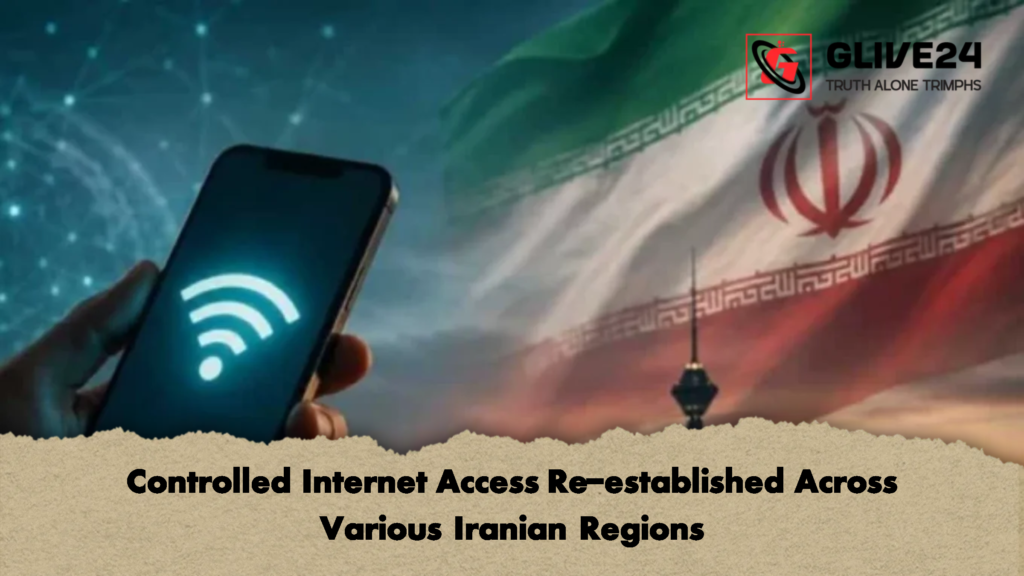
Following an extensive digital shutdown lasting approximately 88 days, internet connectivity has been partially restored across various regions of Iran. Although localized communication networks have re-established active connections, the overriding sentiment documented among the civilian population reflects profound anger, frustration, and systemic uncertainty rather than widespread celebration.
According to a report published by the British newspaper, The Guardian, limited data connectivity was officially reinstated at approximately 5:00 pm on Tuesday. The abrupt restoration triggered a sudden, massive influx of long-backlogged text messages, digital photographs, and social media posts that had been heavily restricted during the months of state-enforced digital isolation. However, a significant portion of the populace views this partial return not as an expansion of civil liberty, but as the deliberate commencement of a highly regulated phase of state digital surveillance.
Table of Contents
Mixed Civilian Reactions In The Capital
For many families, the sudden resumption of data services brought immediate emotional and financial reckonings. Eli, a 42-year-old artist residing in the capital city of Tehran, noted that she was able to access the global network for the first time since late February. Describing the exact moment connectivity returned, she stated that she and her husband wept whilst listening to archived music streaming online. She observed that the experience felt like a temporary glimpse of what genuine freedom could look like.
Conversely, other citizens expressed intense irritation regarding how the resumption of incomplete data services is being perceived and reported internationally. Maryam, a professional photographer based in Tehran, voiced deep dissatisfaction with the global narrative surrounding the technical development.
Statement on Fundamental Rights: “It is deeply frustrating to observe how some Western media outlets are celebrating this partial restoration of internet access,” Maryam stated. “Internet access is a fundamental civic right belonging to the people, not a state gift or a luxury present from the authorities.”
Maryam further disclosed that the prolonged network blackout had completely disrupted her daily professional operations, leaving her with absolutely no source of income and forcing her to borrow money from her parents to cover basic living expenses. She confirmed that mobile internet networks remain highly unstable and largely dysfunctional across the city, whilst global communication applications such as WhatsApp are virtually unusable without advanced, expensive technological workarounds.
Historical Context of the Extensive Blackout
The comprehensive digital blockade was initially instituted by the Iranian authorities in January as a direct mechanism to suppress widespread, localized anti-government protests. Following subsequent military strikes involving the United States and Israel, the state administration implemented even more stringent telecommunications restrictions across the country’s infrastructure.
During the 88-day blackout, a small segment of the population managed to maintain intermittent, slow access to the outside world by purchasing highly priced Virtual Private Networks (VPNs). However, the vast majority of ordinary citizens remained entirely isolated within a state of total digital disconnection, cut off from international relatives and global economic platforms alike.
Upon returning to social media platforms, numerous Iranian users described their experience as being akin to a temporary release from a digital prison. Mina, a local political activist, warned that the state administration may have sanctioned this limited access solely to deploy more comprehensive, centralised monitoring systems over public sentiment. She remarked that the current framework does not signify a return to open, democratic communication, but rather represents an altered, more sophisticated manifestation of a heavily controlled state intranet.
Proliferation of Grief and Academic Perspectives
With the return of data transmission capabilities, local social media platforms have been completely inundated with previously suppressed documentation. This includes raw footage of large funeral processions, images of mourning families, and explicit photographs detailing widespread structural destruction caused by the recent military conflicts.
Amin, a university professor based in Tehran, summarized the grim reality confronting everyday users upon opening their digital devices:
-
Circulation of Traumatic Media: Cellular devices are now dominated by shared videos detailing immense communal grief and institutional mourning.
-
Economic and Generational Losses: The civilian population has emerged as the primary casualty of the geopolitical conflict, suffering the wholesale loss of livelihoods and diminished youth opportunities.
-
Erosion of International Trust: There has been a definitive collapse of faith in the capacity or willingness of the international community to intervene effectively on behalf of the populace.
Severe Anxiety Experienced by the Iranian Diaspora
The partial restoration has similarly triggered complex, agonizing reactions among the Iranian diaspora living abroad. Mahshid Nazemi, a human rights defender currently stationed in Paris, stated that the news brought a combination of brief relief and acute anxiety to exile communities.
She explained that whilst communicating with some individuals provided immediate comfort, the continued online absence of other contacts leaves families and international advocates in a state of terror. Without complete information transparency, they remain unsure whether those silent individuals have been arrested by state security forces or killed during the preceding period of complete information censorship.
Ultimately, the partial reinstatement of network access across Iran has not been experienced as the triumphant return of a fundamental liberty. Instead, it has served to formally expose the deep realities of lost lives, economic ruin, pervasive fear, and collective trauma within the country.