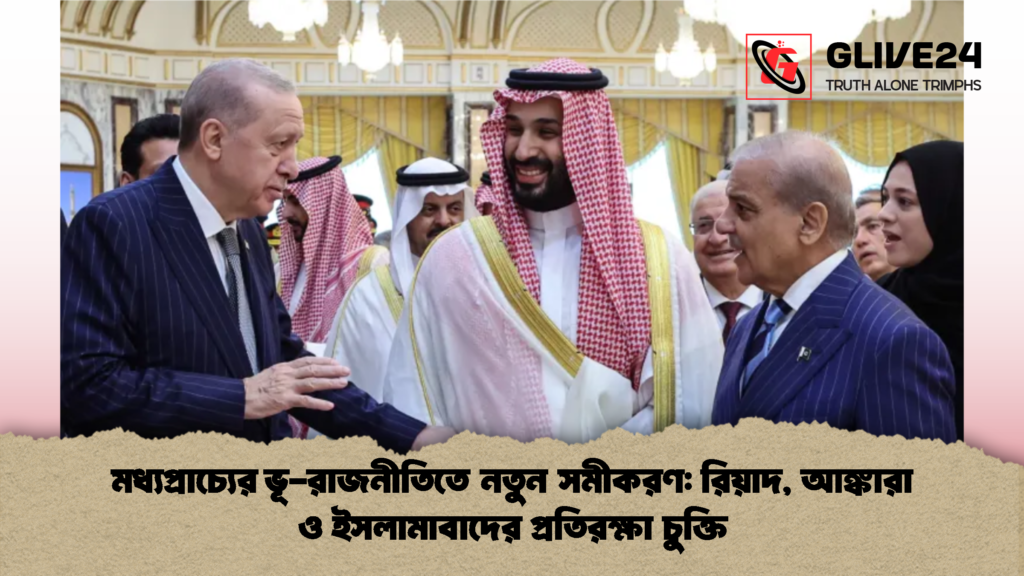
MECCA — Saudi Arabia, Turkey, and Pakistan have executed a landmark trilateral mutual defense pact in Mecca, marking a profound shift in Middle Eastern geopolitical dynamics amidst rising regional volatility.
Formally designated the Mecca Joint Resistance Pact, the historic accord was signed on Friday by Saudi Crown Prince Mohammed bin Salman, Turkish President Recep Tayyip Erdoğan, and Pakistani Prime Minister Shehbaz Sharif. The signing followed religious rites completed by Prime Minister Sharif, who travelled to the kingdom accompanied by Pakistan’s Chief of Army Staff, Field Marshal Asim Munir.
At the core of the treaty lies a mutual defense clause stipulating that an armed attack against any one of the signatory nations will be considered an aggression against all three. The framework establishes mechanisms for combined defense planning, real-time intelligence exchange, and industrial technology sharing.
Complementary Capabilities and Strategic Realignment
Rather than establishing a centralized NATO-style command, the pact binds together three distinct pillars of power within the Muslim world, capitalizing on the relative strengths of each signatory:
-
Turkey: Delivers advanced defense manufacturing capabilities, domestic aerospace technologies, and NATO’s second-largest military force.
-
Saudi Arabia: Supplies unparalleled capital reserves, energy domain dominance, and central diplomatic influence across the Gulf region.
-
Pakistan: Brings a 600,000-strong active-duty military force, extensive combat experience, and its standing as the world’s sole nuclear-armed Muslim state.
Pakistan’s Ministry of Foreign Affairs emphasized in an official statement that the pact builds upon deep-rooted historical bonds and shared strategic priorities, seeking to safeguard state sovereignty and maintain peace across South Asia and the Middle East.
Catalyst for the Alliance: Regional Conflicts and Strategic Autonomy
Talks aimed at forming a trilateral security framework first gathered momentum after the outbreak of the Israel-Hamas conflict in October 2023, gaining further urgency as confrontation between Israel, Iran, and the United States expanded across multiple fronts.
Although Turkey and Pakistan are geographically distant from the immediate core of the hostilities, Saudi Arabia has faced direct security risks, including missile and drone strikes aimed at energy infrastructure, shipping channels, and hosted military facilities. Escalations around the Strait of Hormuz, coupled with Israeli military actions in Lebanon, Syria, and Gaza, have heightened concerns in regional capitals regarding state stability and Western security guarantees.
Furthermore, the treaty aligns with Riyadh’s long-term objective of reducing its historic military dependence on Western arms exporters. By deepening ties with Ankara and Islamabad, Saudi Arabia aims to foster localized defense manufacturing and secure reliable technology transfers.
Timeline of Diplomatic Milestones
The agreement in Mecca follows a series of high-level diplomatic steps taken over recent months:
-
September 2025: Saudi Arabia and Pakistan concluded a bilateral security arrangement in Doha following heightened maritime tensions.
-
19 March 2026: Foreign ministers from all three nations convened during an extraordinary Islamic summit in Riyadh to draft the operational terms of the collective defense framework.
-
17 June 2026: A preliminary US-Iran memorandum of understanding was drafted to curb regional spillover, though cross-border skirmishes have continued to test the agreement.
Initial reactions from Tehran have been reserved. While the Iranian government has refrained from issuing an official statement, senior Iranian parliamentarian Ebrahim Rezaei publicly questioned the pact, asserting that paper security arrangements cannot replace genuine regional confidence-building.
Israeli officials, including Prime Minister Benjamin Netanyahu’s office, have not issued formal comments. However, a senior Turkish official confirmed on condition of anonymity that the treaty is strictly defensive, non-adversarial toward non-threatening neighbours, and remains open to accession by other sovereign states committed to regional integrity.