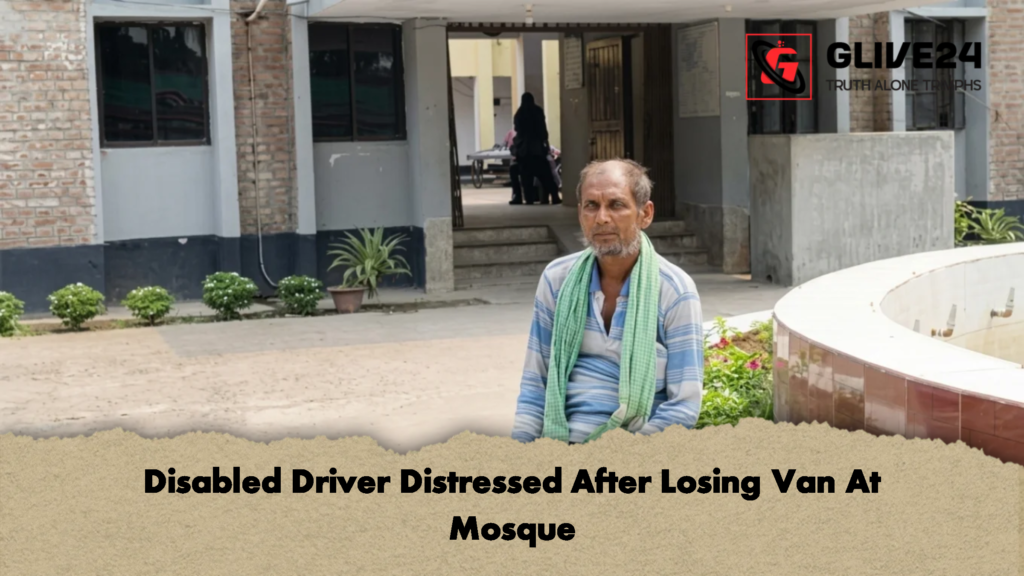
A sixty-one-year-old disabled transport worker, identified as Mohammad Mosharraf Hossain, has been plunged into an acute financial crisis following the theft of his battery-powered van. The vehicle, which served as the singular source of economic livelihood for his entire dependent household, was stolen whilst he was attending congregational evening prayers at a local mosque in Kumarkhali Upazila, situated under the Kushtia district of western Bangladesh. Since the incident transpired, the driver and his family have been enduring exceptionally harsh living conditions inside their family home.
Table of Contents
The Theft at Jotomora Grand Jame Mosque
Mohammad Mosharraf Hossain is a permanent resident of the Mathpara area, which is located within Ward Number 7 of the Kumarkhali Municipality. On Tuesday, 2 June, he travelled to the neighbouring Jaduboyra Union to conduct his routine commercial transport activities. At dusk, he parked his primary three-wheeled transport vehicle directly in front of the Jotomora Grand Jame Mosque and entered the religious premises to perform the traditional Maghrib prayer service.
Upon completing his prayers and exiting the main mosque building, Hossain discovered that his commercial van, which carries an estimated market value of approximately 65,000 Bangladeshi Taka, had been removed from the site. Despite launching immediate searches across various potential locations and regional transit points in the immediate vicinity, he was entirely unable to trace the whereabouts of the vehicle. Following these unsuccessful personal recovery attempts, he approached local law enforcement authorities and lodged a formal written complaint at the Kumarkhali Police Station on Wednesday, 3 June.
Severe Impact on Family and Medical Welfare
Hossain subsequently visited the physical premises of the Kumarkhali Police Station to enquire about the progress of the official investigation. Speaking within the police station courtyard in a voice choked with emotion, he recounted the devastating moment he realised his means of livelihood had been taken away. He explained that he had spent four consecutive days approaching the local Union Parishad Chairman, local political leaders, and the police administration, yet no tangible outcome or recovery had been achieved by the authorities.
The daily income generated from operating the van was entirely responsible for sustaining his multi-generational household. Hossain stated that whilst they currently possess a basic storage supply of raw rice at home, they completely lack the financial liquidity required to purchase vegetables, protein, or other essential grocery items, forcing them to survive on leftover soaked rice. He further highlighted that both he and his wife suffer from serious chronic illnesses, and his elderly mother is similarly indisposed. The household requires an expenditure of at least 120 Taka every alternate day purely for essential medical supplies.
Three years prior to this incident, Hossain was involved in a major road traffic accident that left his left leg severely damaged and broken. He currently walks with a distinct, permanent limp. Due to this severe physical impairment, he is incapable of performing heavy physical manual labour or agricultural work, leaving public van driving as his only viable employment option. Prior to the theft of his asset, he was earning between 500 Taka and 600 Taka daily, an amount that was just sufficient to manage the basic food and survival requirements of the family.
Dilapidated Living Conditions and Local Accounts
A physical inspection of his residential environment reveals that Hossain lives in a highly dilapidated, weathered corrugated iron sheet house built directly alongside the Khaurchara Bazar-Phultala Road. He shares this small, precarious dwelling with his dependent family members, including his ailing elderly mother, Nabiran Nesa, his wife, Aleya Khatun, and an unemployed son.
Hossain expressed his deep psychological distress regarding the current lack of funds to purchase his regular medical prescriptions, stating that a replacement commercial vehicle is absolutely essential for him to resume working and feeding his family. His elderly mother, Nabiran Nesa, confirmed that her son has been in a state of continuous weeping and deep distress since the evening of the theft, noting that his broken leg strictly prevents him from pursuing alternative forms of physical work.
His wife, Aleya Khatun, disclosed that she has previously suffered two strokes, whilst her mother-in-law suffers from a broken waist. She stated that the family has been completely unable to purchase standard groceries or essential medicines for several days, relying strictly on salt and water to consume their remaining rice portions. She appealed for collective assistance from society to provide them with an operational vehicle. A local neighbour, Mohammad Panna, corroborated the family’s extreme vulnerability, noting that Hossain lacks the financial savings to purchase a new vehicle independently and urged the government to intervene.
Official Investigations and Administrative Statements
Rabiul Islam, a member of the Jotomora Grand Jame Mosque Management Committee, confirmed that the theft took place precisely during the time of the Maghrib prayer service. He noted that the entire criminal incident was successfully captured on the mosque’s closed-circuit television (CCTV) security footage. However, due to clarity limitations in the recording, the specific identity of the thief could not be clearly recognized or identified from the visual data alone. Islam assured that the mosque committee would extend as much financial and logistical assistance as possible within their institutional capacity.
The Officer-in-Charge (OC) of Kumarkhali Police Station, Jamal Uddin, stated that the law enforcement authorities have accepted the written complaint and are currently verifying the specific details to trace the stolen property and apprehend the culprit. Furthermore, the Upazila Nirbahi Officer (UNO), Farzana Akhter, stated that the administrative authorities would look into the family’s situation and provide support based on their available public resources. She also urged affluent members of the local community and business leaders to step forward and assist the distressed family on urgent humanitarian grounds.