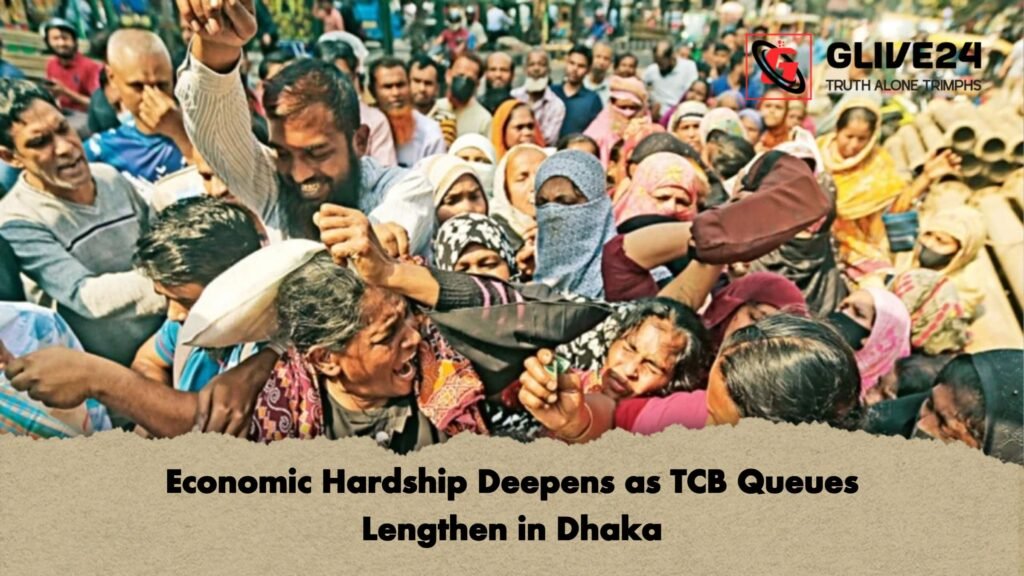
As the clock struck 2:12 PM last Thursday beneath the Kazipara Metro Station in Dhaka, a familiar yet harrowing scene unfolded. A Trading Corporation of Bangladesh (TCB) truck sat parked by the kerb, trailing a human chain that stretched far into the distance. This line, composed largely of women from low-income households, is not merely a queue for groceries; it is a barometer of a deepening national economic crisis.
For many, the 400 BDT saved by purchasing this government-subsidised package instead of buying from the open market represents the razor-thin margin between having a meal and going hungry.
The Cost of Survival
The TCB’s “Truck Sale” programme offers a lifeline of essential commodities at fixed, subsidised rates. When compared to volatile market prices, the relief is substantial for those living on the periphery of the economy.
| Commodity | TCB Price | Quantity Limit | Total TCB Cost | Est. Market Price |
| Soybean Oil | 115 BDT / Litre | 2 Litres | 230 BDT | 340 BDT |
| Lentils | 70 BDT / kg | 2 kg | 140 BDT | 210 BDT |
| Sugar | 80 BDT / kg | 1 kg | 80 BDT | 135 BDT |
| Chickpeas | 60 BDT / kg | 1 kg | 60 BDT | 110 BDT |
| Dates | 80 BDT / 500g | 0.5 kg | 40 BDT | 155 BDT |
| Total | — | — | 550 BDT | ~950 BDT |
Human Stories Behind the Statistics
Among those waiting was 40-year-old Nasir Khan, perched on a rickshaw with his left leg encased in plaster. A former waste-disposal worker, Nasir has been unemployed for four months following a debilitating accident. His wife, Mahinur, supports their family of four on a domestic worker’s salary of 9,000 BDT. “Living like this with two school-going daughters is impossible,” Nasir remarked, his eyes fixed on the truck. After half an hour of pleading by his wife, officials allowed the injured man to bypass the queue.
Others were less fortunate. Shakil, a coconut vendor from the Geneva Camp, sacrificed four hours of business—and thus, four hours of income—to secure his package. “I am lucky I got it, but my shop was closed all morning. It is a loss either way,” he lamented.
A Grim Economic Outlook
The desperation in these lines reflects a broader, more alarming trend. Data from the Bangladesh Bureau of Statistics (BBS) indicates that food inflation surged to 8.29% in January 2026. Furthermore, the World Bank warns that the national poverty rate could climb from 18.7% in 2022 to a staggering 22.9% this year, potentially pushing an additional three million people into extreme destitution.
Professor Selim Raihan, Executive Director of SANEM, argues that the current scale of TCB operations is insufficient. “Many labourers lose half a day’s wages just standing in line. We need targeted distribution in industrial zones and informal settlements to ensure that the cost of receiving aid doesn’t outweigh the benefit,” he observed.
As the TCB aims to reach 3.5 million consumers before March 12, the lengthening shadows of the queues suggest that for millions of Bangladeshis, the struggle for the next meal has become a full-time occupation.