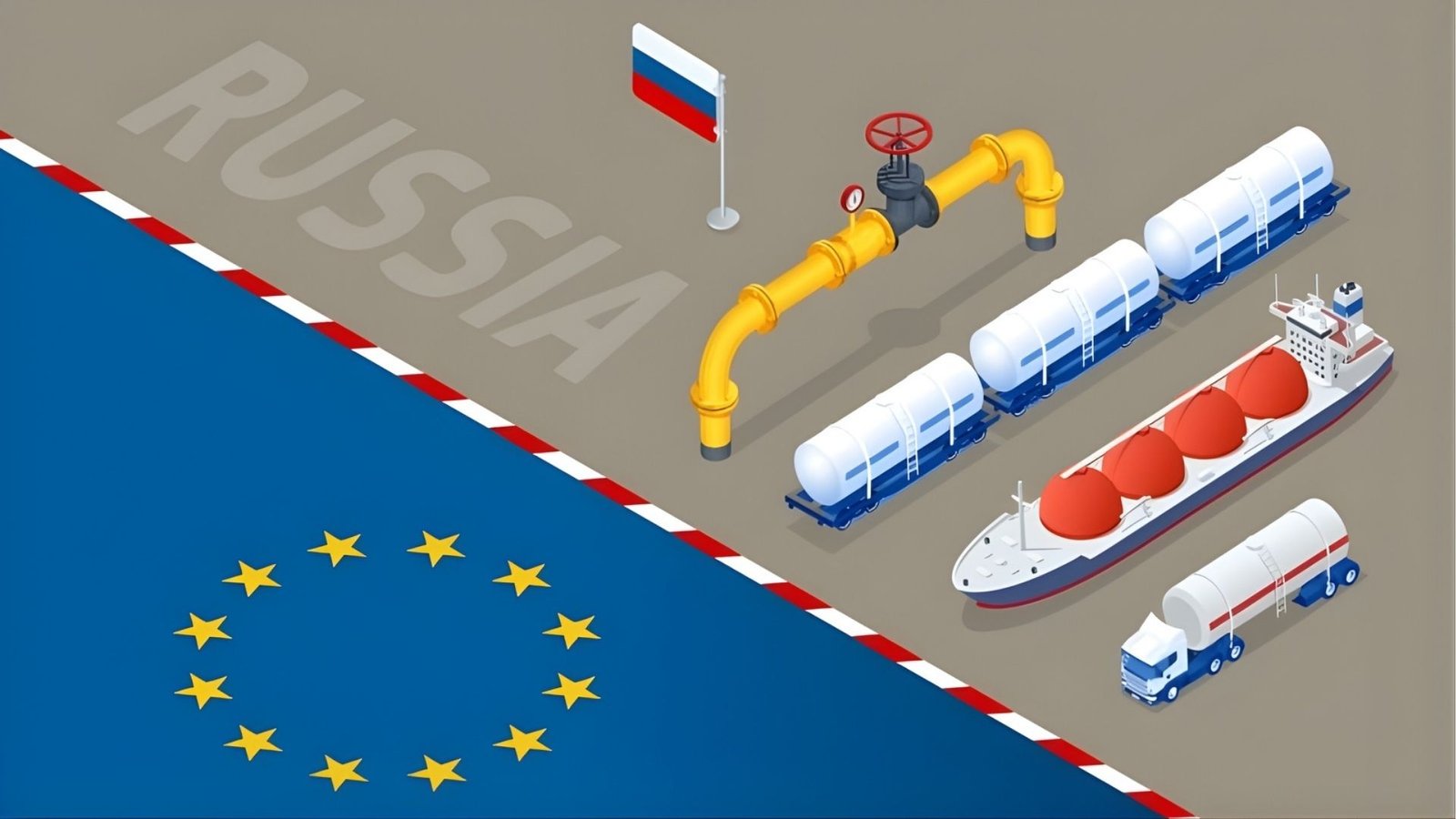
The European Union has taken a landmark step toward ending its decades-long reliance on Russian energy, with member states agreeing to phase out imports of Russian gas entirely by 2027. The historic agreement was finalised on Wednesday, following months of intense negotiation between the European Parliament and EU member governments. International news agency AFP confirmed the development, describing it as one of the most significant geopolitical energy decisions taken by the bloc in recent years.
The decision comes against a backdrop of heightened tensions stemming from Russia’s invasion of Ukraine and the resulting energy crisis that unfolded across Europe. For years, the EU had depended heavily on Russian gas supplied through major pipelines such as Nord Stream. However, the sudden disruption of supplies, coupled with Moscow’s strategy of using gas deliveries as leverage during political disputes, pushed European leaders to reassess their energy security at a foundational level.
According to an official statement issued by the European Council, Russia’s use of gas as a “political weapon” demonstrated the urgent need for the EU to free itself from energy dependence that could be manipulated in times of geopolitical crisis. The statement further emphasised that achieving full independence from Russian gas was not only a strategic necessity but also a matter of long-term stability and sovereignty for the bloc.
Under the new agreement, all long-term contracts governing pipeline gas imports from Russia will be prohibited from 1 November 2027. The ban will apply both to existing contracts and to any attempts to renegotiate or extend them. In parallel, imports of liquefied natural gas (LNG) from Russia will be banned from 1 January 2027, effectively shutting the door on one of the main remaining channels through which Russian energy still enters Europe.
Short-term and spot-market arrangements are also addressed in the framework. Imports of Russian LNG on short-term contracts will be banned much earlier — beginning on 25 April 2026. Pipeline gas imported under short-term deals will be prohibited from 17 June 2026. These earlier deadlines are intended to accelerate the transition process and prevent companies from stockpiling Russian energy under interim agreements before the final ban comes into effect.
Despite the strong political consensus behind the move, the agreement still requires formal approval from both the European Parliament and the governments of the member states. While analysts expect the decision to pass smoothly, some countries have expressed concerns about the short-term economic impact, particularly those that historically relied more heavily on Russian supplies. However, the EU has already diversified its energy portfolio significantly since 2022, increasing imports from Norway, the United States, the Middle East, and North Africa, as well as investing heavily in renewable energy capacity.
Once approved, the decision will mark a decisive turning point in Europe’s modern energy history. For the first time since the Cold War, the EU will move towards complete energy independence from Russia — an ambition that seemed unlikely only a few years ago. The shift represents not just an economic reorientation but a profound geopolitical realignment aimed at reducing vulnerability and reinforcing the bloc’s collective resilience.
European officials have described the agreement as a new era for the continent — one in which energy policy is shaped not by dependency and external pressure but by strategic autonomy, climate goals, and shared security interests. If fully implemented, the ban will symbolise the EU’s transition from an era of reliance to one of self-determination in its energy future.