
It is a routine net session at a cricket academy in New Delhi, yet the joy among the colourfully jersey-clad young girls is unmistakable.
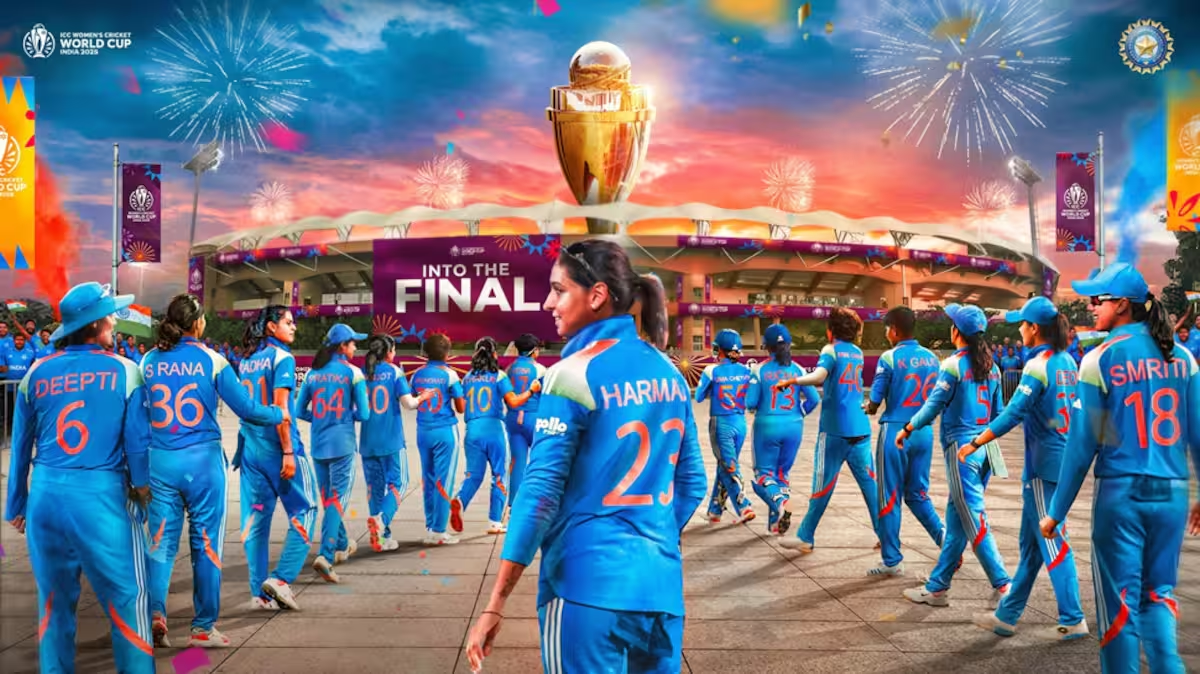
They have a new source of inspiration, after the Indian women’s team pulled off a stunning victory against tournament favourites Australia in the semi-final of the Women’s World Cup on Thursday.
Batter Jemimah Rodrigues smashed an unbeaten 127 as India chased down a record 339 at Mumbai’s DY Patil Stadium, securing a place in Sunday’s final against South Africa.
“There is always that one thing that inspires a generation,” said 19-year-old Armeet Kaur, a batting all-rounder for the Delhi state team.
“Jemmy’s innings yesterday was like that. It will really change things.”
Twelve-year-old Ridhima Chaudhary admitted she was star-struck.
“It made me feel like I have to play like them,” she said.
The sixth-grade student has already been training towards that goal, practising three hours a day, five days a week.
“My parents also say that cricket academy is as important as school,” she added.
Coach Sumit Poria described the victory as a “turning point” for women’s cricket in India.
“The way the crowd cheered for the team—it’s a shot in the arm like nothing else before,” he said.
While infrastructure has improved in recent years, Poria believes a major win like Thursday’s “will go a long way in convincing parents” to allow young women to pursue cricket seriously.
The eight-nation tournament, co-hosted by India and Sri Lanka, has already shattered records.
Data released by the International Cricket Council (ICC) and streaming platform JioHotstar revealed that the first 13 matches drew over 60 million viewers—five times more than the 2022 edition.
The India-Pakistan clash earlier this month became the most-watched women’s international match ever, with 28.4 million viewers. While modest for the world’s most populous nation, it highlights the rising popularity of women’s cricket.
India, twice runners-up, are chasing a maiden 50-over World Cup title, now boasting a record $13.88 million prize purse—surpassing even the men’s total from two years ago.
In New Delhi, the excitement is palpable. Replica women’s team jerseys sold out online within hours of India reaching the final.
The popularity of the women’s game is matched by economic clout. India’s broader sports market is projected to reach $130 billion by 2030, according to a 2024 report by Deloitte and Google.
The launch of the Women’s Premier League in 2023 generated around $700 million in franchise and media rights for the Board of Control for Cricket in India (BCCI).
The push towards pay parity, driven by then-BCCI secretary and now ICC chairman Jay Shah, has further strengthened the women’s game.
“The rise of digital platforms has transformed sports consumption, occurring alongside a growing diversification of India’s sports fans,” the Deloitte report noted.
Women are central to this trend.
“Women’s sports are on the rise,” it added. “Fans are increasingly interested in women’s sports.”
Whether or not India lift the trophy on Sunday, young cricketers at Delhi’s training nets say the impact is already immense.
“When I started playing six years ago, there were only the men to get inspired by,” said 18-year-old Ishita Singh. “But now there’s the women’s team too.”
Veteran Indian sports journalist Sharda Ugra described the semi-final win as “a very big moment”.
“It will elevate the game in India in terms of attention and make it a viable career option for so many girls,” she said.
“Already there is a mass of talent emerging in women’s cricket. This will make that five times bigger, whatever happens in the final.”
India’s women’s cricketing stars, including Harmanpreet Kaur and Smriti Mandhana, have become household names, attracting major sponsorships and extensive media coverage.
There is also a significant market to tap into.
“Women now comprise 236 million fans—or 36 per cent—of the fanbase,” the study estimated.
“This disproves the notion of a male-only fanbase and highlights women’s fast-growing influence in sport.”