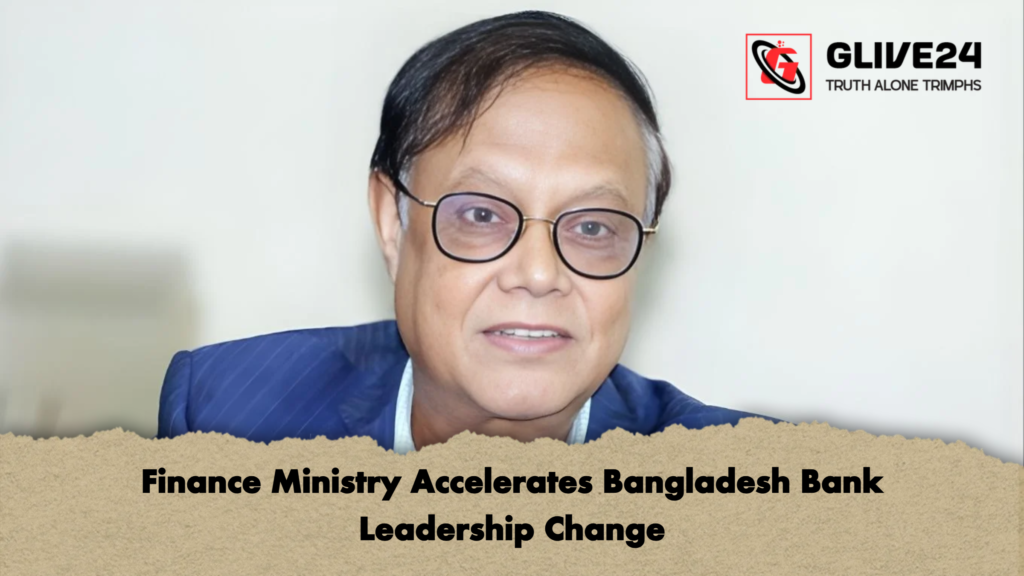
The Ministry of Finance has decided to relieve Dr. Ahsan H. Mansur from his position as Governor of Bangladesh Bank, simultaneously expediting the appointment process for a new governor. This development was confirmed by ministry sources on Wednesday, 25 February, in the early afternoon.
According to officials, a distinguished economist from a reputed United States university has been proposed for the post. The proposal has been forwarded from the Finance Ministry to the Prime Minister’s Office for final approval. Once the process is completed, the appointment of the new governor is expected to be formally announced today.
Dr. Mansur assumed office as the Governor of Bangladesh Bank on 13 August 2024. During his tenure, he played a pivotal role in various high-level positions, including advisory and policy roles with the International Monetary Fund (IMF) and BRAC Bank. He also served as a government advisor in formulating guidelines for public-private partnership (PPP) projects, contributing significantly to national economic policymaking.
Dr. Ahsan Mansur: Education and Career Overview
| Branch | Details |
|---|---|
| Early Education | Began his academic and professional journey at Dhaka University as a student and later as a faculty member in Economics. |
| Higher Education | Obtained a Master’s degree in Economics from McMaster University, Canada, and a PhD from Western Ontario University. |
| IMF Career | Joined the IMF in 1981 during his doctoral studies, working in Fiscal Affairs and Policy Review & Development departments. |
| Middle East & Asia | Oversaw IMF operations in the Middle East and Central Asia from 1996 to 2007. |
| Government Advisory Roles | Economic adviser to former Finance Minister Wahidul Haque in 1989; contributed to the introduction of VAT in 1991. |
Over his extensive IMF career, Dr. Mansur provided policy and economic advice to countries across the Middle East, Asia, Africa, and Central America. His analytical expertise and international experience were instrumental in shaping Bangladesh Bank’s monetary and fiscal policies.
The finalisation of the new governor’s appointment marks the beginning of a new chapter in the leadership of Bangladesh Bank. Economists suggest that this transition may have a significant impact on the country’s financial stability and international trade relations.
Currently, the Finance Ministry is working swiftly to complete the approval process, ensuring that there is no disruption to Bangladesh Bank’s policy-making and operations. Analysts view this leadership change as a potential pivot point for internal management reforms and the introduction of fresh strategic directions in foreign financial policy.