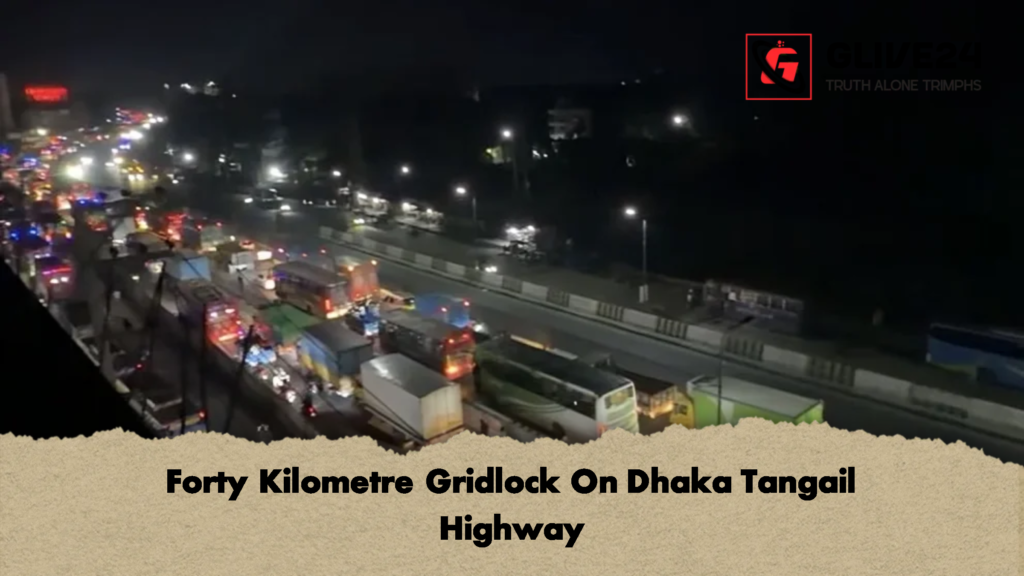
A massive forty-kilometre traffic jam has synchronised across the strategic Dhaka-Tangail highway, causing severe operational disruptions and leaving hundreds of thousands of home-bound passengers stranded. The logistical crisis began escalating immediately after dusk, driven by an exponential surge in commuter volume and public transport units ahead of the Eid holiday celebrations. The severe gridlock originally manifested past the Chandra tri-junction in Gazipur and quickly expanded backward and forward, stretching as far as the Mirzapur bypass area in the Tangail district.
Official assessments verified that the vehicular congestion became distinctly visible on Tuesday, 26 May 2026, following the conclusion of evening shifts. Initially, the bottleneck remained tightly constrained within the geographic boundaries separating the Bhogra bypass road from the central Chandra bus station area in Gazipur. However, as the night progressed, the intensity of the congestion grew exponentially. By 21:30, the boundaries of the gridlock breached the Chandra intersection, extending multiple kilometres northward to sub-districts within Tangail.
Table of Contents
Influx of Industrial Workers Triggers Congestion
According to local administrative sources, the primary catalyst behind the gridlock was the simultaneous departure of long-distance passenger coaches, heavy freight trucks, and smaller private vehicles heading towards the northern districts of Bangladesh. These vehicles simultaneously emerged from the capital city of Dhaka, Savar, and the surrounding industrial zones of Gazipur.
As the primary geographical gateway connecting the capital to the northern division, the Chandra tri-junction experienced immediate structural strain. The resulting tailbacks cascaded backward to the Bhogra bypass, while vehicles attempting to head north past Chandra faced complete immobility, forcing passengers to remain inside stationary coaches for hours.
Shifting Traffic Dynamics and Weather Complications
Field reports from Tangail indicated that during the daylight hours of Tuesday, the highway segment spanning from the Mirzapur Cadet College region to Elenga remained entirely clear of obstructions. All passenger buses and freight transport units maintained a normal, uninterrupted flow of speed. This baseline condition shifted rapidly after 21:00 when the highway stretch connecting Kaliakair to Mirzapur experienced an acute accumulation of vehicles. Concurrently, significantly slowed traffic and minor blockages were observed from Elenga up to the eastern toll plaza of the Jamuna Bridge.
The systemic breakdown of traffic management was compounded earlier in the day by environmental factors and industrial scheduling. All ready-made garment (RMG) factories and production facilities operating within the industrial city of Gazipur officially closed for the holidays on Tuesday morning. This caused an immediate influx of workers into the Chandra area. The situation worsened further around midday due to a sudden, two-hour downpour of torrential rain, which left thousands of commuters exposed. Following the rainfall, over 100,000 passengers concurrently occupied the highway shoulders, precipitating a severe shortage of available commercial vehicles and leaving desperate travellers stranded at major intersections.
Stranded Motorists and Commuters Recount Delays
The individual accounts provided by commercial drivers and passengers trapped within the perimeter of the gridlock highlighted the severity of the delay. Suman, a bus driver operating a vehicle for Itihash Paribahan, reported that the density of the traffic allowed him to advance a single kilometre over the course of an entire hour. He noted that the protracted waiting periods within closed vehicles were beginning to induce physical illness among his passengers.
| Stranded Individual | Role / Association | Route Traveled | Documented Operational Delay |
| Suman | Commercial Driver | Itihash Paribahan | Advanced only 1 km in 60 minutes |
| Samir Hossain | Passenger | Ekta Paribahan | Spent 3.5 hours from Gazipur to Chandra |
| Mujahid Mian | Coach Captain | Sohan Travels | Forced to shut down engine periodically |
Samir Hossain, a northern-bound passenger traveling aboard an Ekta Paribahan coach towards Bogura, expressed his immense frustration regarding the journey. Hossain had departed from his station in Gazipur at 18:00 but only managed to reach the Chandra intersection by 21:30, reflecting an absolute state of operational uncertainty for the remainder of his journey. Similarly, Mujahid Mian, a coach captain driving for Sohan Travels from Uttara, stated that the severity of the gridlock forced him to turn off his engine for extended periods to preserve fuel, concluding that clear roads would have significantly reduced both fuel expenditure and passenger suffering.
Law Enforcement Response and Scale of Exodus
Detailing the scale of the crisis, the Superintendent of Gazipur Highway Police, Rahmat Ullah, explained that the situation grew highly unstable due to the simultaneous convergence of a massive population and an unprecedented volume of vehicles during the final hours before Eid. He clarified that highway police detachments had been actively deployed since the early morning hours, executing strategic interventions to keep the transit routes functional.
The Superintendent disclosed that an estimated two million people were simultaneously vacating the Gazipur industrial belt to return to their ancestral homes. This massive human migration was accompanied by hundreds of long-distance commercial coaches and additional seasonal transport vehicles. The presence of this immense volume of travelers at a singular transit bottleneck caused the extreme pressure at the Chandra junction, though law enforcement authorities maintained that comprehensive containment efforts remain underway.