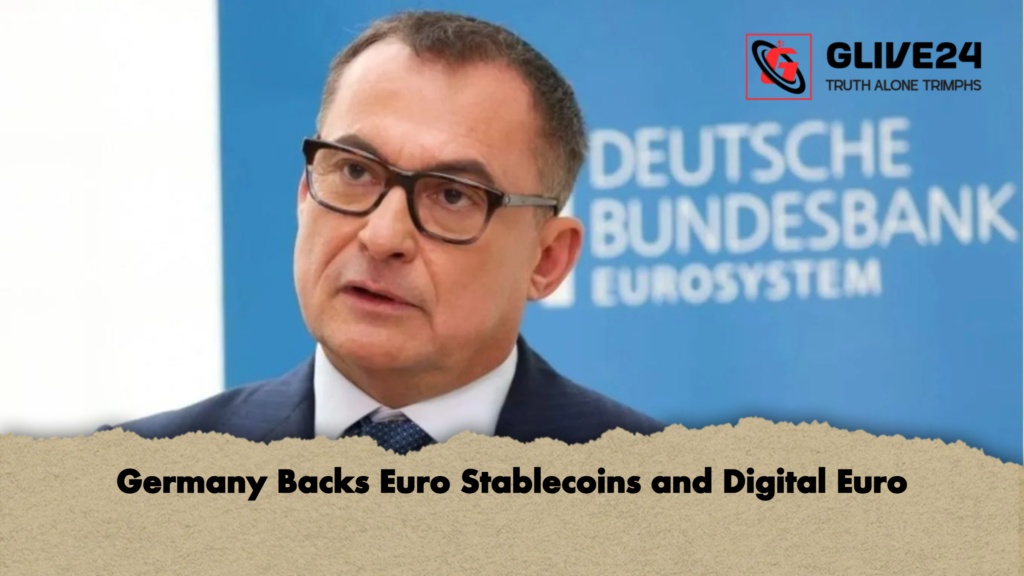
The President of Germany’s central bank, Joachim Nagel, has recently expressed strong support for euro-denominated crypto stablecoins and a retail central bank digital currency (CBDC), signalling a significant shift in European monetary policy. Unlike previous statements framing such initiatives as optional experiments, Nagel emphasised that these digital tools are essential to protecting Europe from the dominance of the US dollar in global finance.
Speaking at a forum in Frankfurt, Nagel stated: “We must secure our own transaction infrastructure, otherwise we risk falling further behind in the digital money landscape.” His comments come amid the European Union’s push to regulate digital assets through the Markets in Crypto-Assets (MiCA) framework, which aims to establish clear rules and oversight for digital financial instruments.
The urgency is underscored by current market dynamics. Dollar-backed stablecoins now account for over $310 billion, dominating global markets. By contrast, euro-based liquidity remains marginal. This stark imbalance has raised concerns among European regulators, who fear that without viable euro-denominated alternatives, the continent could face a wave of “digital dollarisation,” where cross-border payments and settlements increasingly rely on the US currency.
Nagel drew a clear distinction between institutional and retail applications of digital currencies:
-
Wholesale CBDC: Intended for institutional use, allowing banks to execute programmable payments directly in central bank money.
-
Euro Stablecoins: Targeted at the private sector, offering efficient and cost-effective cross-border payment solutions.
The following table illustrates the current disparity between dollar- and euro-based stablecoins:
| Type of Stablecoin | Market Value (USD Billion) | Target Use | Notes |
|---|---|---|---|
| Dollar-backed Stablecoins | 310+ | International transactions, retail, institutional | Dominant in global market |
| Euro-backed Stablecoins | Negligible | European retail and cross-border payments | Requires development and expansion |
Nagel’s message is clear: Europe must develop competitive euro-denominated alternatives rather than merely issuing warnings. However, the stringent capital requirements and regulatory constraints under MiCA could slow innovation.
The battle for stablecoin supremacy is poised to extend beyond blockchain technology into legislative and policy arenas, as governments worldwide increase scrutiny over digital assets. The digital euro is no longer a theoretical concept; the critical question is how quickly it can be implemented. Both Europe and the United States are moving to finalise regulatory frameworks, and the timing of their rollouts will likely determine which currency takes the lead in the rapidly evolving digital payments market.
In essence, Nagel’s stance positions Europe at a crossroads: either accelerate the adoption of euro-based digital infrastructure or risk ceding influence in global digital finance to the dollar.