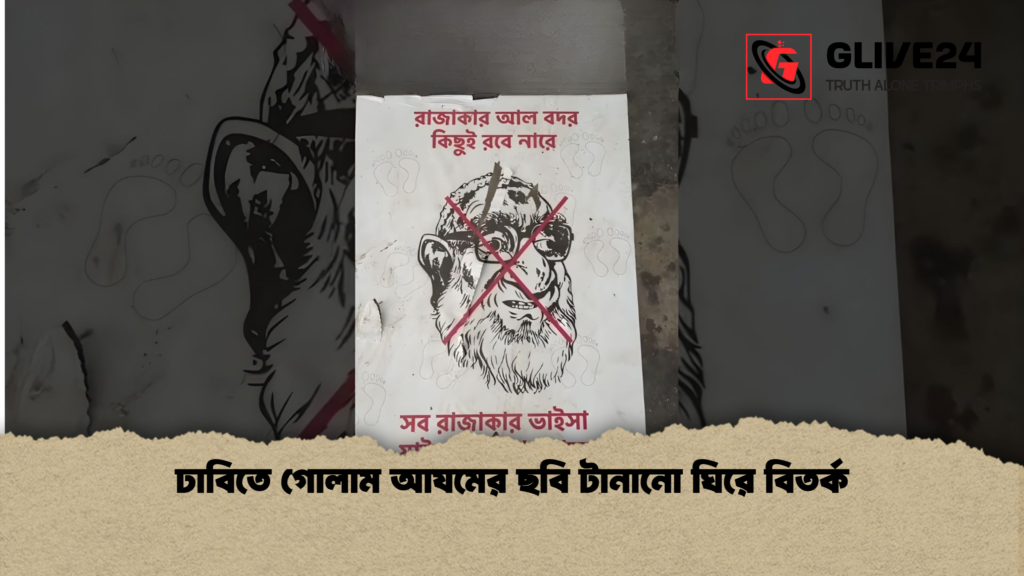
A recent incident on the Dhaka University campus has reignited debate and raised searching questions about ethics, protest culture, and the boundaries of symbolic expression within educational institutions. A video circulating widely on social media platforms shows a portrait of Ghulam Azam hung deliberately at the entrance of a residential hall in such a manner that students entering the premises are compelled to step on it. The footage, which rapidly went viral, has prompted passionate discussion among students, teachers and the wider public.
Table of Contents
Context of the Incident
Ghulam Azam remains one of the most controversial figures in Bangladesh’s modern history. As the long-time leader of Jamaat-e-Islami, he was accused of crimes against humanity for his alleged collaboration during the Liberation War of 1971. For many, particularly those identifying with pro-Liberation political ideals, Azam symbolises the darkest chapters of wartime brutality.
From this standpoint, several students argue that stepping on his portrait constitutes a form of symbolic resistance—an assertion of historical accountability and moral rejection of wartime atrocities.
However, another segment of students, teachers and civil society voices hold the view that such an act—regardless of the individual portrayed—crosses the boundaries of decency and undermines the dignity expected of an academic environment. To them, the gesture not only fuels hostility but also degrades the heritage of respectful dialogue that universities are expected to nurture.
Reactions on Campus
Within hours of the video’s spread, various student groups, academic staff members and general students began issuing statements. Some hailed the act as a visible stance in favour of the Liberation War’s legacy. Others, particularly academics, argued that protest can and should take more constructive and educational forms that encourage intellectual engagement rather than confrontation.
Summary of Responses
| Group | Type of Response | Brief Description |
|---|---|---|
| General Students | Supportive | Considered stepping on the portrait a symbolic protest against war crimes |
| University Teachers | Objection | Emphasised that educational spaces should not endorse acts of disrespect |
| Politically Affiliated Students | Mixed | Some endorsed the gesture; others questioned its moral and cultural appropriateness |
| General Social Media Users | Mostly Critical | Many labelled the act distasteful, unnecessary or reflective of poor taste |
Social Media Dialogue
The video gained hundreds of thousands of views across YouTube, Facebook and other platforms. Comment sections revealed a starkly divided public. Supporters described the act as “emotionally liberating” and “a rightful expression of zero tolerance toward war criminals”.
Critics, on the other hand, denounced the gesture as a descent into “the politics of hatred”, arguing that civilised societies should prioritise history-based education, rational discourse and research-driven condemnation rather than symbolic humiliation.
Position of the University Administration
At the time of writing, Dhaka University’s central administration had not issued an official statement. However, sources indicate that the hall authorities are reviewing the matter closely. Given the campus’s historically charged political climate, administrators appear cautious, mindful that symbolic acts—no matter how minor—can quickly escalate into larger tensions.
Broader Analysis
The episode once again demonstrates how deeply embedded the political and historical narratives of the Liberation War remain in Bangladesh’s collective consciousness. Issues connected to 1971 continue to shape national identity, moral values and public debate.
Furthermore, the rapid amplification of campus activities via social media means that incidents once confined to university grounds now almost instantly enter national discourse. Whether viewed as justified protest or inappropriate behaviour, the incident highlights a broader truth: in today’s Bangladesh, symbolic acts carry profound social implications, capable of provoking intense reflection on history, justice and the responsibilities of educational institutions.