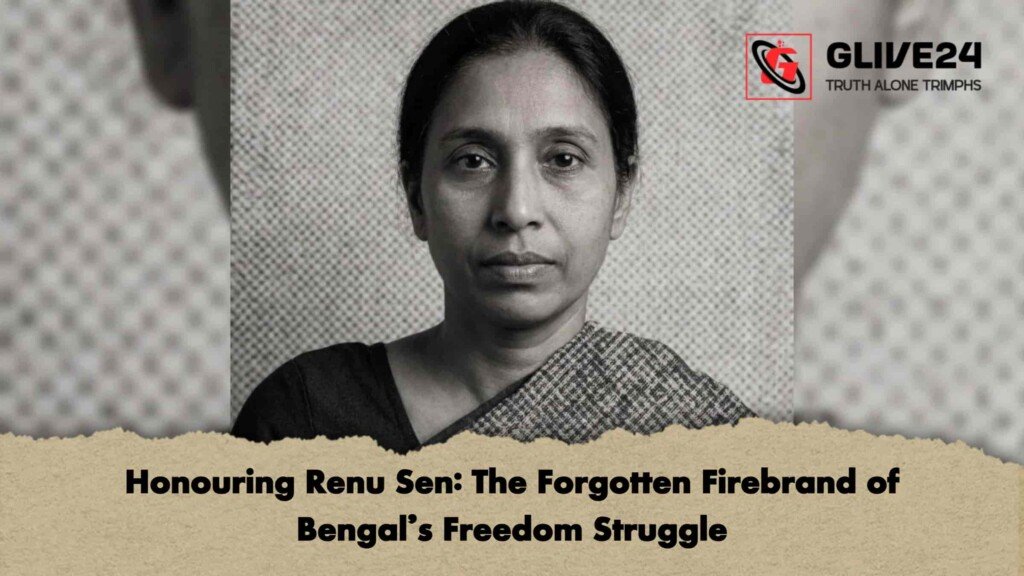
The early twentieth century in Bengal was defined by an intense, subterranean surge of anti-colonial nationalism, a period often referred to as the Agniyuga or the fiery era. Among the formidable women who openly challenged the might of the British Empire, Renu Sen occupies a place of profound historical significance. A fiery revolutionary, dedicated social reformer, and pioneer of female emancipation, Sen dedicated her brief but extraordinary life to the twin causes of national liberation and women’s rights. Her death anniversary, observed on 2 July, offers a striking reminder of the radical sacrifices that shaped the subcontinent’s path to independence.
Born on 28 December 1909 in Munshiganj at her maternal home, Sen hailed from a family rooted in the Faridpur district of undivided Bengal. Her early intellectual development was nurtured under the close guidance of her grandfather, Umacharan Sen, alongside her parents, Binodbihari and Kusumkona Sen.
Her political consciousness ignited exceptionally early. At the tender age of fourteen, captivated by the swelling tide of patriotism, she relocated from Munshiganj to Dhaka. There, she enrolled in the Deepali School, an institution founded by the legendary revolutionary leader Leela Nag. This move proved pivotal, transforming a young student into a highly motivated political organiser within a network that sought to dismantle British rule through both social reform and armed resistance.
Sen’s dedication to education matched her commitment to the nationalist cause. She secured her Bachelor of Arts degree in 1930, a time when higher education for women was heavily discouraged. However, her overt political engagements soon drew the ire of the colonial authorities. On 16 September 1930, the British administration arrested her. By 1931, she was formally imprisoned for her alleged involvement in the high-profile Dalhousie Square Bomb Case—a daring operation targeting the notorious Calcutta Police Commissioner, Charles Tegart. Undeterred by the harsh realities of colonial incarceration, Sen demonstrated astonishing mental fortitude by successfully completing her Master of Arts examinations whilst behind bars.
Even when placed under strict house arrest in Munshiganj in 1937, Sen refused to be silenced. Confronted with the government’s refusal to grant basic allowances and livelihood means to political detainees, she deliberately violated the restrictive internment laws. She escalated the fight to the judiciary, launching a landmark lawsuit against the crown at the Calcutta High Court. Her historic legal victory against the colonial government established a crucial precedent for the rights and humane treatment of political prisoners across India.
Sen’s contributions to the institutional framework of women’s rights were equally groundbreaking. Recognising the severe accommodation crisis faced by young women arriving in Calcutta for higher education, she worked closely with Leela Nag to establish the ‘Chhatri Bhavan’ and the ‘Deepali Chhatri Sangha’ in 1930. These safe spaces served as critical incubators for nationalist thought and female solidarity.
She also lent her administrative acumen to the publication of Jayasree, a progressive journal edited by Nag that championed female empowerment. Later, she travelled extensively through the villages of Barisal, mobilising rural women under the banner of the Mahila Atmaraksha Samiti (Women’s Self-Defence Association), teaching them self-reliance and political awareness.
In 1940, she married the prominent revolutionary scholar and academic, Dr Atindranath Bose. Tragically, her indefatigable journey was cut short just a year later. Renu Sen passed away on 2 July 1941 at the age of thirty-one. Though her life was brief, her legacy as a fearless vanguard of freedom and equality remains an enduring inspiration for generations.