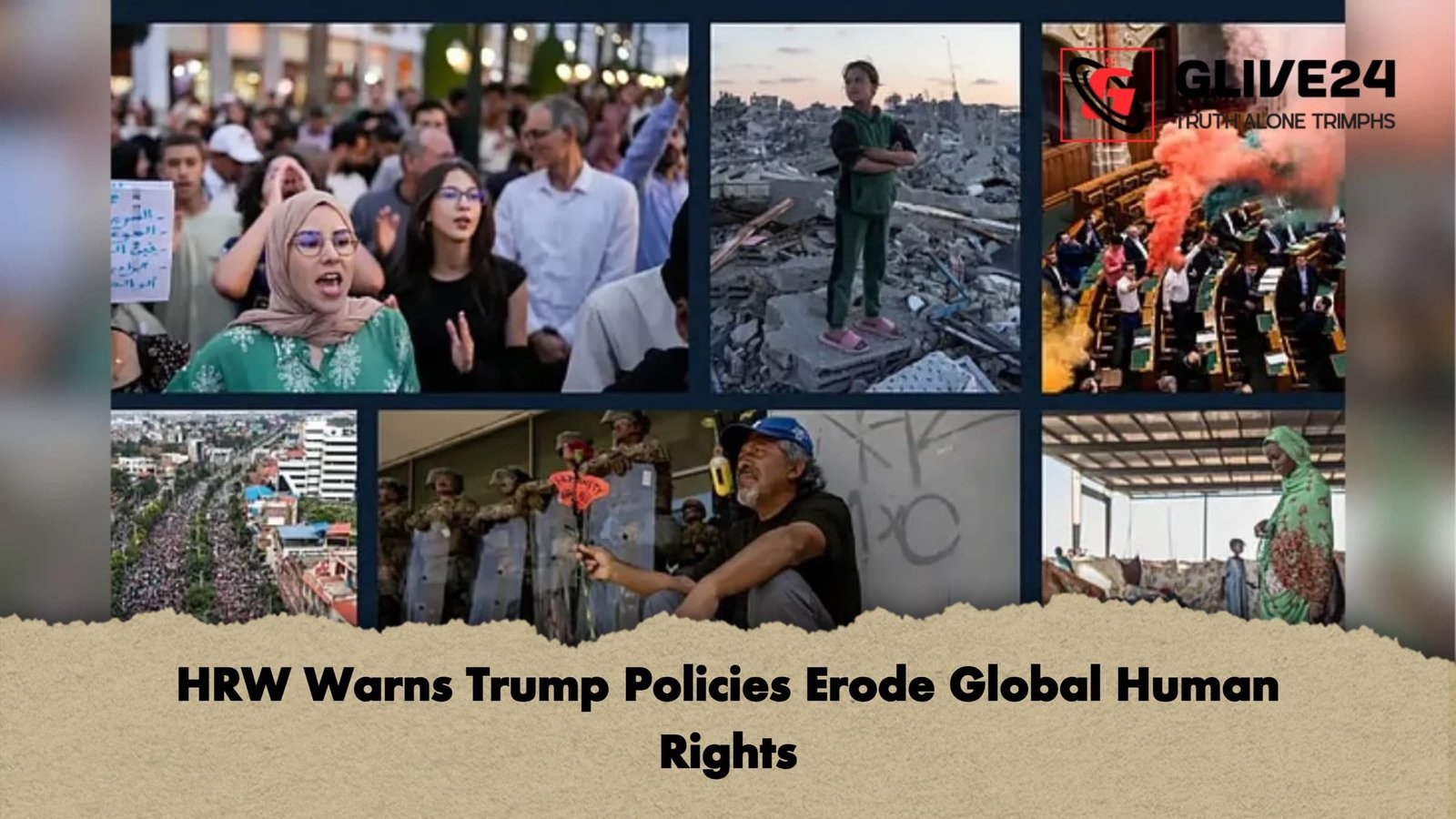
The international rules-based order, forged in the wake of the 20th century’s darkest atrocities, is currently facing an existential threat. In its comprehensive World Report 2026, Human Rights Watch (HRW) asserts that the convergence of Donald Trump’s authoritarian impulses with the long-standing efforts of China and Russia is systematically dismantling the global security architecture and the protection of fundamental liberties.
Table of Contents
The Rise of Authoritarianism
In the 36th edition of this 529-page global review, which evaluates conditions in over 100 nations, HRW Executive Director Philippe Bolopion characterises the resistance to global authoritarian trends as the “defining challenge of this generation.” The report highlights a disturbing shift in Washington, where the administration has allegedly transitioned from a flawed protector of rights to an active disruptor.
The report details a litany of domestic abuses, including:
Assaults on the Rule of Law: Systematic attacks on the independence of the Judiciary and the open defiance of court mandates.
Civil Liberty Retractions: The erosion of reproductive rights, the withdrawal of protections for transgender and intersex individuals, and the weaponisation of state power against the media and civil society.
Targeting Opponents: The use of government machinery to intimidate political rivals, lawyers, and even satirists.
A Vacuum in Global Leadership
The Trump administration’s foreign policy has fundamentally upended the international consensus. By withdrawing from the UN Human Rights Council and the Paris Climate Agreement, the United States has left a leadership vacuum that is being filled by powers less concerned with individual freedoms.
Nowhere is this shift more evident than in the administration’s stance on global conflicts. In Ukraine, the report alleges that President Trump has undermined accountability for Russian war crimes, instead pressuring President Zelenskyy to cede vast territories and demanding “exploitative mineral deals” in exchange for peace. Similarly, in the Middle East, the administration maintains “unconditional support” for Israeli operations in Gaza, despite international courts weighing allegations of ethnic cleansing and a death toll exceeding 71,000.
Comparative Impact on Global Mechanisms
| Mechanism / Concept | Historical Context | Current Status under Trump/China/Russia |
| Responsibility to Protect (R2P) | Adopted in 2005 to prevent genocide. | Effectively dormant; ignored in Sudan and Gaza. |
| Intl. Criminal Court (ICC) | A tool for prosecuting war crimes. | Under severe threat and diplomatic isolation. |
| Foreign Humanitarian Aid | Life-saving support for global crises. | Abruptly suspended or cut significantly. |
| Multilateral Treaties | Frameworks for collective rights. | Systematic withdrawal and bilateral “deal-making.” |
The Call for a Strategic Coalition
To counter this “illiberal convergence,” HRW calls for the urgent formation of a strategic alliance of democratic nations. This coalition must unite governments that still value human rights with social movements and international institutions.
Bolopion argues that if rights-respecting nations coordinate their efforts, they could emerge as a formidable political and economic bloc. Such a coalition would serve as a vital voting bloc within the United Nations, safeguarding the integrity of human rights frameworks even in the face of superpower opposition. As the report concludes, the battle for 2026 will require a “firm, strategic, and coordinated initiative” from voters and civil society alike to prevent the total collapse of the global moral compass.