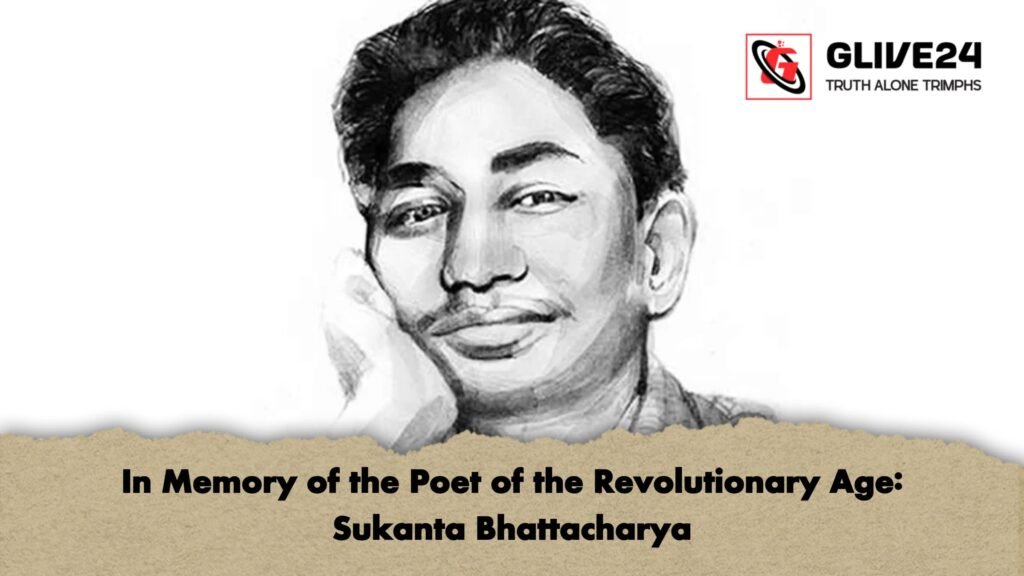
In the history of Bengali literature, Sukanta Bhattacharya is not merely a name of a poet; he represents a conscious voice of awakening and an unwavering expression of protest. In his brief life of just twenty-one years, he constructed a powerful poetic language that remains equally relevant, inspiring, and revolutionary even today. His poetry burns with the fire of revolution, echoes the sighs of the hungry, reflects the pain of the oppressed, and dreams of building a humane world.
Born on 15 August 1926 in Kolkata, Sukanta became associated with leftist political consciousness at an early age and closely observed social realities. The Second World War, famine, colonial exploitation, and widespread inequality deeply influenced his poetic sensibility. As a result, his poetry gives greater emphasis to struggle, hunger, the lives of working people, and the aspiration for liberation rather than romantic idealism.
His famous poetry collections such as Chharpatra (The Letter of Departure), Ghum Nei (No Sleep), Purbabhas (Premonition), and timeless poems like Hey Mohajibon (O Great Life), Runner, Charagachh (Sapling), and Bhukher Rajye Prithibi Gadomoy continue to stir readers’ hearts. In particular, the lines:
“In the kingdom of hunger, the world becomes dull prose,
The full moon looks like a burnt piece of bread,”
demonstrate the extraordinary power with which he transformed harsh social reality into poetry.
In contemporary society, when materialism is increasingly dominating over humanity, and when a section of youth is drifting into self-centredness, confusion, and aimlessness, Sukanta becomes even more relevant. His poetry is not merely literature; it is a social consciousness that teaches resistance against injustice, encourages solidarity with the oppressed, and inspires thoughts of a broader humanity.
Today’s youth possess immense technological power, yet in many cases social awareness, empathy, and the spirit of struggle are diminishing. It is precisely here that Sukanta’s poetry once again offers direction. He showed that even a young person can wield the pen as a weapon and dream of transforming the times. In his writings, young readers find the courage to protest, the strength to dream, and the commitment to build a humane world.
On 13 May 1947, at the age of just twenty-one, this poet of the revolutionary age passed away from tuberculosis. Yet his voice did not die with him. His poetry still lives on in every protest, every demand for justice, every cry of the hungry, and in the hearts of dreaming youth.
Therefore, his death anniversary is not only a day of remembrance but also a moment to renew commitment to his ideals. Even today, society, the times, and the youth deeply need Sukanta Bhattacharya.
Finally, his immortal words remain:
“I shall make this world fit for children to live in;
To the newborn, this is my firm promise.”