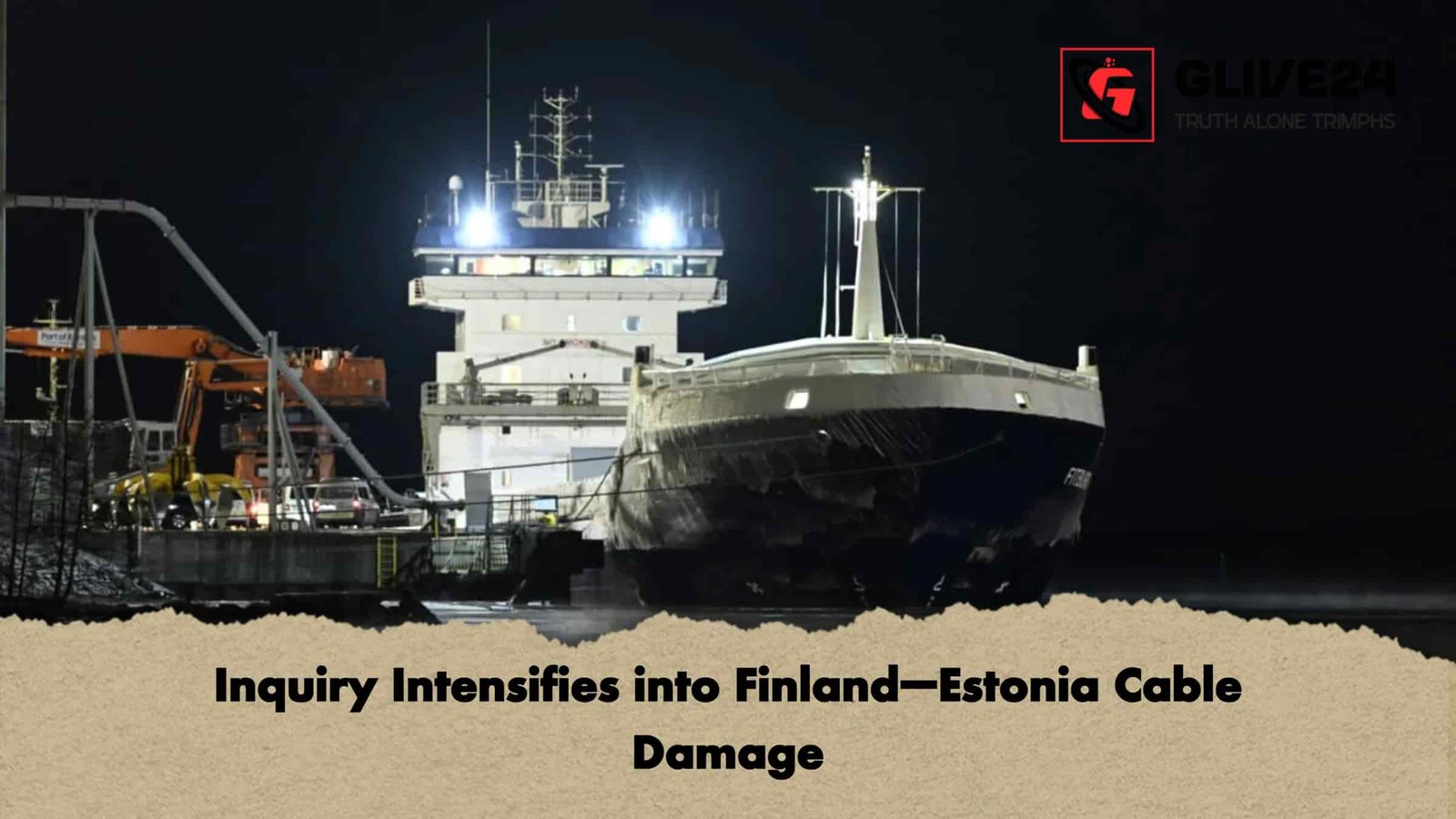
Authorities in Finland and Estonia have launched a wide-ranging joint investigation after a key submarine telecommunications cable in the Gulf of Finland was damaged, heightening concerns about the security of critical undersea infrastructure in Northern Europe. The Gulf, which links the Nordic and Baltic regions, is regarded as a strategically sensitive waterway because of the dense concentration of power cables, data links and energy pipelines crossing its seabed.
The fault was detected in the early hours of Wednesday along the cable route between Helsinki and Tallinn. Following the alert, maritime authorities, border guards and criminal investigators from both countries moved swiftly to secure the area and assess potential causes. Finland’s Border Guard confirmed that a commercial vessel suspected of involvement was intercepted and searched while anchored within Finland’s exclusive economic zone (EEZ).
Preliminary findings suggest that the vessel may have been dragging its anchor for several hours, a practice that can pose a serious risk to undersea infrastructure. In response, Helsinki police have opened a criminal investigation on suspicion of aggravated criminal damage, attempted aggravated damage, and serious interference with telecommunications systems.
The damaged cable is owned by Elisa, one of Finland’s largest telecommunications companies, and is officially classified as critical underwater infrastructure. Although the precise point of damage lies within Estonia’s EEZ, the cross-border nature of the network has prompted close operational coordination between the two countries. Elisa has stated that, despite the incident, customer services have remained largely unaffected, reflecting the resilience and redundancy built into the regional network.
The vessel under scrutiny, the Fitberg, sails under the flag of Saint Vincent and the Grenadines and was en route from Russia to Israel at the time of the incident. Finnish media report that its 14-member crew—nationals of Russia, Georgia, Azerbaijan and Kazakhstan—have been detained for questioning. Finland’s National Police Commissioner, Ilkka Koskimäki, emphasised that investigators are not, at this stage, drawing conclusions about possible state involvement.
President Alexander Stubb sought to reassure the public, stating that Finland remains vigilant against potential security threats and is prepared to take firm action should vital infrastructure come under risk.
The incident comes against a backdrop of heightened geopolitical sensitivity in the Baltic Sea. Since Russia’s full-scale invasion of Ukraine in 2022, the strategic value of submarine cables and pipelines has grown, particularly as European states have moved to reduce dependence on Russian energy supplies.
Nor is this an isolated case. On Christmas Day 2024, Finnish prosecutors charged the captain and two senior officers of the oil tanker Eagle S over damage to cables on the Finland–Estonia route. European Union officials later described the vessel as part of Russia’s so-called “shadow fleet”, a claim Moscow has denied. Adding to the complexity, Swedish operator Arelion reported damage to another cable on Wednesday, with repairs due to begin once weather conditions permit.
As investigations continue, calls are mounting across Europe for stronger monitoring, enhanced maritime regulation and improved protection of the continent’s increasingly vital undersea networks.
Recent Submarine Cable Incidents in the Baltic Region
| Date | Cable Owner | Location | Suspected Vessel | Service Impact |
|---|---|---|---|---|
| Wednesday | Elisa (Finland) | Gulf of Finland (Estonian EEZ) | Fitberg | No significant impact |
| Tuesday–Wednesday | Arelion (Sweden) | Gulf of Finland / Baltic Sea | Under inquiry | Limited disruption |
| 25 December 2024 | Multiple operators | Finland–Estonia route | Eagle S | Partial disruption |
These cases collectively underline the growing urgency of safeguarding Europe’s submarine infrastructure amid an increasingly complex security environment.