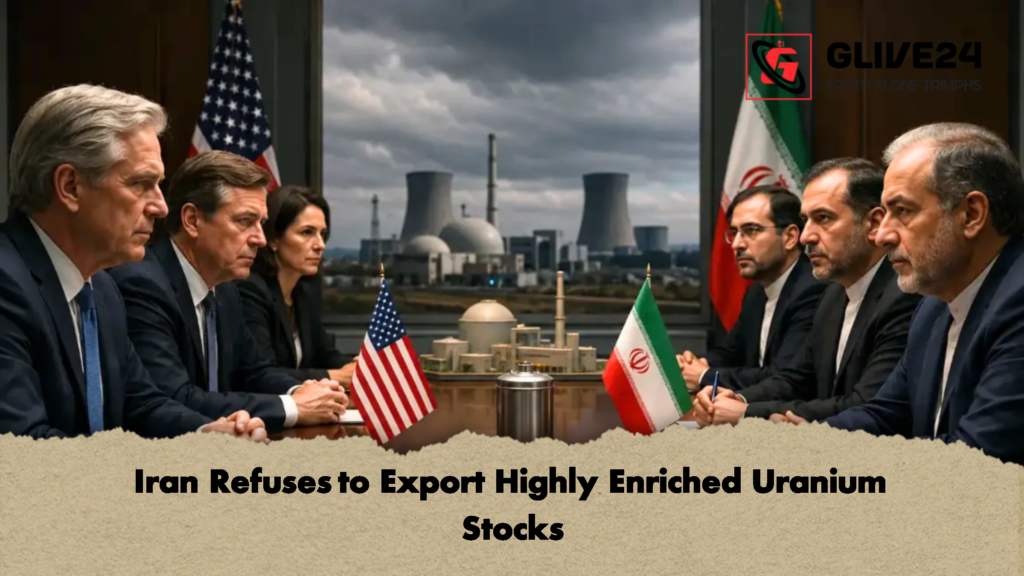
An unnamed senior Iranian official has confirmed that the Government of the Islamic Republic of Iran has flatly rejected any proposal to transfer its existing stockpile of highly enriched uranium to a foreign nation during its continuous diplomatic negotiations with the United States. Speaking in an interview with the international news agency Reuters, the executive source clarified that the country’s sovereign atomic assets remain strictly non-negotiable under the current interim framework.
The official stated that the preliminary diplomatic understanding recently established between Washington and Tehran consciously omitted any restrictive measures regarding Iran’s sovereign nuclear programme. The complex atomic issue has been intentionally decoupled from the immediate parameters of the active truce agreement, with both negotiating delegations consenting to postpone the resolution of the nuclear file until formal discussions for a definitive final treaty commence. The senior source explicitly reinforced this stance by emphasizing that absolutely no administrative or diplomatic consensus has been reached that would require the physical removal or external deportation of Iran’s highly enriched uranium reserves from its domestic territory.
American Verification and Post-Treaty Commitments
The operational boundaries of the diplomatic impasse were further corroborated in a separate series of statements published by The New York Times. Speaking to the publication on the condition of anonymity, two United States government officials confirmed that the Iranian administration has systematically refused to sign any formal agreement outlining specific procedures or timelines for the relinquishment or reduction of its processed uranium materials at this current juncture.
According to the American regulatory sources, the representatives from Tehran have instead provided a diplomatic pledge to engage in detailed, comprehensive consultations regarding the long-term management of their atomic infrastructure only after the broader provisions of a final, permanent diplomatic settlement have been successfully ratified by all relevant geopolitical entities.
Geopolitical Catalyst and the Regional Security Context
The highly sensitive nuclear negotiations are unfolding against a backdrop of unprecedented regional kinetic conflict and structural instability in the Middle East. The current wave of diplomacy follows a series of significant military escalations that completely altered the geopolitical landscape of the region earlier this year:
-
The Joint Strategic Offensive: On 28 February, the United States and Israel executed a coordinated joint military operation involving targeted air strikes against highly critical commands and strategic infrastructure units within Iranian territory.
-
High-Profile Casualties: The joint offensive resulted in the deaths of several senior Iranian administrative and military figures, including the Supreme Leader of the Islamic Republic, Ayatollah Ali Khamenei.
-
The Retaliatory Response: Following the destruction of its state infrastructure, Iran launched extensive retaliatory strikes utilizing drone networks and ballistic missile systems aimed directly at United States military assets stationed throughout the Middle East, alongside designated Israeli defensive positions.
Mediation Operations and Ongoing Diplomatic Engagement
Following weeks of intensive, high-intensity military engagements that threatened to destabilise global energy markets, international observers successfully brokered a fragile, temporary ceasefire between the conflicting parties. In the wake of the cessation of direct hostilities, the Government of Pakistan stepped forward to act as the primary neutral mediator, facilitating multiple rounds of high-level diplomatic talks hosted within its sovereign territory.
Despite the execution of several successive consultative sessions under Pakistani mediation, the negotiating teams representing Washington and Tehran have thus far failed to secure a permanent, legally binding international treaty. Nevertheless, diplomatic channels remain actively open, and international envoys continue to pursue rigorous back-channel communication strategies in a persistent effort to transition the unstable regional truce into a comprehensive, verifiably secure, and permanent diplomatic framework.