
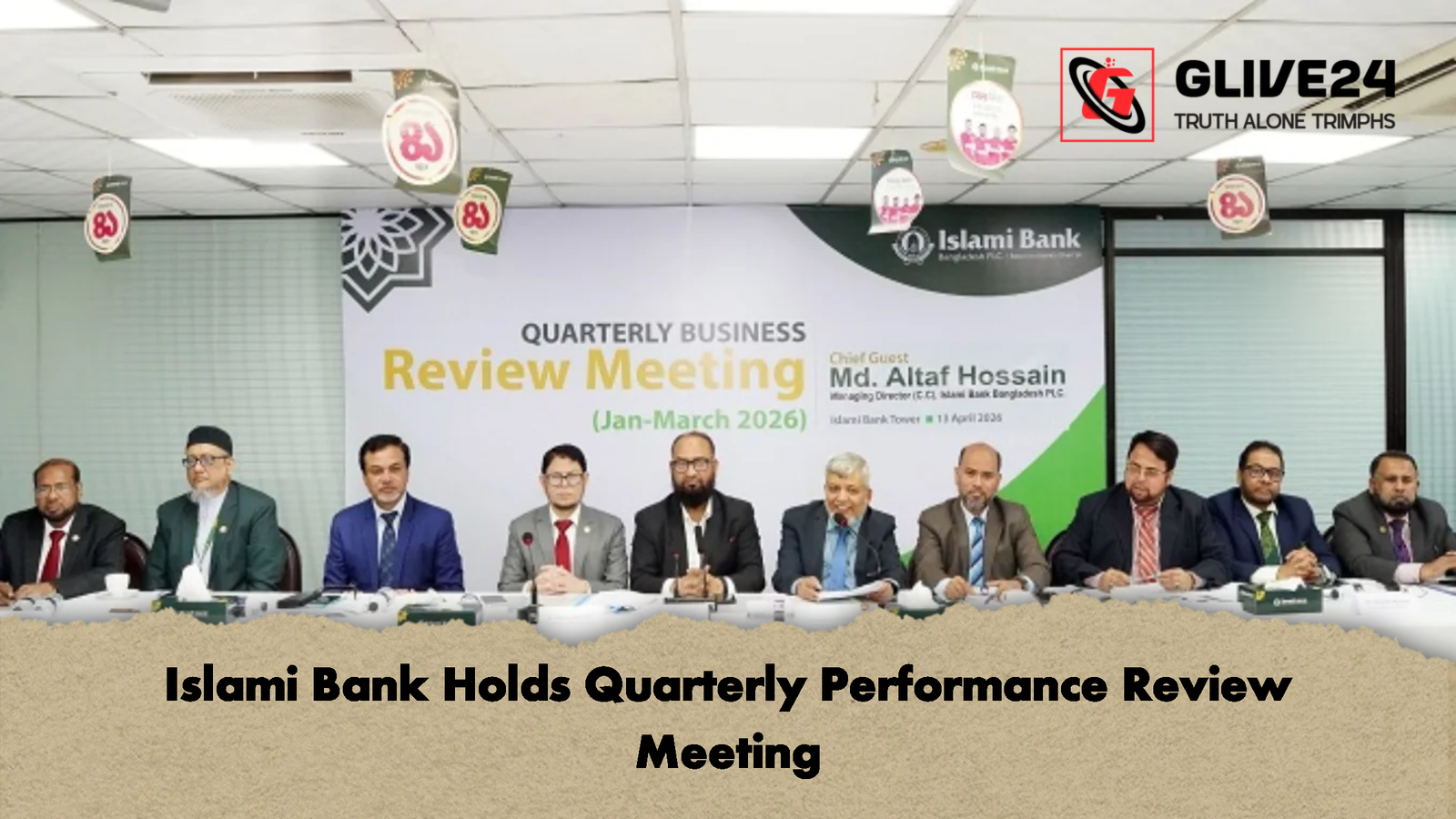
A quarterly business review meeting of Islami Bank Bangladesh PLC covering its nine operational zones and four corporate branches was held on Monday at the bank’s head office in Dhaka. The session assessed operational performance for the January–March 2026 period and reviewed overall business progress across key divisions of the organisation.
The meeting was chaired by Acting Managing Director Md Altaf Hossain, who led discussions on key performance indicators, operational efficiency, and strategic priorities for the coming quarters. The review formed part of the bank’s regular governance framework aimed at ensuring accountability, consistency, and sustained growth across its nationwide network.
Table of Contents
Senior Leadership in Attendance
The session brought together senior executives from across the institution, including Additional Managing Directors Mohammad Jamal Uddin Mojumder and Dr M Kamal Uddin Jasim, along with Deputy Managing Directors and other high-ranking officials from the head office.
Heads of all nine operational zones and managers of the four corporate branches were also present, ensuring representation from all major operational units. The broad participation reflected the bank’s decentralised operational structure and its emphasis on coordinated performance monitoring.
Review of Key Business Indicators
During the meeting, participants evaluated a range of financial and operational metrics for the first quarter of 2026. These included deposit mobilisation trends, investment portfolio performance, branch-level productivity, and customer service delivery standards.
Senior officials also reviewed progress in strengthening governance systems, improving risk management frameworks, and expanding digital banking services across the network. Emphasis was placed on ensuring that technological upgrades translate into improved customer experience and operational efficiency.
Executives reiterated the importance of maintaining steady, sustainable growth while adhering strictly to regulatory requirements and Islamic banking principles. Consistency in performance across different zones was identified as a key area requiring continued focus.
Organisational Representation
| Category | Representation in Meeting |
|---|---|
| Head Office Leadership | Acting MD, Additional MDs, Deputy MDs |
| Zonal Offices | Heads of 9 operational zones |
| Corporate Branches | Managers of 4 corporate branches |
| Functional Executives | Senior executives from head office departments |
Strategic Priorities for 2026
The review outlined several strategic priorities for the bank in the coming period. These included expanding investment operations in line with Islamic finance principles, improving customer acquisition in competitive urban markets, and strengthening digital banking infrastructure to support faster and more secure service delivery.
Attention was also given to ensuring balanced growth across all zones, reducing operational disparities, and maintaining strong asset quality amid changing macroeconomic conditions. Enhancing efficiency at branch level and improving cross-unit coordination were highlighted as essential for achieving these objectives.
Focus on Governance and Operational Discipline
Speakers at the meeting emphasised the importance of robust internal governance, compliance adherence, and continuous efficiency improvement. Leadership stressed the need to align all branch-level operations with central strategic directives while encouraging innovation in service delivery.
Zonal heads were instructed to enhance monitoring mechanisms and ensure timely execution of head office policies. Strengthened coordination between corporate branches and zonal offices was identified as a critical driver of future business growth.
Outlook
The quarterly review reflects the bank’s continued focus on disciplined expansion and operational stability across its nationwide network. As competition intensifies in the banking sector and customer expectations evolve, the institution is prioritising stronger financial fundamentals alongside digital transformation initiatives.
Looking ahead, management is expected to maintain close oversight of quarterly performance trends, ensuring that growth remains sustainable, compliant, and aligned with long-term strategic goals across all business segments.