
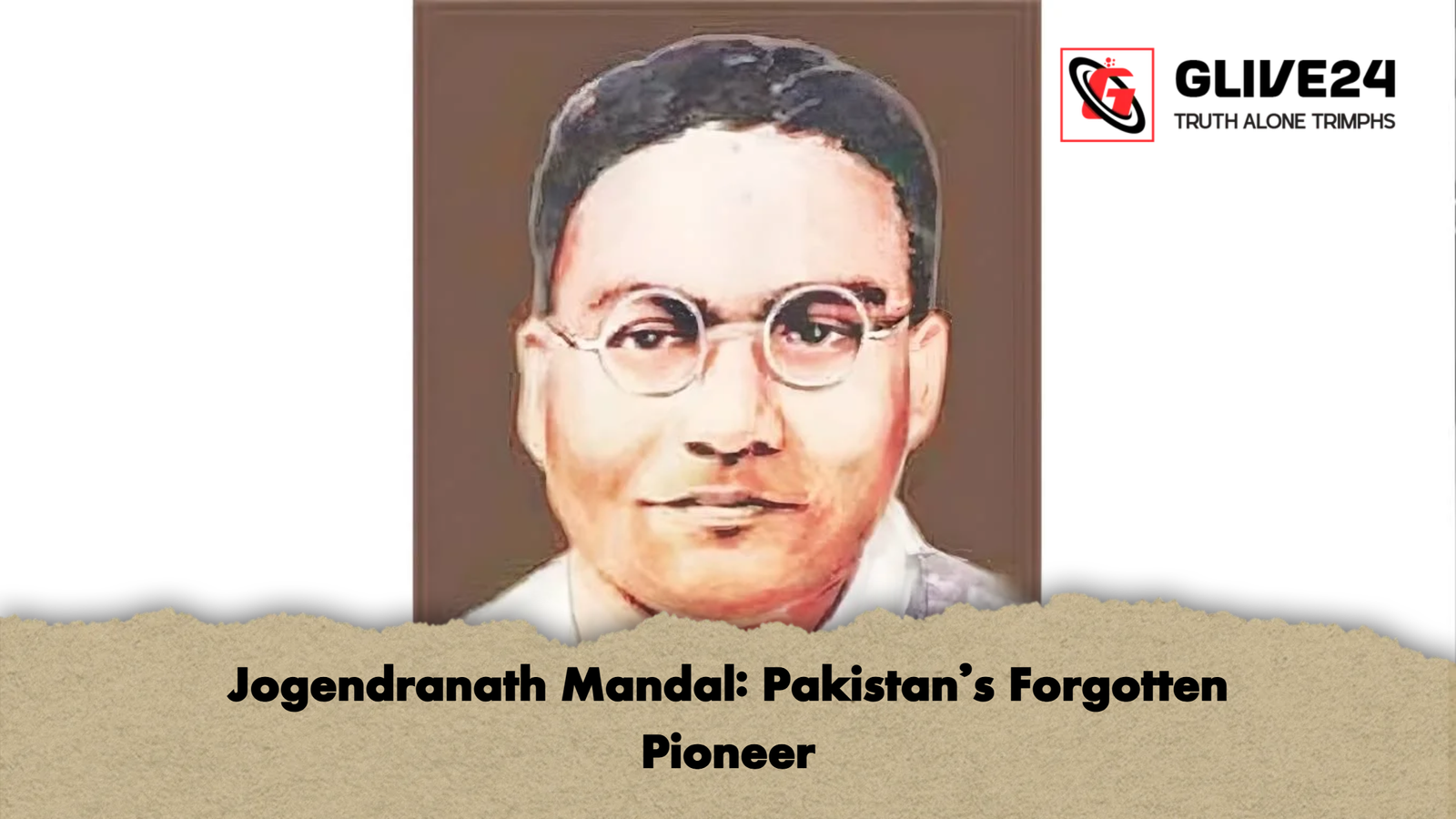
In the annals of South Asian political history, certain lives read like silent archives—bearing witness to dreams, betrayals, struggles, and dignity. Jogendranath Mandal is one such overlooked yet profoundly significant figure. Despite serving as Pakistan’s first Minister of Law, he resigned in protest against state-sponsored discrimination and eventually left the country—a chapter still largely unknown.
Table of Contents
Early Life and Political Rise
Jogendranath Mandal was born on 29 January 1904 in the Greater Barisal district of undivided Bengal. Emerging from the Bengali Namashudra community, one of the most marginalised in colonial India, he became a steadfast advocate for the rights and political empowerment of the socially disadvantaged.
In 1937, he contested the Bengal Provincial Legislative Assembly elections as an independent candidate and defeated a Congress nominee—a surprising feat that highlighted his political acumen. He was initially influenced by Netaji Subhas Chandra Bose and the reformist thinker Sarat Chandra Bose. In 1940, following Netaji’s expulsion from Congress, Mandal too left the party and sought new political avenues, ultimately aligning with the Muslim League.
Dalit Politics and Ambedkar Collaboration
Later, Mandal joined the cabinet of Huseyn Shaheed Suhrawardy. During this period, he collaborated with Dr. B.R. Ambedkar to establish the Bengal branch of the Dalit Federation, a historic step in institutionalising Dalit politics in the region.
Partition, Pakistan, and Disillusionment
Amid the communal riots of 1946, Mandal strongly discouraged the Namashudra community from engaging in violence. He feared that the community could become pawns in the larger power struggle between Congress and the Muslim League.
Following the Partition in 1947, Mandal was elected to Pakistan’s Constituent Assembly, becoming one of its 69 members and serving as its interim chairman. He was appointed Minister of Law and Labour in Liaquat Ali Khan’s cabinet, earning recognition as one of the country’s founding figures. However, his belief that minority Hindus would find security under the emerging Muslim political framework was soon shattered.
Resignation and Protest
On 8 October 1950, citing discrimination and persecution of Hindus in Pakistan, Mandal resigned from the cabinet, openly condemning the state’s failures in protecting minorities. He subsequently migrated to India, refusing to be complicit in injustice despite his foundational role in Pakistan.
Later Life and Legacy
Settling permanently in Bongaon, 24 Parganas district, Mandal withdrew from active politics but remained a moral touchstone in history. He passed away on 5 October 1968 in Bongaon, leaving behind a legacy of principle over power.
| Key Milestones | Year | Significance |
|---|---|---|
| Birth | 1904 | Greater Barisal, Bengal |
| Election victory | 1937 | Defeated Congress candidate as independent |
| Collaboration with Ambedkar | 1940s | Established Bengal Dalit Federation |
| Ministerial post in Pakistan | 1947 | Law & Labour Minister under Liaquat Ali Khan |
| Resignation | 1950 | Protested discrimination against minorities |
| Death | 1968 | Bongaon, India |
Jogendranath Mandal’s journey—from the political corridors of Barisal and Karachi to a quiet life in Bongaon—reminds us that in politics, principles and self-respect outweigh power. He was a statesman who stood not with convenience, but with truth.