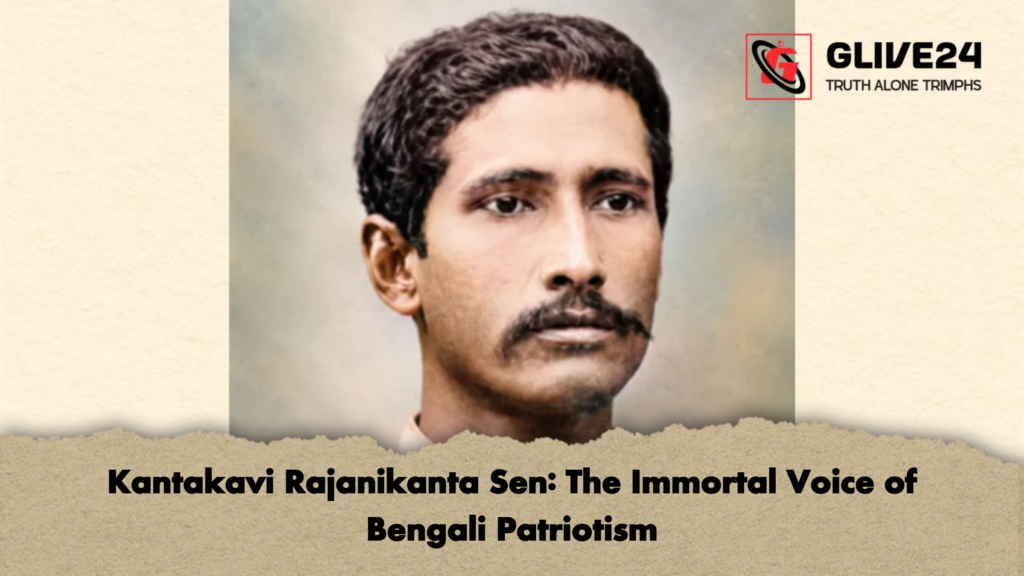
Amongst the luminary figures who shaped the golden era of Bengali music and literature, few voices possess the lingering emotional and spiritual resonance of Kantakavi Rajanikanta Sen. Though his total output was modest in comparison to giant contemporaries such as Rabindranath Tagore, Dwijendralal Ray, and Atulprasad Sen, the unpretentious clarity of his lyrics, haunting melodies, and unwavering devotion elevated him to a unique pedestal in Bengal’s cultural heritage.
Early Life and Formative Years
Born on 26 July 1865 in the historic village of Bhangabari, situated within the Sirajganj district of present-day Bangladesh, Rajanikanta inherited a rich artistic and intellectual lineage. His father, Guruprasad Sen, was a distinguished judicial officer who rose from a munsif to a sub-judge, and was himself a gifted poet. His mother, Manomohini Devi, was a deeply religious and culturally minded woman who nurtured her son’s artistic sensibilities.
From early childhood, Rajanikanta showed little enthusiasm for conventional academic routine, gravitating instead towards music and poetry. He quickly mastered the bamboo flute, becoming a noted performer in his youth. His artistic journey received immense encouragement from his close friend and mentor Tarakeshwar Chakraborty, a skilled vocalist who helped refine his musical sensibilities.
From Law to Literary Fame
Following his school years, Rajanikanta moved to Kolkata, earning a bachelor’s degree from City College before completing his legal training. He established a legal practice in Rajshahi, yet his heart remained irrevocably tied to the arts. He became a fixture at literary gatherings and cultural functions, enthralling audiences with spontaneous poetry recitals and soulful singing.
His literary debut came in 1902 with the publication of his poetry collection Bani. This was subsequently followed by Kalyani and Amrita. In total, eight books bear his name—three published during his lifetime and five brought out posthumously. His musical legacy comprises approximately three hundred compositions spanning devotional hymns, patriotic anthems, light satire, and poignant reflections on human existence.
The Swadeshi Movement and National Legacy
Rajanikanta’s defining moment arrived during the anti-Partition of Bengal movement in 1905. As the Swadeshi agitation called upon citizens to reject imported British goods in favour of home-grown products, Rajanikanta composed what would become an immortal anthem of national pride:
“Mayer dewa mota kapor mathay tule ne re bhai…”
(“Embrace with reverence the coarse cloth gifted by our Motherland, my brothers…”)
The song spread rapidly across undivided Bengal, sung in rallies, homes, and street processions. It transformed into a powerful emblem of anti-colonial resistance, self-sufficiency, and national dignity.
Final Days and Enduring Remembrance
In the final year of his life, Rajanikanta was struck down by terminal laryngeal cancer. Despite suffering severe physical distress and losing his speech, his faith, fortitude, and creative passion remained undiminished. While undergoing treatment at Kolkata’s Medical College Hospital, he was visited by Rabindranath Tagore—a deeply moving encounter that remains etched in Bengali literary memory.
Rajanikanta Sen passed away on 13 September 1910 at the age of forty-five. Over a century after his death, his immortal songs continue to evoke deep devotion, patriotic pride, and humanistic warmth across the Bengali-speaking world.