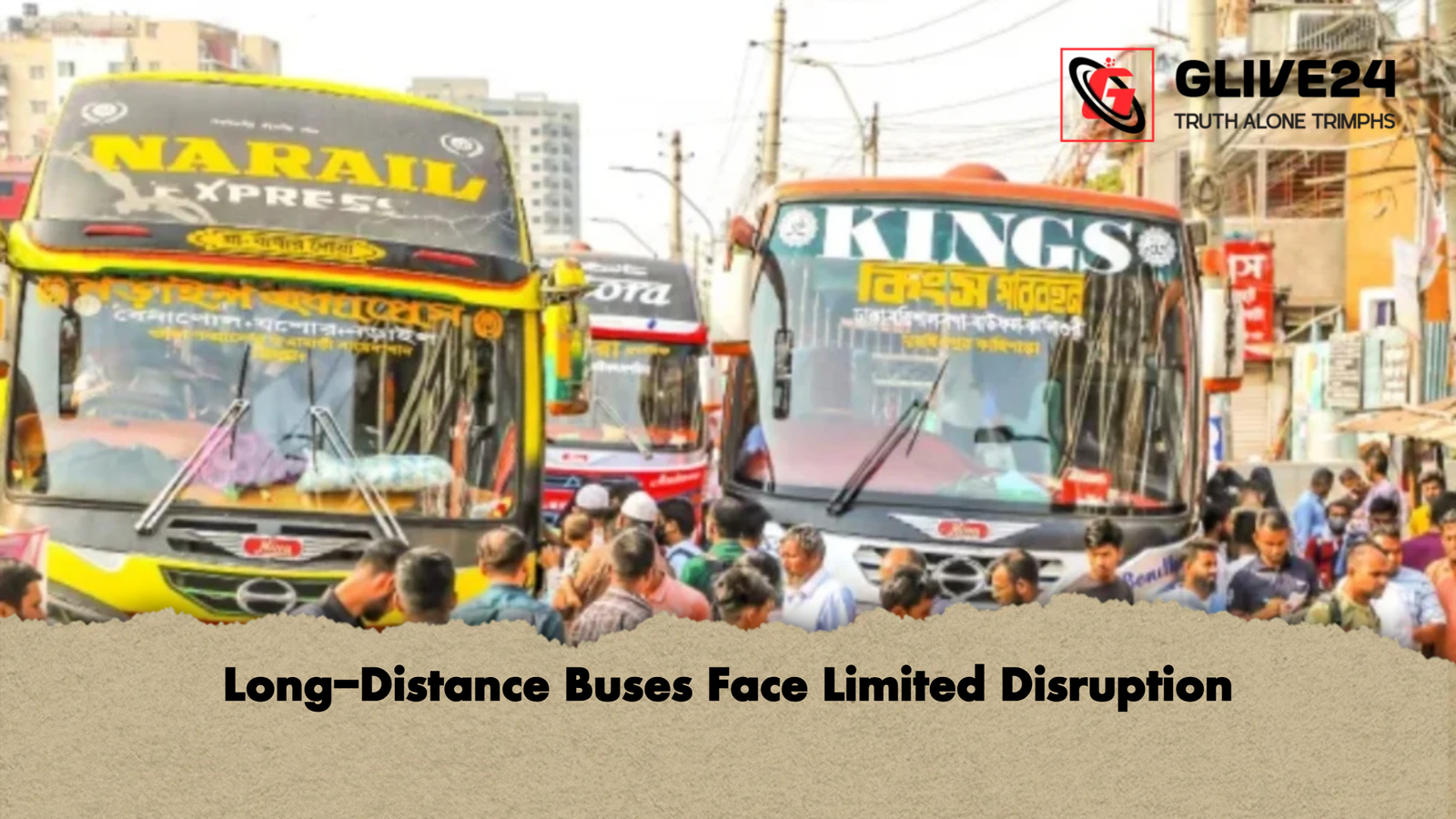
With the thirteenth National Parliamentary Election and a nationwide referendum scheduled for 12 February, authorities have imposed a series of temporary transport restrictions aimed at ensuring a peaceful and orderly voting process. Amid public uncertainty over travel arrangements, the Bus and Truck Owners’ Association has clarified that long-distance coach services will not be formally suspended during the election period, although operations may be limited on polling day itself.
According to the Election Commission’s directives, implemented through a recent gazette notification by the Ministry of Road Transport and Bridges, several categories of vehicles will face time-bound restrictions. These measures are being introduced under Section 32 of the Road Transport Act 2018 to safeguard public security and maintain discipline during the vote.
The Association’s President, Ramesh Chandra Ghosh, informed the media that long-distance buses will operate as usual on 11 February, the day preceding the election. However, on 12 February—the day of polling—most services may remain temporarily suspended due to staff shortages. “There is no official prohibition on bus operations,” he explained. “Nevertheless, many drivers and transport workers have applied for leave to exercise their voting rights. Services are expected to resume gradually on the evening of polling day, subject to the overall situation.”
The government’s notification specifies that taxis, pick-up vehicles, microbuses and trucks will be barred from operating for 24 hours, from midnight on 11 February until midnight on 12 February. Motorcycles will face a broader 72-hour restriction, beginning at midnight on 10 February and continuing until midnight on 13 February. These extended controls are intended to reduce the risk of disorder and unauthorised gatherings during the sensitive electoral period.
A summary of the transport restrictions is set out below:
| Vehicle Category | Restriction Period | Duration |
|---|---|---|
| Taxis (Cab Services) | 11 Feb, 12:00 am – 12 Feb, 12:00 am | 24 hours |
| Pick-up Vehicles | 11 Feb, 12:00 am – 12 Feb, 12:00 am | 24 hours |
| Microbuses | 11 Feb, 12:00 am – 12 Feb, 12:00 am | 24 hours |
| Trucks | 11 Feb, 12:00 am – 12 Feb, 12:00 am | 24 hours |
| Motorcycles | 10 Feb, 12:00 am – 13 Feb, 12:00 am | 72 hours |
| Long-Distance Buses | No formal ban; operations may be limited on 12 Feb | Not fixed |
Importantly, the notification allows exemptions for emergency services, election officials, law enforcement agencies, media personnel and vehicles engaged in essential public services. Long-distance passenger coaches and locally necessary transport may also operate under relaxed conditions, depending on operational feasibility and security considerations.
In addition to transport restrictions, authorities have announced the temporary closure of shops and shopping centres across the country on polling day. Such measures are customary during national elections, intended to encourage voter participation and minimise unnecessary movement.
Transport analysts observe that while the absence of a blanket ban on long-distance buses will ease travel concerns for many citizens, reduced service frequency on polling day is likely. Passengers are therefore advised to confirm departure schedules with operators in advance.
Overall, while strict controls will be in place for specific vehicle categories, long-distance bus travel will not be entirely halted, reflecting a balance between electoral security and public convenience.