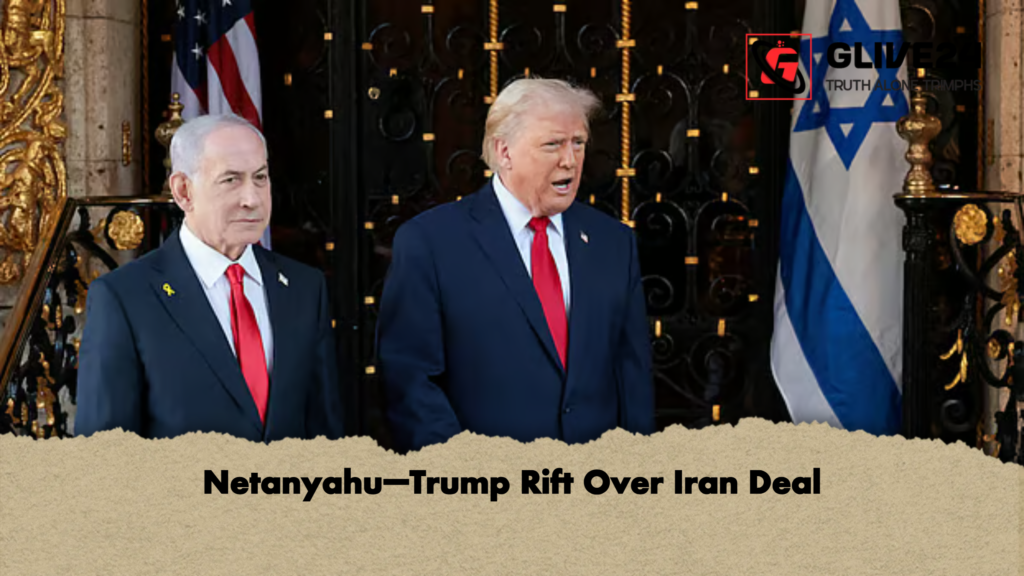
Israeli Prime Minister Benjamin Netanyahu had reportedly expected that a joint approach with US President Donald Trump toward Iran would significantly weaken Tehran’s clerical leadership and strengthen his own political position ahead of Israel’s upcoming elections. His broader objective was to position himself as the architect of a US–Israel strategic alignment capable of reshaping the political balance in the Middle East.
However, according to the developments described, none of these expectations have materialised. Instead, Netanyahu—Israel’s longest-serving prime minister—has found himself moving towards an open disagreement with Trump, as Washington seeks to distance itself from further escalation. This divergence has emerged even as both leaders appear not to have achieved their stated objectives, and as Israeli military activity in Lebanon is constrained by ceasefire-related diplomatic pressures.
Israeli officials, while publicly cautious to avoid straining relations with Washington, have expressed private frustration over the evolving arrangement with Iran. One senior official, speaking anonymously, described the preliminary US–Iran understanding as “terrible for Israel,” adding that there is no disagreement within Israel’s leadership—from the prime minister to the military chief—that the situation is deeply concerning.
Washington has indicated that during a 60-day ceasefire period, negotiations will take place to establish a comprehensive agreement addressing key issues, including Iran’s nuclear programme. Israeli officials, however, reportedly believe that this negotiating window may be extended to around 90 days, potentially limiting Israel’s ability to take military action while unresolved security concerns persist.
Tensions between Netanyahu and Trump have also been linked to differing approaches regarding Hezbollah in Lebanon. Israel has previously resisted limiting its military operations against the Iran-backed group, while ceasefire arrangements require de-escalation in the Lebanese theatre.
A reported phone call earlier in the month reflected these tensions, with Trump allegedly instructing Netanyahu not to carry out a strike in Beirut and describing him as “completely crazy,” according to the account provided. Although Israel initially paused planned operations, strikes in southern Beirut suburbs reportedly followed a week later, prompting retaliatory missile fire from Iran into Israel. Trump subsequently criticised both sides publicly, describing the exchanges as “small and meaningless.”
Key developments and timeline
| Event | Description |
|---|---|
| Early US–Iran talks | US signals intent to pursue a negotiated framework with Iran |
| 60-day ceasefire window | Period allocated for comprehensive negotiations |
| Possible extension | Israeli officials believe talks may extend to 90 days |
| Beirut strike dispute | Reported disagreement between Netanyahu and Trump over Israeli military action |
| Lebanon escalation | Israeli strikes followed by reported retaliatory missile fire |
| Public remarks | Trump criticises ongoing exchanges as “small and meaningless” |
Following the announcement of the US–Iran understanding, Israel reportedly conducted further strikes in Lebanon shortly after rockets were fired towards Israeli territory. The timing underscored the fragile security environment and competing strategic priorities between Washington and Jerusalem.
Netanyahu has publicly acknowledged occasional differences with Trump, stating that while cooperation is frequent, disagreements arise due to their respective national responsibilities. He emphasised that his primary obligation is Israel’s security interests.
Domestically, Netanyahu faces mounting political pressure ahead of national elections scheduled for October. Public opinion trends, including those cited by the Israel Democracy Institute, indicate declining confidence among Israeli Jews in the United States’ commitment to Israel’s security under the current US leadership.
Bar-Ilan University political scientist Jonathan Rynhold has assessed that Netanyahu’s political advantage, previously linked to close ties with Trump, is now harder to maintain in light of the evolving US–Iran negotiations. He suggested that Israel’s preferred outcome would be the failure of negotiations, potentially leading to a resumption of hostilities within the 60-day window.
Meanwhile, Israeli Energy Minister Eli Cohen has stated that Israel remains prepared to act independently if Iran rebuilds its nuclear and missile capabilities, though he assessed that such a scenario is less likely during Trump’s current term.