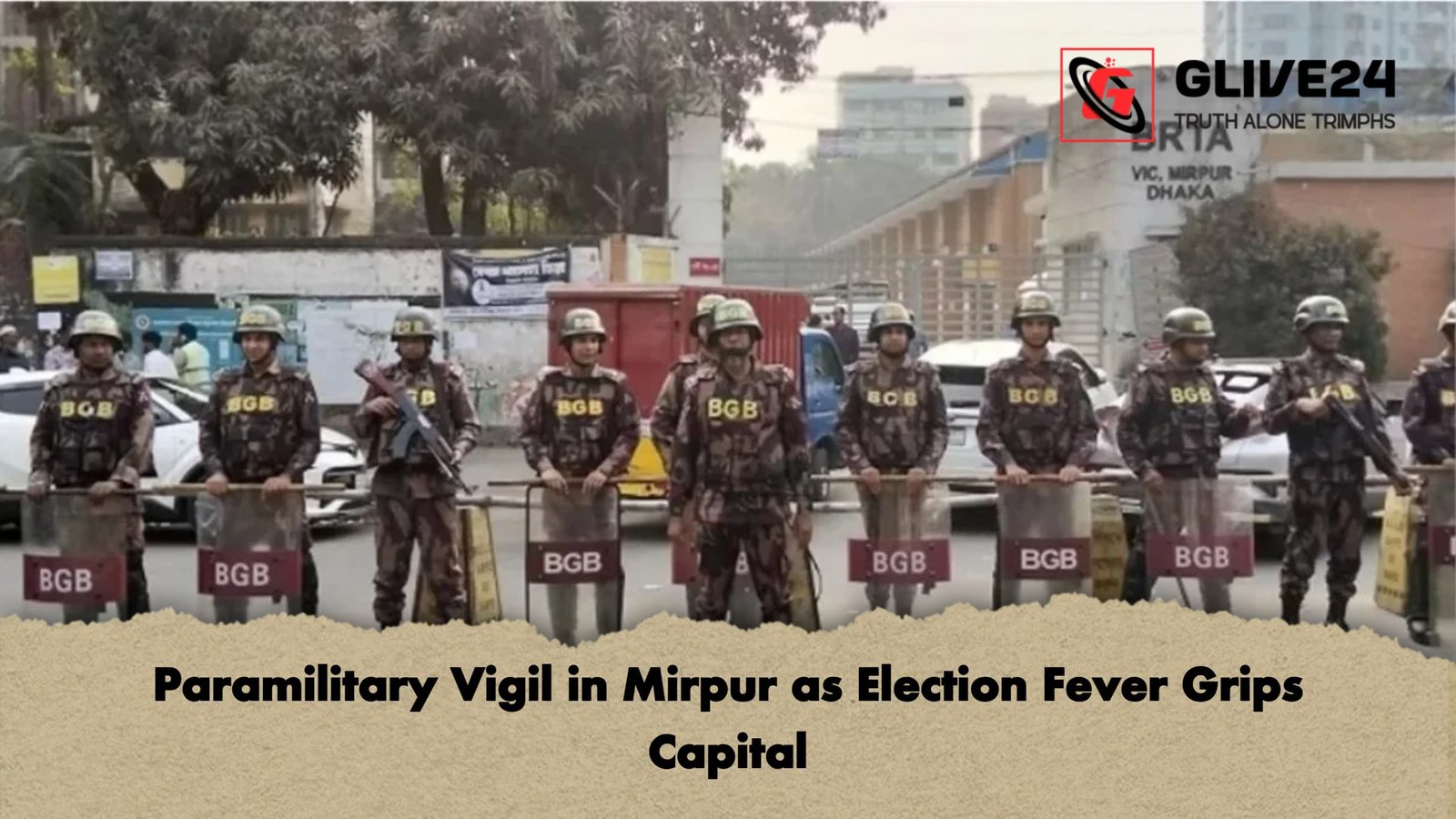
In a decisive move to maintain civic order, the Border Guard Bangladesh (BGB) has been deployed across the Mirpur area of Dhaka. The deployment, confirmed by paramilitary headquarters on the afternoon of Thursday, 22 January 2026, serves as a preventative measure to safeguard public peace during a period of intensifying political activity ahead of the 13th National Parliamentary Election.
Table of Contents
Securing the Mirpur Heartland
The catalyst for this heightened security presence was a significant public rally held at the Adarsha High School grounds in Mirpur-10. This event marked the official campaign launch for Dr Shafiqur Rahman, the Ameer of Bangladesh Jamaat-e-Islami and the heavyweight candidate for the 10-party alliance in the Dhaka-15 constituency.
Given the district’s status as a critical electoral battleground, BGB personnel have been tasked with patrolling strategic intersections and supporting local police in crowd management. The presence of the paramilitary force is intended to act as a “striking force,” ready to respond to any untoward incidents or partisan friction as rival supporters take to the streets.
Election Security: Deployment and Logistics (Dhaka Sector)
| Agency Involved | Personnel Strength (National) | Primary Local Task |
| BGB (Border Guard) | ~38,000 | Mobile patrols and “striking force” duties |
| Armed Forces (Army) | ~100,000 | Strategic support to civil administration |
| Police (DMP) | ~150,000 | Local law enforcement & traffic control |
| Ansar & VDP | ~576,000 | Static security at polling & rally sites |
| New Tech (Drones) | ~500 Units | Aerial surveillance of high-risk zones |
A High-Stakes Campaign Environment
The rally in Mirpur was more than a local gathering; it served as a platform for Dr Shafiqur Rahman to outline his vision for a “discrimination-free” Bangladesh. Addressing thousands of supporters, the Jamaat leader pledged to eliminate extortion (chandabazi) and ensure that justice is “never sold” under an alliance government. He also called on the youth, whom he described as the backbone of the July 2024 uprising, to defend their voting rights in the upcoming 12 February polls.
The BGB’s presence underscored the administrative challenge of managing such large-scale gatherings. For residents of Mirpur, the sight of uniformed patrols offered a reassuring layer of protection against the “muscle power” that has historically disrupted urban elections.
Modern Surveillance for 2026
This election cycle marks the first time the Bangladeshi government is employing high-tech surveillance on such a scale. Alongside the BGB, the administration has introduced 25,500 body-worn cameras for police and a fleet of 500 drones to monitor rallies and potential flashpoints. In Mirpur, these measures are being rigorously tested to ensure that the electoral process remains transparent and that any attempt at violence is documented and swiftly neutralised.
As the BGB maintains its vigil, the message from the interim government is clear: while the right to campaign is absolute, the sanctity of public safety is non-negotiable.