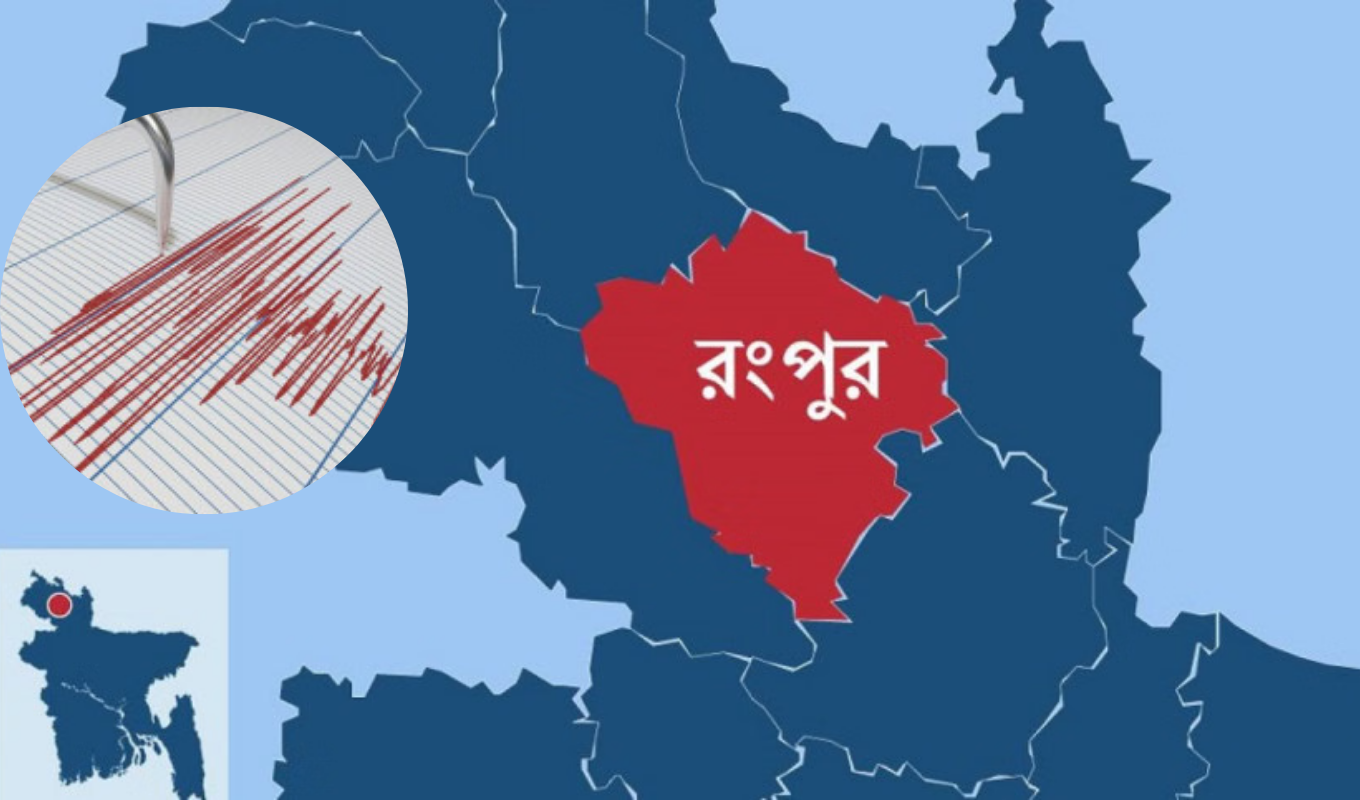
In the afternoon of 25 April 2016, an earthquake of magnitude 7.5 at the source shook the region for 25 to 30 seconds. Terrified, residents of Rangpur rushed out of homes, offices and shops to take refuge on roads and open grounds.
Earlier that same year, on 5 January, two tremors of magnitude 6.7 rattled Rangpur city at dawn. On 18 September 2011, at 6:41 pm, another tremor lasting about a minute and a quarter was felt, measuring 6.8 on the Richter scale.
Most recently, on Friday (21 November), the epicentre of an earthquake was located in Ghorashal of Narsingdi, Bangladesh—something experts view as concerning for the quake-prone Rangpur region.
Mostafizur Rahman, head of the Department of Geography and Environmental Science at Begum Rokeya University, Rangpur, told the media that Bangladesh is divided into three seismic zones, with Sylhet ranking first and Rangpur second. Its location between the Madhupur Fault and the Shillong Fault puts Rangpur at heightened risk.
He added that in the late 18th century, a massive earthquake of magnitude 8.5 struck ChilmarI in the Rangpur region, leading to the formation of the Jamuna River. Although the region has not been the epicentre of an earthquake for the past 21 years, if one originates here in the future, it is likely to exceed magnitude seven. A major reason behind earthquakes in this area is the alarming depletion of groundwater levels.
Sources say the Ministry of Disaster Management and Relief declared Rangpur a red zone 29 years ago. However, no significant initiatives have been taken since.
According to the Met Office, between August 2009 and 21 November 2025, the region experienced 185 earthquakes. In 2007, 25 quakes were recorded and in 2008, 40. In August 2009, there were five tremors and three more in September. Two quakes occurred in September 2010. Rangpur recorded 74 tremors in 2020—35 of magnitude 3 to 4, 33 of magnitude 4 to 5 and six of magnitude 5 to 6.
On 6 April 2021, a mild earthquake of magnitude 5.1 lasting three seconds was felt in Rangpur and nearby districts at 9:20 pm; the epicentre was Chamkhi in Bhutan. On 23 February 2025, tremors measuring 2.9 in Badarganj of Rangpur and 2.4 in Bhurungamari of Kurigram were recorded.
Despite the red zone designation, no significant earthquake-preparedness measures have been implemented. Instead, numerous high-rise buildings continue to be constructed without adhering to building codes, and activities continue in many abandoned government structures.
In 2016, Rangpur City Corporation listed 47 government structures as abandoned, including the offices of the Deputy Commissioner, Superintendent of Police, Treasury Building, and the old Circuit House. Most of these buildings are being used after temporary repairs.
Sources further revealed that in 2020, a three-day meeting was held at Rangpur Cantonment, led by the army, to formulate a preparedness plan for earthquake damage and emergency response. City officials, district administration, police, fire service and various government departments participated. Recommendations were submitted to higher authorities, but no progress has been reported.
Badsha Masud Alam, acting deputy director of Rangpur Fire Service and Civil Defence, told the media that the region is at risk due to its proximity to the Himalayas. He warned that tremors exceeding magnitude 6 could cause major disasters. He also noted shortages of essential equipment but added that awareness campaigns are ongoing to prepare citizens for earthquakes and other natural disasters.
SS