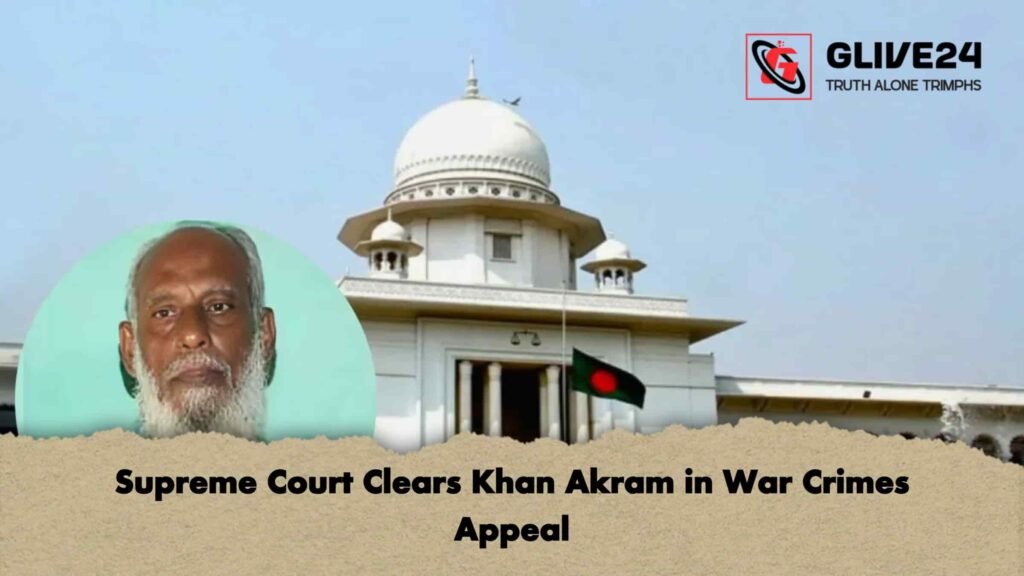
The Supreme Court has acquitted Khan Akram Hossain, a prominent figure from Bagerhat, of charges relating to crimes against humanity allegedly committed during the 1971 War of Independence. The judgement was delivered on Thursday, 26 February, by the Appellate Division led by Chief Justice Zubayer Rahman Chowdhury. The state was represented by Chief Prosecutor Mohammad Aminul Islam.
The case originated in 2015 before the International Crimes Tribunal-1 in Bagerhat, a court established to adjudicate allegations of atrocities committed during the Liberation War. The tribunal delivered its initial verdict on 11 August 2015. In that ruling, Sheikh Sirajul Haque, widely known as Siraj Master, was convicted on five of six charges and sentenced to death. In the same proceedings, Khan Akram Hossain was found guilty on one of three charges and sentenced to life imprisonment. A third accused, Abdul Latif Talukdar, died during the trial, and the charges against him were subsequently withdrawn.
Upon appeal, the Supreme Court reviewed the evidentiary record and legal arguments presented by both prosecution and defence. The Appellate Division upheld the death sentence imposed on Sheikh Sirajul Haque, affirming his conviction on five counts. However, it overturned the conviction of Khan Akram Hossain, ruling that the prosecution had failed to meet the requisite standard of proof on the charge for which he had been convicted. As a result, he was acquitted.
The principal details of the case are summarised below:
| Name of Accused | Total Charges | Proven Charges | Initial Verdict | Appellate Verdict |
|---|---|---|---|---|
| Sheikh Sirajul Haque (Siraj Master) | 6 | 5 | Death sentence | Upheld |
| Khan Akram Hossain | 3 | 1 | Life imprisonment | Acquitted |
| Abdul Latif Talukdar | 1 | 0 | Trial pending | Withdrawn due to death |
Legal analysts have observed that the ruling underscores the complexity of prosecuting decades-old war crimes cases, particularly those involving events from 1971. The evidentiary challenges inherent in such proceedings, including reliance on witness testimony and historical documentation, demand meticulous judicial scrutiny.
The International Crimes Tribunal-1 has handled several high-profile cases concerning allegations of mass killings, torture, abductions, and other atrocities during the Liberation War. These trials remain among the most sensitive and closely watched in the country’s legal history.
The Supreme Court’s decision is widely regarded as a significant development in the continuing process of war crimes adjudication. While the confirmation of one death sentence demonstrates the court’s firmness where guilt is established beyond reasonable doubt, the acquittal of Khan Akram Hossain illustrates the judiciary’s commitment to due process and evidentiary standards.
Families of the accused have reportedly accepted the judgement, and legal experts suggest that the ruling may strengthen public confidence in the independence and procedural integrity of the judicial system. As the nation continues to confront the legacy of 1971, the case marks another pivotal chapter in its ongoing pursuit of accountability and justice.