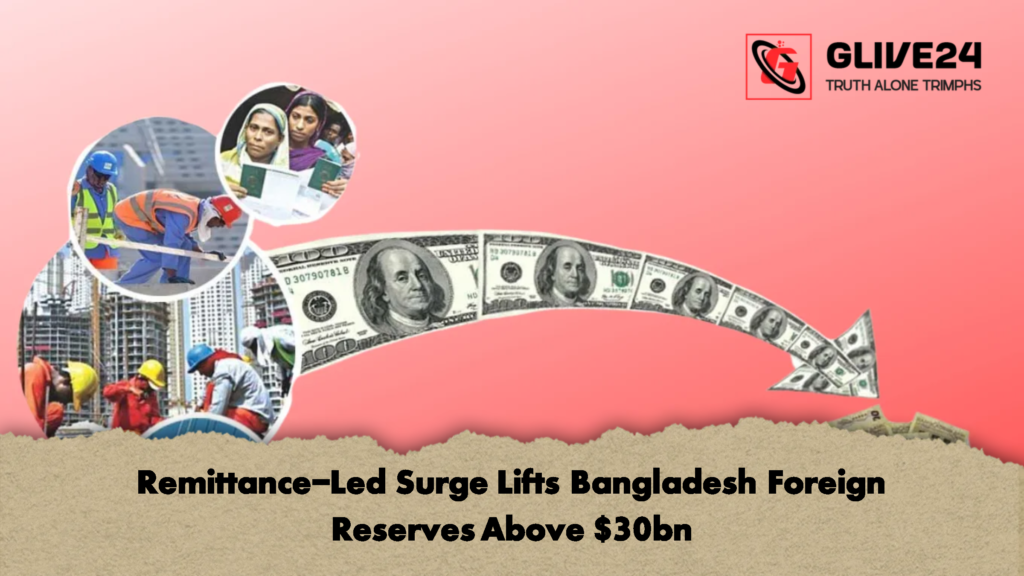
Bangladesh’s foreign exchange reserves have strengthened notably, supported by a sustained rise in remittance inflows from expatriate workers, offering renewed relief to the country’s external financial position.
According to data published by Bangladesh Bank, reserves calculated under the International Monetary Fund’s International Monetary Fund BPM6 methodology stood at $30.20 billion as of 15 April 2026. This marks a significant psychological milestone, as reserves have climbed back above the $30 billion level after an extended period below it. Gross foreign exchange reserves rose further to $34.87 billion, signalling broader stabilisation in external accounts.
Table of Contents
Remittances Emerge As Key Growth Engine
The latest improvement has been primarily driven by strong remittance inflows. In the first 14 days of April 2026 alone, expatriate Bangladeshis sent home $1.607 billion, reflecting a robust 25.2% increase compared with $1.284 billion during the same period a year earlier.
Momentum has remained strong throughout the month, with $171 million received in just two days (13–14 April), underscoring the consistency of foreign income flows through formal banking channels.
Over the broader 2025–26 fiscal year (July to 14 April), total remittances reached $27.816 billion, up from $23.069 billion in the same period of the previous fiscal year—representing a healthy 20.6% year-on-year growth.
Remittance Performance Overview
| Period | Remittance Inflow (USD) | Year-on-Year Change |
|---|---|---|
| 1–14 April 2026 | $1.607 billion | +25.2% |
| 1–14 April 2025 | $1.284 billion | — |
| July 2025 – 14 April 2026 | $27.816 billion | +20.6% |
| July 2024 – 14 April 2025 | $23.069 billion | — |
| March 2026 | $3.75 billion (record) | — |
Policy Support And Seasonal Boost
Economists attribute the sustained rise in remittances to a combination of policy interventions and seasonal factors. Stricter enforcement against informal money transfer channels such as hundi, alongside incentives encouraging the use of formal banking systems, has helped redirect flows into official channels.
Officials also point to relative stability in the foreign exchange market as a key factor restoring confidence among overseas workers. In addition, seasonal demand during Ramadan and Eid typically boosts remittance inflows, as expatriates send additional funds to support families and holiday spending.
External Sector Gains But Risks Remain
The rise in reserves provides welcome breathing space for Bangladesh’s external sector, which has been under pressure in recent years due to import costs and currency volatility. Higher reserves enhance the central bank’s capacity to stabilise the exchange rate, meet import obligations, and service external debt commitments.
However, analysts caution that the improvement remains heavily dependent on remittance performance. Structural vulnerabilities persist, including elevated import bills, external debt repayment obligations, and continued pressure on foreign exchange liquidity.
Economic Outlook: Stability With Conditions
While the current trend is encouraging, experts emphasise that long-term stability cannot rely solely on remittances. Expanding export earnings, attracting greater foreign direct investment, and diversifying service-sector income are considered essential to strengthening the external balance.
At present, remittances remain the backbone of Bangladesh’s external finances, easing dollar shortages and supporting essential economic activity. Yet economists warn that sustaining this progress will require policy consistency and broader structural reforms.
Reserve Position Snapshot
| Indicator | Amount |
|---|---|
| BPM6 Reserves | $30.20 billion |
| Gross Reserves | $34.87 billion |
In summary, Bangladesh’s return above the $30 billion reserves mark highlights a positive shift driven by strong remittance inflows. However, maintaining this stability will depend on whether current gains can be reinforced through deeper structural economic resilience in the months ahead.