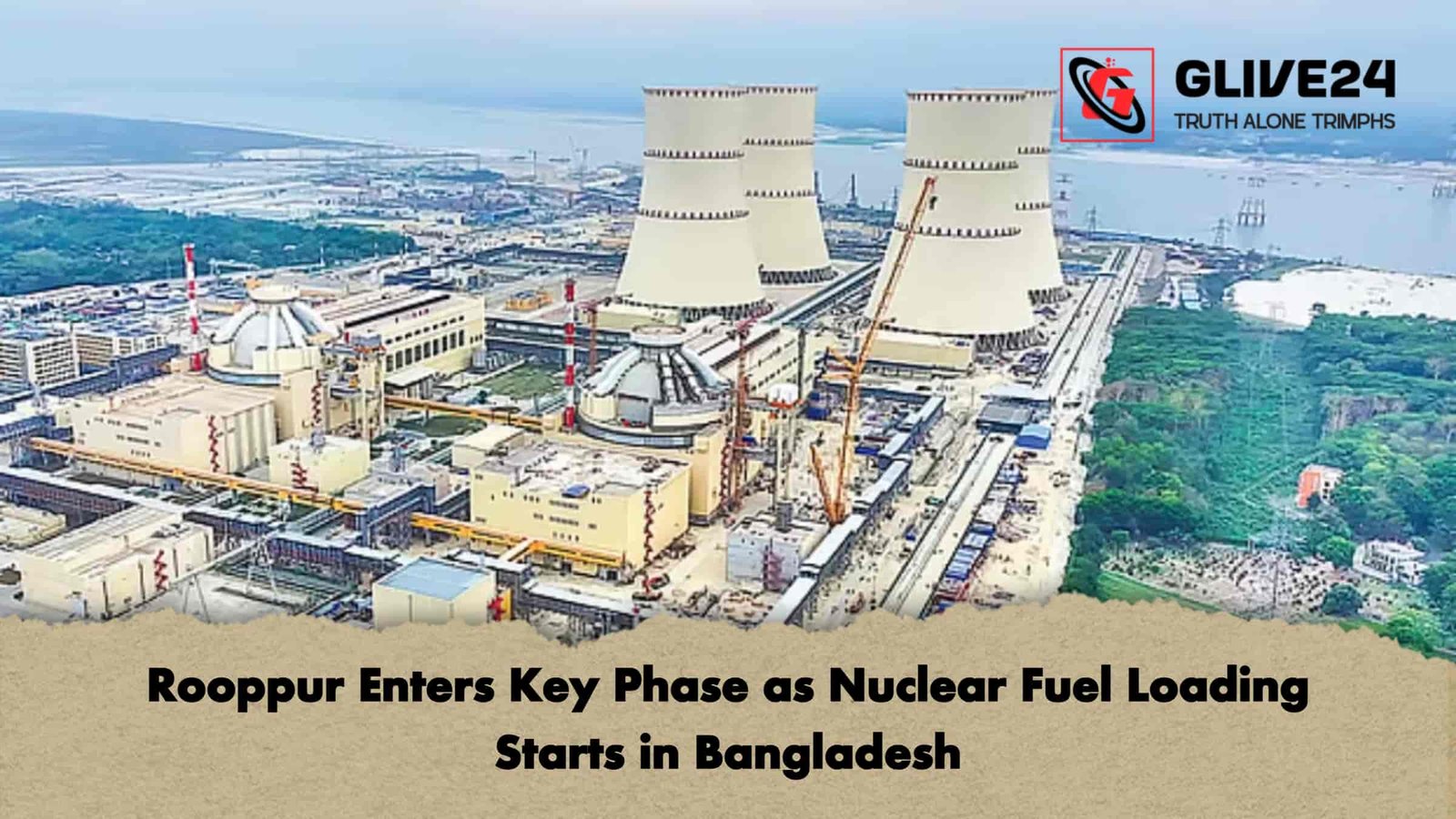
Bangladesh has officially begun the most critical stage of its nuclear energy programme with the commencement of uranium fuel loading at the Rooppur Nuclear Power Plant in Pabna on Tuesday. This milestone places the country among the world’s nuclear energy users, becoming the 33rd nation to utilise nuclear power for electricity generation.
The fuel loading into the reactor core represents the final preparatory stage before commercial operation. Once the uranium fuel assemblies are placed inside the reactor, a controlled nuclear fission process will generate heat. This heat will be used to produce steam, which drives turbines connected to generators, ultimately producing electricity for the national grid.
Officials from the Ministry of Science and Technology, Bangladesh confirmed that this step precedes phased commissioning and trial electricity production. Initial supply to the national grid is expected in August at an estimated capacity of 300 megawatts.
The Rooppur Nuclear Power Plant is being implemented by the Bangladesh Atomic Energy Commission with engineering and construction support from Russia’s Atomstroyexport, a subsidiary of Rosatom. The project consists of two units, each with a generating capacity of 1,200 megawatts.
The fuel loading ceremony is expected to be attended by Science and Technology Minister Fakir Mahbub Anam and Science and Technology Adviser to the Prime Minister Rehan Asif Asad. The Director General of International Atomic Energy Agency, Rafael Grossi, is scheduled to join virtually.
Each fuel assembly used in the reactor is composed of uranium oxide pellets formed into ceramic tablets. These pellets are inserted into metal tubes to create fuel rods, and multiple rods are assembled into a single fuel unit.
| Component | Specification |
|---|---|
| Reactor site | Rooppur, Pabna |
| Total capacity | 2,400 MW (2 × 1,200 MW) |
| Fuel assemblies (Unit 1) | 163 + 1 spare (164 total delivered) |
| Fuel rod count per assembly | 312 |
| Fuel cycle duration | Approx. 18 months |
The fuel was delivered to Bangladesh in several shipments, beginning in September 2023, and transported under strict security arrangements to Rooppur in October 2023, where it has since been stored.
The commissioning process will proceed in carefully controlled stages. Fuel loading is expected to take approximately 30 days. This will be followed by reactor testing and low-power physics experiments lasting around 34 days. Subsequently, reactor output will be gradually increased in phases—3%, 5%, 10%, 20%, and 30%—over an estimated 40-day period. Connection to the national grid is permitted once the 30% threshold is reached. Full-scale commercial operation is projected to take up to ten months from the start of fuel loading.
Once fully operational, the plant is expected to contribute between 10% and 12% of Bangladesh’s electricity demand, according to government estimates.
The idea of nuclear power in Bangladesh dates back to 1961, although early plans were suspended. After independence, the initiative was revived and incorporated into the national energy framework in 1995. A major breakthrough occurred in 2011 when Bangladesh signed an intergovernmental agreement with the Russian Federation, followed by a general contract in 2015 covering construction, equipment supply, commissioning, training, and initial fuel supply.
The total project cost has risen to approximately 1,38,686 crore Bangladeshi taka, with around 26,000 crore taka of additional expenditure attributed mainly to currency fluctuations and global disruptions. Despite delays, officials maintain that no further cost escalation has been included in contract revisions.
Project timelines have also shifted. Originally scheduled for completion in 2023–2024, the first unit is now expected to reach completion by the end of 2026, with the second unit following in 2027. Full project completion has been extended further, reflecting adjustments in commissioning schedules and global supply chain constraints.
Government officials argue that once operational, Rooppur will provide long-term, low-carbon electricity and significantly reduce dependence on imported fossil fuels. The project also represents a major step in developing domestic nuclear expertise and infrastructure capacity.
> Three Policemen Sentenced to Death over July Uprising Murders
> Three Arrested Over Student League Flash Protest in Purbadhala
> Son Accused of Killing Father Over Room Dispute
> Neymar Unlikely to Start for Brazil in Crucial Japan Clash
> Journalist Assault Alleged in Kalapara Over Report Publication
> Who Is the Rome Family Murder Suspect?
> Bangladesh Currency Rates Show Mixed Stability Today
> Proposal to Suspend 500 and 1000 Taka Notes
> Messi Leads World Cup Golden Boot Race After Jordan Masterclass
> Iran launches new strikes against Kurdish groups in Iraq
> Club Goal Rankings in World Cup History
> Anupam Roy Live Concert Announced Dhaka
> Footballer’s Family Missing After Venezuela Quake
> Oxford Authorities Contradict Claims by Hasnat, Sadik
> Two Arrested With Tapentadol
> The Psychology and Philosophy of Unwarranted Defamation
> Simrin Lubaba Begins New Life After Marriage Shift

সম্পাদক ও প্রকাশক: এ বি এম জাকিরুল হক টিটন
যোগাযোগের ঠিকানাঃ পশ্চিম কাফরুল, বেগম রোকেয়া সরণি, ঢাকা
© Copyright 2026 Khaborwala। All Rights Reserved



Comments