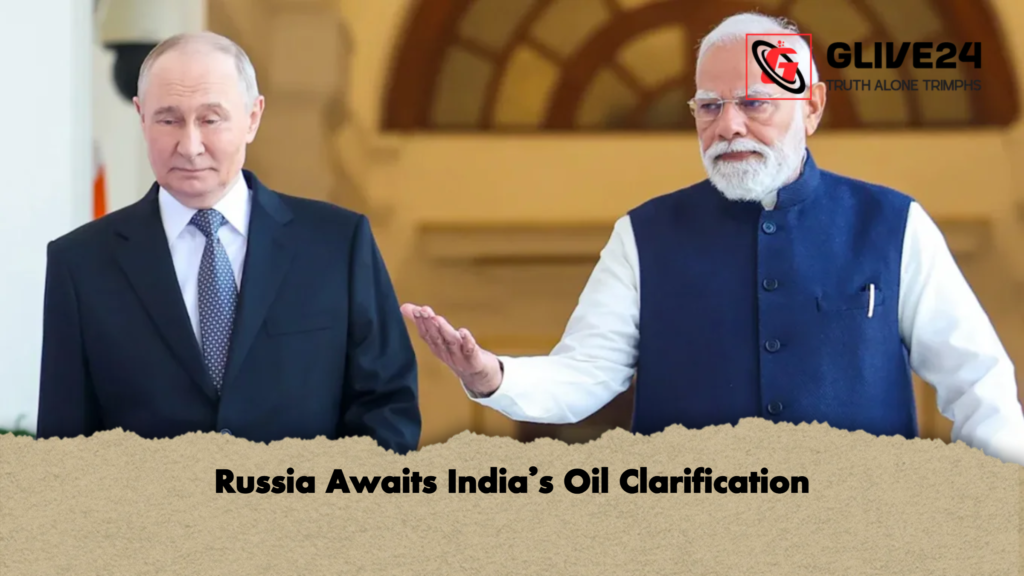
Russia has said it has received no formal notification from India regarding any decision to halt purchases of Russian oil, despite claims by United States President Donald Trump that such a move forms part of a newly announced bilateral trade agreement between Washington and New Delhi. The statement from Moscow has added a note of caution and ambiguity to what could otherwise be interpreted as a major shift in global energy and geopolitical alignments.
President Trump announced on Tuesday that the United States and India had reached a trade understanding under which India would stop importing oil from Russia. In return, according to Trump, tariffs on Indian goods entering the US market would be reduced to 18 per cent. He further claimed that India had agreed to source its oil instead from the United States and, potentially, Venezuela. The announcement was made on Trump’s social media platform, where he presented the agreement as a step that could help bring an end to the ongoing war in Ukraine by reducing Russia’s oil revenues.
However, the Kremlin quickly sought to distance itself from these claims. Speaking on Tuesday, 3 February, Kremlin spokesperson Dmitry Peskov said Russia had not received any official statement or communication from New Delhi confirming such a policy change. “We have not heard any formal declaration from the Indian side on this matter,” Peskov said. While emphasising that Moscow respects the bilateral relationship between India and the United States, he stressed that Russia attaches great importance to its own “advanced strategic partnership” with India. “Developing our bilateral relations with Delhi remains a priority for us,” he added.
The lack of an official Indian position has left analysts questioning whether Trump’s announcement reflects a binding agreement, a political signal, or an aspirational statement rather than an immediate policy shift. India has, in recent years, significantly increased its imports of discounted Russian crude oil, particularly after Western sanctions reshaped global energy flows. At the same time, India has sought to maintain a careful balance between deepening economic and strategic ties with the United States and preserving long-standing relations with Russia.
Minutes after Trump’s announcement, the Indian Prime Minister issued a social media statement congratulating the US president, offering greetings on behalf of India’s 1.4 billion people. Notably, the message made no explicit reference to oil imports, Russia, or changes to India’s energy sourcing strategy. This silence has been interpreted by many observers as a deliberate attempt to avoid prematurely confirming or denying a sensitive issue with far-reaching diplomatic consequences.
India’s energy policy has traditionally focused on diversification of supply to ensure energy security and price stability. While Russian oil has accounted for a growing share of India’s imports, New Delhi continues to purchase crude from the Middle East, the United States, and other regions. Any abrupt move away from Russian oil would have economic, logistical, and geopolitical implications.
To place the issue in context, the table below outlines a broad, indicative picture of India’s crude oil import sources in recent years, based on publicly available data and industry estimates:
| Source Region/Country | Approximate Share of Imports | Key Notes |
|---|---|---|
| Russia | 30–35% | Increased sharply due to discounted prices |
| Middle East | 40–45% | Long-standing primary suppliers |
| United States | 5–7% | Gradually rising share |
| Other regions | 10–15% | Part of diversification strategy |
Until India issues a clear and formal statement, Russia’s position remains one of cautious waiting. The episode underlines the complex interplay between trade, energy security, and geopolitics, where public announcements can sometimes run ahead of diplomatic reality.