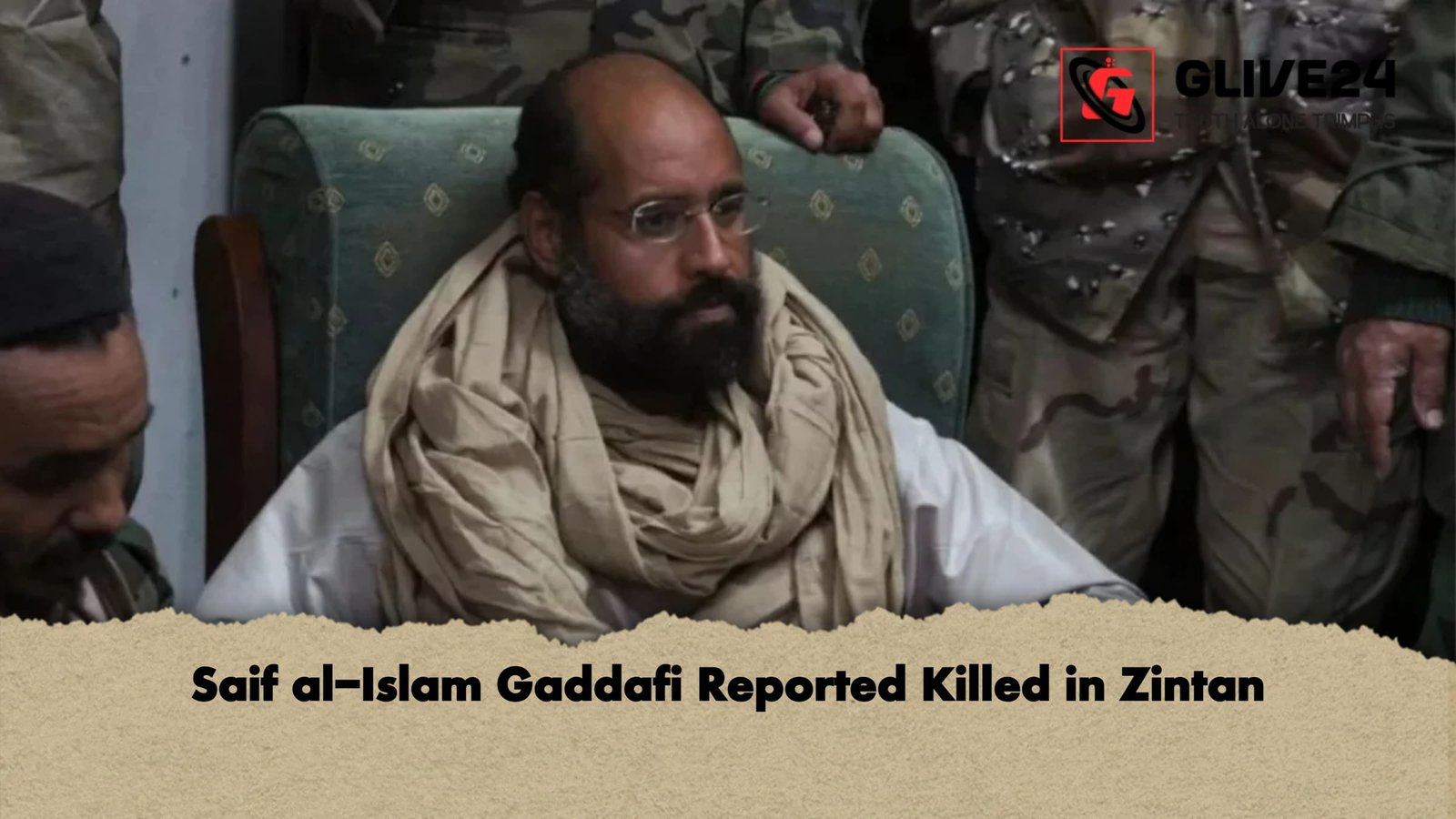
In a development that threatens to further destabilise the precarious political landscape of North Africa, Saif al-Islam Gaddafi, the preferred successor and most prominent son of the late Libyan dictator Muammar Gaddafi, has been killed. Reports emerging from Libya on Tuesday indicate that the 53-year-old was shot dead in the western mountain city of Zintan, where he had lived under a shroud of both protection and house arrest for over a decade.
The Circumstances of the Assassination
Ahmed Khalifa, a correspondent for Al Jazeera reporting from the region, stated that the incident occurred in the early hours of Tuesday. While the specific details regarding the perpetrators remain obscured by the fog of Libya’s fractured security apparatus, the death was officially confirmed by Saif al-Islam’s senior political advisor, Abdullah Osman.
As of Tuesday evening, the Tripoli-based Government of National Unity (GNU) has maintained a conspicuous silence, neither confirming nor denying the reports. The lack of an official statement has fueled speculation regarding whether the killing was the result of a targeted assassination by rival militias or a breakdown in the local security arrangements that had guarded him since his release from formal imprisonment in 2017.
From Reformer to Fugitive: A Profile
Saif al-Islam was long regarded as the “westernised face” of the Gaddafi regime. Educated at the London School of Economics (LSE), where he earned a PhD in 2008, he initially positioned himself as a reformer capable of mending Libya’s fractured relationship with the international community.
| Key Milestone | Year | Significance |
| LSE Doctorate | 2008 | Cemented his image as a pro-Western intellectual and reformer. |
| Lippa Uprising | 2011 | Shifted from reformist rhetoric to a hardline defence of his father’s rule. |
| Capture in Zintan | 2011 | Apprehended by rebels while attempting to flee to Niger. |
| Amnesty & Release | 2017 | Released by the Abu Bakr al-Siddiq Battalion under a general amnesty law. |
| Presidential Bid | 2021 | Attempted to run for the presidency, highlighting his enduring influence. |
A Legacy of Conflict and Contradiction
Despite his academic credentials and efforts to lead the “Gaddafi Foundation for Development,” Saif’s legacy was permanently stained during the 2011 Arab Spring. He infamously traded his tailored suits for combat fatigues, appearing on television to warn of “rivers of blood” if the uprising continued. Following the brutal lynching of his father in October 2011, Saif was captured by Zintani fighters and later sentenced to death in absentia by a court in Tripoli—a sentence that was never carried out due to the refusal of his Zintani captors to hand him over.
His death marks the end of the Gaddafi dynasty’s political aspirations. Despite his controversial past, many loyalists viewed him as a potential unifying figure in a country currently split between rival administrations. His removal from the board leaves a significant power vacuum among the tribes of central and southern Libya who still remained loyal to the Green Flag.