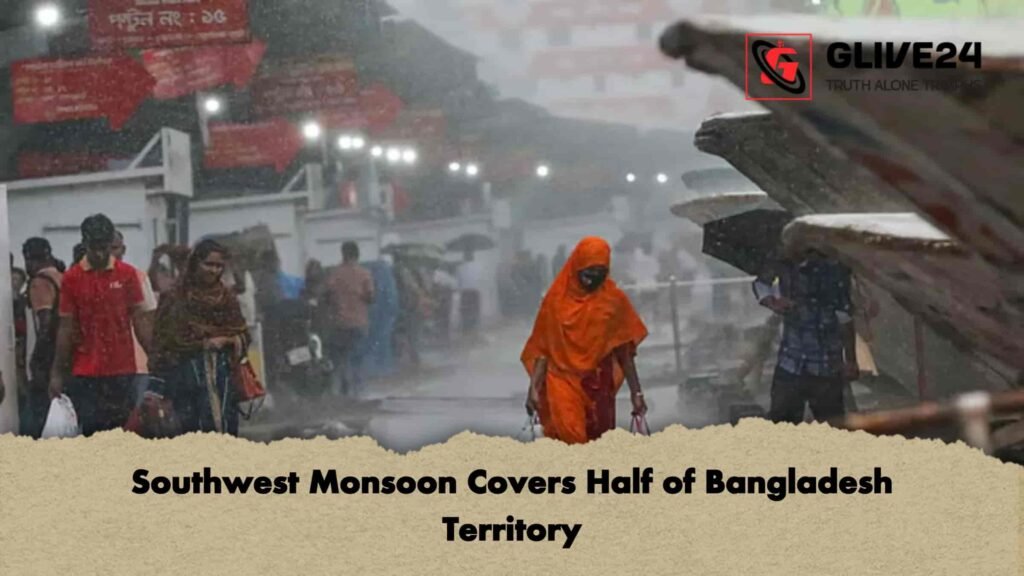
The seasonal southwest monsoon has advanced across approximately half of Bangladesh, introducing widespread rainfall across five administrative divisions. Despite this progression, the monsoon has yet to exhibit its typical full-strength pattern due to the prevailing influence of a western low-pressure system counteracting the moisture-laden winds.
The Bangladesh Meteorological Department (BMD) has forecast continued precipitation on Wednesday, including a high probability of afternoon showers in the capital city, Dhaka.
Meteorological Analysis and Divisional Forecasts
According to BMD meteorologist Md. Omar Faruq, rain or thundershowers are expected to manifest across various areas within the following five divisions:
-
Rajshahi
-
Mymensingh
-
Sylhet
-
Chattogram
-
Rangpur
Forecasters anticipate a marginal increase in total rainfall volume on Wednesday compared to the preceding 24 hours, an shift that is expected to trigger a subsequent nationwide reduction in ambient temperatures.
Temperature Fluctuations and Thermal Thresholds
On Tuesday, the highest maximum temperature across the country was recorded in the Jashore district at 37.2°C. According to standard meteorological metrics in Bangladesh, a temperature range between 36.0°C and 37.9°C is officially classified as a mild-to-moderate heatwave.
Aside from Jashore, no other region in the country breached the 36.0°C threshold on Tuesday, indicating an absence of heatwave conditions across the remainder of the territory.
In Dhaka, the maximum temperature on Tuesday reached 34.3°C, marking a 1°C decrease compared to the day prior. Meteorologists project that temperatures in the capital will remain within a tolerable range on Wednesday, with localized downpours expected to develop after midday.
Monsoonal Delays and Changing Precipitation Anomalies
The onset of the southwest monsoon occurred approximately one week later than its climatological normal baseline this year. However, it has successfully established its presence over the Chattogram, Mymensingh, Sylhet, Khulna, and Barishal divisions, effectively encompassing half of the nation’s geographic area.
While monsoonal winds historically account for more than 80 per cent of Bangladesh’s total annual rainfall, the BMD’s long-range seasonal outlook suggests that total precipitation during this current monsoon cycle may fall below historical averages.
This projected deficit stands in contrast to the anomalously wet conditions observed during the transition months of April and May. Specifically, April recorded an exceptional surge in precipitation, exceeding normal monthly baselines by more than 75 per cent.
National Weather and Temperature Metrics
The recorded temperature parameters, regional heat thresholds, and historical anomalies across Bangladesh are detailed in the table below:
| Meteorological Metric | Recorded Value / Standard Baseline |
| National Maximum Temperature (Tuesday) | 37.2°C (Recorded in Jashore) |
| Dhaka Maximum Temperature (Tuesday) | 34.3°C (1°C decrease from prior day) |
| Mild-to-Moderate Heatwave Threshold | 36.0°C to 37.9°C |
| April 2026 Precipitation Anomaly | Greater than 75% above normal baseline |
| Monsoon Rainfall Contribution | Greater than 80% of annual national volume |
| Monsoon Geographic Coverage | Approximately 50% of total territory |