
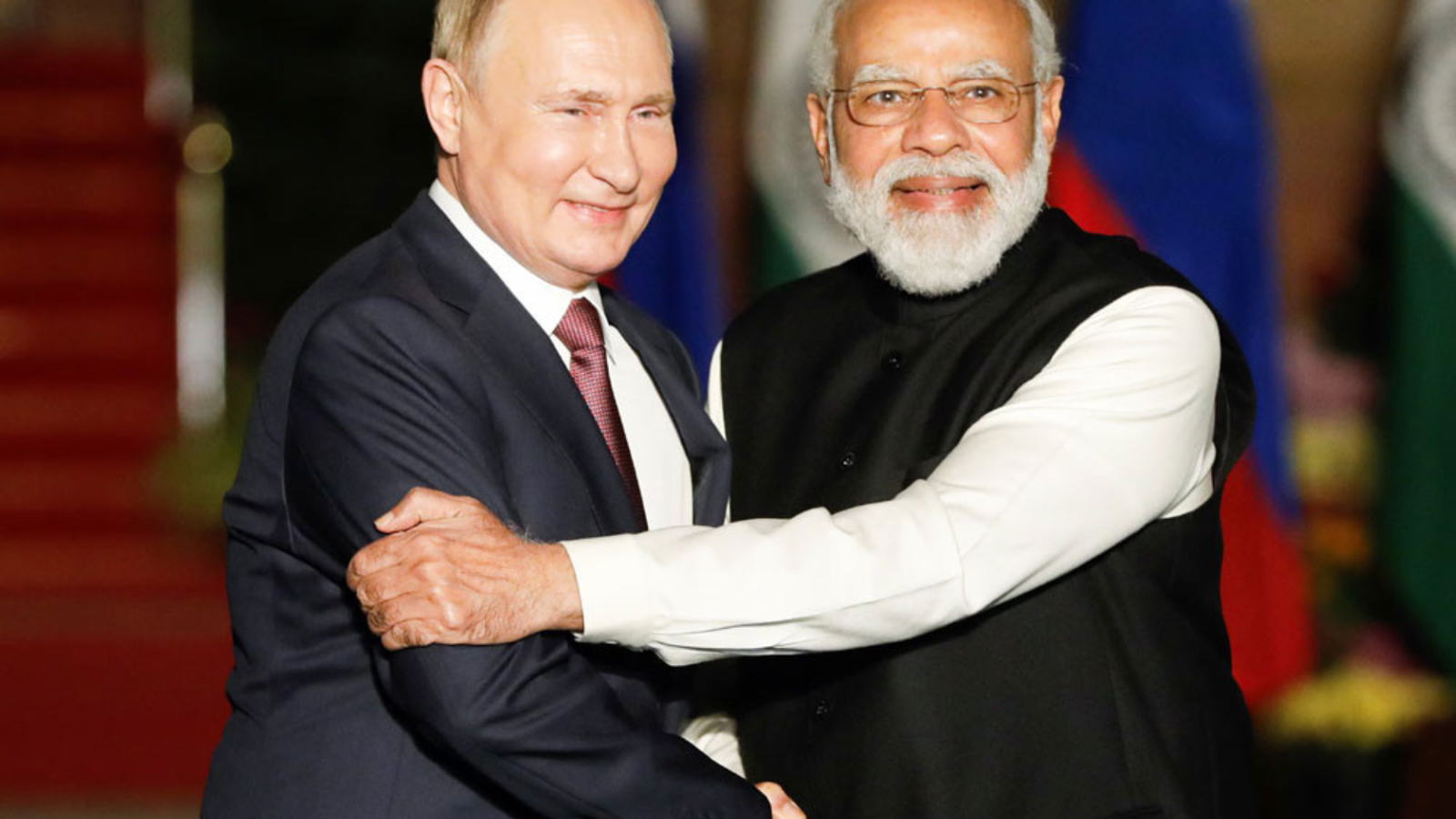
Russian President Vladimir Putin arrived in New Delhi on Thursday to participate in the 23rd India-Russia Annual Summit, responding to an official invitation from Indian Prime Minister Narendra Modi. The visit follows a significant endorsement from the Russian Parliament, which approved a broad military cooperation agreement with India prior to Putin’s departure.
The newly ratified pact allows the armed forces of both nations to provide logistical support to each other, granting access to military infrastructure abroad. It also encompasses joint exercises, personnel training, humanitarian missions, and disaster relief operations, signalling a deepening of strategic ties between the two countries.
Russia’s First Deputy Prime Minister, Denis Manturov, told ANI that military collaboration with India is “strategic and multifaceted,” extending into technical and industrial domains. Manturov emphasised that over 30 per cent of India’s defence equipment continues to be supplied by Moscow, underlining the enduring interdependence in military procurement.
According to Reuters, discussions during Putin’s visit are expected to cover the potential supply of Su-57 fighter jets, S-400 air defence systems, and upgraded BrahMos cruise missiles. Russian Presidential spokesperson Dmitry Peskov stressed that the scope of cooperation will be contingent on India’s willingness, highlighting the importance of maintaining bilateral relations free from external interference. Peskov further noted that Russia is prepared to mirror India’s level of engagement in all strategic endeavours.
Geopolitical analyst Velina Chakareva observed that Russia’s message is clear: there are no predefined limits on strategic military cooperation with India, though progress ultimately depends on Indian acceptance. Conversely, Sriram Chaulia, Dean of the Jindal School of International Affairs, suggested that Russian expectations may not be fully realised. Chaulia argued that India, reliant on the United States for technological and economic development, is unlikely to join any China-Russia-led anti-US alignment.
Key Features of India-Russia Military Agreement
| Feature | Details |
|---|---|
| Logistical Support | Reciprocal access to military bases and infrastructure |
| Joint Exercises | Combined training exercises across land, air, and sea |
| Personnel Training | Exchange programs for skill and tactical development |
| Humanitarian Assistance | Collaborative disaster response and aid missions |
| Technical Collaboration | Defence production and modernisation projects |
| Major Equipment | Su-57 fighter jets, S-400 systems, BrahMos missiles (under discussion) |
The summit underscores a strategic recalibration, balancing India’s long-standing partnership with Russia against its contemporary security and economic needs involving the United States. Analysts view the engagement as a demonstration of Russia’s intent to strengthen defence ties while respecting India’s independent foreign policy trajectory.