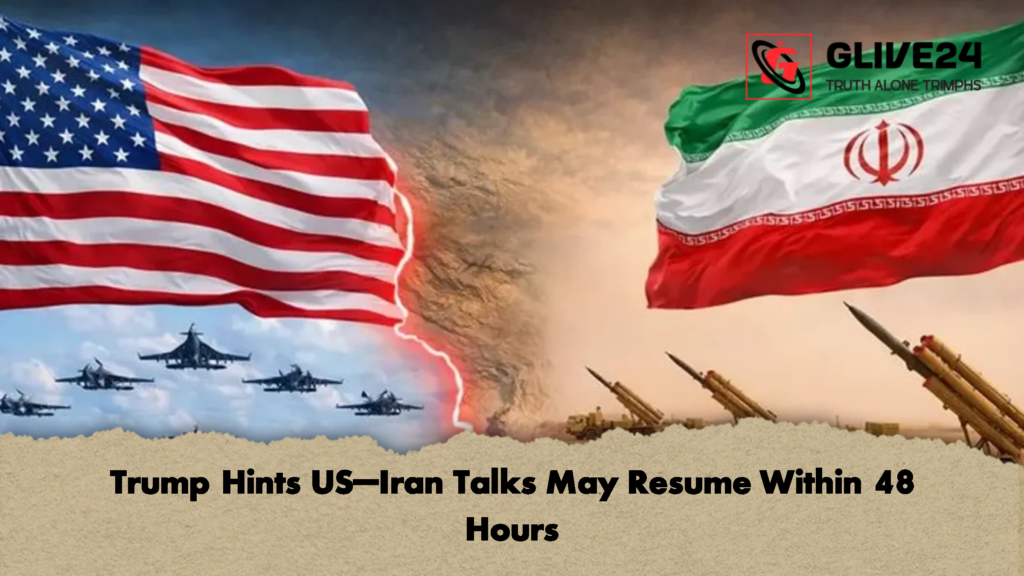
US President Donald Trump has suggested that renewed diplomatic engagement between the United States and Iran could take place within the next 48 hours, raising cautious expectations of movement in one of the world’s most volatile geopolitical standoffs.
Speaking in an interview with The New York Post, Trump said that “major progress” could be achievable within a short timeframe, adding that there is increasing interest in re-establishing Pakistan as a potential venue for indirect or facilitated discussions between Washington and Tehran.
The remarks come against the backdrop of heightened regional instability, following the collapse of earlier high-level negotiations held in Islamabad, which ended without any meaningful agreement or joint framework for further dialogue.
Table of Contents
Breakdown of Islamabad Negotiations
The previous round of talks in Islamabad reportedly brought together senior figures from both sides in an attempt to ease long-standing tensions. Among the participants were US Vice President JD Vance and Iranian Parliament Speaker Mohammad Bagher Ghalibaf, alongside other diplomatic and advisory delegations.
Despite initial optimism surrounding the meeting, discussions ultimately ended in deadlock. Both Washington and Tehran subsequently accused each other of inflexibility and poor faith engagement, further deepening mistrust at a critical diplomatic moment.
The failure of these talks has since contributed to renewed international concern over the trajectory of US–Iran relations, particularly given the already fragile security environment across the Middle East, where maritime security, energy flows, and proxy tensions remain highly sensitive.
Trump’s Renewed Diplomatic Signal
Trump’s latest remarks represent a notable shift towards cautious diplomatic optimism, though no formal negotiating framework has been announced. His reference to a 48-hour window has not been substantiated by official statements from either government.
Neither the US State Department nor Iranian foreign policy authorities have confirmed any scheduled resumption of talks, and diplomatic channels remain, at this stage, unofficial and unverified.
A summary of the current reported diplomatic landscape is set out below:
| Issue | Current Status |
|---|---|
| Previous talks (Islamabad) | Concluded without agreement |
| Proposed new negotiations | Possible within 48 hours (unconfirmed) |
| Suggested mediation venue | Pakistan (under consideration, unconfirmed) |
| US position | Publicly open to renewed engagement |
| Iranian position | No formal confirmation of participation |
| Diplomatic framework | Not yet established |
Iran’s Measured Response
Iranian state media reports indicate that while communication channels between Tehran and Islamabad remain active on broader regional matters, there is no confirmed agreement with the United States regarding a new round of negotiations.
Officials in Tehran have not endorsed Trump’s proposed timeline, and Iranian diplomatic sources are reported to be insisting on clearer guarantees, structured mediation mechanisms, and assurances regarding the scope and continuity of any future dialogue.
This cautious stance reflects longstanding Iranian concerns about the durability of US commitments in previous negotiation cycles, where diplomatic momentum has often stalled or reversed following initial engagement.
Escalation After Diplomatic Breakdown
The collapse of the Islamabad talks has already contributed to increased geopolitical friction. In the aftermath of the breakdown, Trump reportedly signalled tougher measures concerning the Strait of Hormuz, one of the world’s most strategically important maritime chokepoints through which a significant portion of global oil shipments pass.
Iranian officials, in turn, issued warnings suggesting possible retaliation should US actions be perceived as escalatory or threatening to regional shipping security. This exchange has further heightened fears of a broader confrontation, particularly in a region already marked by overlapping security crises.
Strategic Importance of Pakistan’s Role
Pakistan’s repeated emergence as a potential intermediary reflects its evolving diplomatic positioning in complex international disputes. While Islamabad has not formally confirmed any new mediation effort linked to Trump’s remarks, its earlier hosting of talks underscores its perceived utility as a neutral or facilitating venue for indirect dialogue.
Analysts suggest that such third-party mediation remains one of the few viable channels for communication between Washington and Tehran, given the absence of formal diplomatic relations and persistent mistrust between the two governments.
Uncertain Diplomatic Horizon
Despite the attention generated by Trump’s comments, significant uncertainty remains over whether any substantive negotiations will actually materialise within the suggested timeframe. The absence of official confirmation from Tehran, combined with the lack of a publicly defined agenda, leaves the situation fluid and unresolved.
For now, global observers continue to monitor developments closely, as the coming days may determine whether diplomatic re-engagement becomes possible—or whether tensions continue to escalate in an already fragile regional landscape.