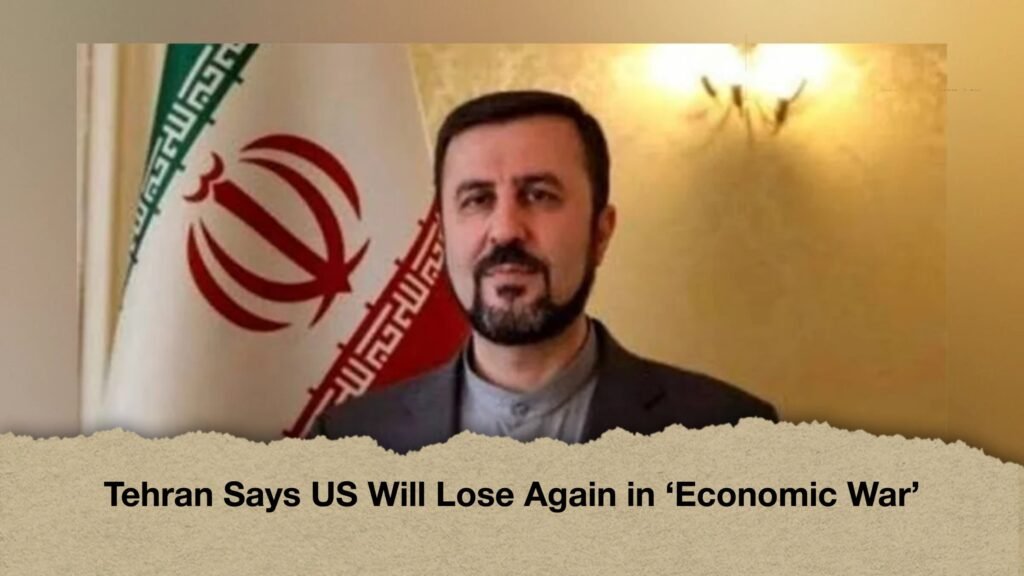
Iran has dismissed the United States’ latest threat of tougher economic measures, arguing that Washington’s repeated policy calculations are producing greater failures rather than achieving its intended objectives.
A senior Iranian diplomat has sharply criticised the new US approach, suggesting that economic pressure will prove no more successful than previous attempts to force Tehran to change its policies. The remarks reflect Iran’s continued rejection of Washington’s strategy of using sanctions and economic restrictions as a means of exerting political pressure.
According to international media reports on Thursday, 20 August, Iran’s Deputy Foreign Minister for International and Legal Affairs, Kazem Gharibabadi, made the comments in response to stringent economic measures announced by former US President Donald Trump. Gharibabadi expressed his criticism in a post on the social media platform X.
Although he did not directly name Washington, the target of his remarks was clear. Gharibabadi said those responsible were being forced to take steps that would result in even greater defeats as they attempted to conceal their previous failures.
The Iranian diplomat also drew a direct comparison between military confrontation and economic pressure. He argued that military action had failed to deliver the desired outcome and that economic pressure was now being presented as the next form of confrontation.
“Economic war” has long been a central feature of the dispute between Iran and the United States. Washington has relied heavily on sanctions to restrict Iran’s access to international financial and commercial networks, particularly over concerns surrounding its nuclear programme and wider regional policies. Tehran, meanwhile, has consistently condemned such measures as a form of economic coercion and has maintained that sanctions will not force it to abandon its strategic positions.
Iran’s latest response indicates that its leadership does not view the prospect of additional US economic pressure as sufficient to alter its policy direction. Instead, Tehran argues that escalating sanctions will expose the limitations of Washington’s strategy.
The dispute also highlights the wider tension between the two countries, whose relations have remained deeply strained for years. Economic restrictions have repeatedly been accompanied by political and diplomatic confrontations, while disagreements over Iran’s nuclear activities and regional influence have made efforts to ease tensions difficult.
Gharibabadi’s remarks therefore amount to a broader warning from Tehran: Iran believes that the United States is repeating a pattern of failed calculations by turning increasingly towards economic pressure after military options have failed to achieve its objectives.
For Tehran, the latest measures are not evidence of a successful American strategy but another chapter in a prolonged confrontation in which both sides remain firmly opposed to the other’s approach.