Even as the T20 World Cup is underway, the International Cricket Council (ICC) appears to have little respite from controversy. From one dispute to another, the world cricket governing body has found itself under mounting pressure. The latest challenge involves persuading Pakistan to play its scheduled match against India—a matter that has remained unresolved amid ongoing speculation about whether the match will ultimately take place.
Yesterday, discussions around this issue intensified, with a notable development brought in by Bangladesh Cricket Board (BCB) President Aminul Islam, who made a swift visit to Lahore.
According to a source familiar with Pakistan’s cricket administration, Aminul’s visit was aimed at facilitating a “mutual understanding” between the parties. The source elaborated that the understanding would serve both ICC and Bangladesh’s interests.
Previously, Pakistan had threatened to boycott its match against India, citing solidarity with Bangladesh, which had withdrawn from the tournament over security concerns. To bring Pakistan on board, ICC now seeks Bangladesh’s support, creating a diplomatic bridge. For Bangladesh, this cooperation could mitigate potential losses arising from its withdrawal, such as revenue entitlements from ICC’s annual distribution and assurances against complications for future international tours to Bangladesh.
This arrangement is therefore being described as a “mutual understanding” between the two nations.
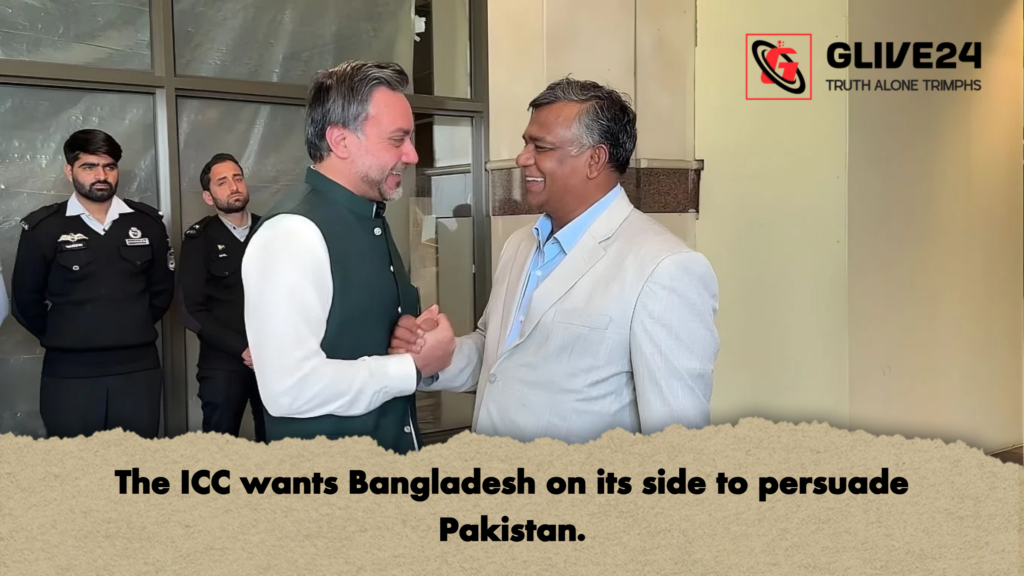
In preparation for the meeting, Aminul received an urgent communication late the night before, prompting him to travel to Lahore immediately. Reports indicate he arrived in the Pakistani city in the early hours yesterday and was welcomed by PSL Chief Executive Salman Naseer. The PCB shared a video on its official Facebook page, captioning it with Naseer’s words: “We have warmly welcomed our distinguished guest to Pakistan.”
The ICC convened this emergency meeting with representatives from Pakistan and other member nations, including Bangladesh. The Bangladesh delegation’s presence was central to the discussion, reflecting its earlier decision to refrain from playing in India due to security concerns. Notably, Pakistan had publicly supported Bangladesh from the outset, including voting for Bangladesh in ICC matters beyond its own membership.
The negotiations reached a point where Pakistan, initially considering a boycott of the World Cup itself, ultimately limited its action to withdrawing from the India match scheduled for 15 February. In response, Indian media reported that the ICC has employed diplomatic channels to encourage Pakistan to reconsider its stance. Deputy Chairman Imran Khwaja, a representative of the Singapore Cricket Association, has played a key role as ICC’s informal liaison with the PCB.
Prior to the ICC’s virtual session, Aminul also met with PCB Chairman Mohsin Naqvi, reinforcing the high-level nature of these discussions. The outcome remains closely watched by fans, stakeholders, and the cricketing world alike.
Key Developments in ICC-Bangladesh-Pakistan Talks
| Date | Event | Parties Involved | Outcome/Notes |
|---|---|---|---|
| 14 Feb 2026 | Aminul Islam travels to Lahore | BCB, PCB | Urgent visit to discuss “mutual understanding” |
| 15 Feb 2026 | Pakistan announces boycott of India match | PCB, ICC | Solidarity with Bangladesh, matches against other teams unaffected |
| During WC 2026 | ICC holds emergency virtual meeting | ICC, PCB, BCB, other members | Bangladesh participation leveraged to mediate Pakistan |
| Prior to WC 2026 | Bangladesh withdraws from tournament | BCB | Security concerns in India; triggers ICC diplomatic efforts |
| Ongoing | ICC Deputy Chairman Imran Khwaja liaises with PCB | ICC, PCB | Diplomatic channel to resolve standoff |
The episode underscores ICC’s increasingly complex role, not just as a regulator of cricket but as a diplomatic intermediary in politically sensitive situations, with Bangladesh’s involvement proving pivotal.