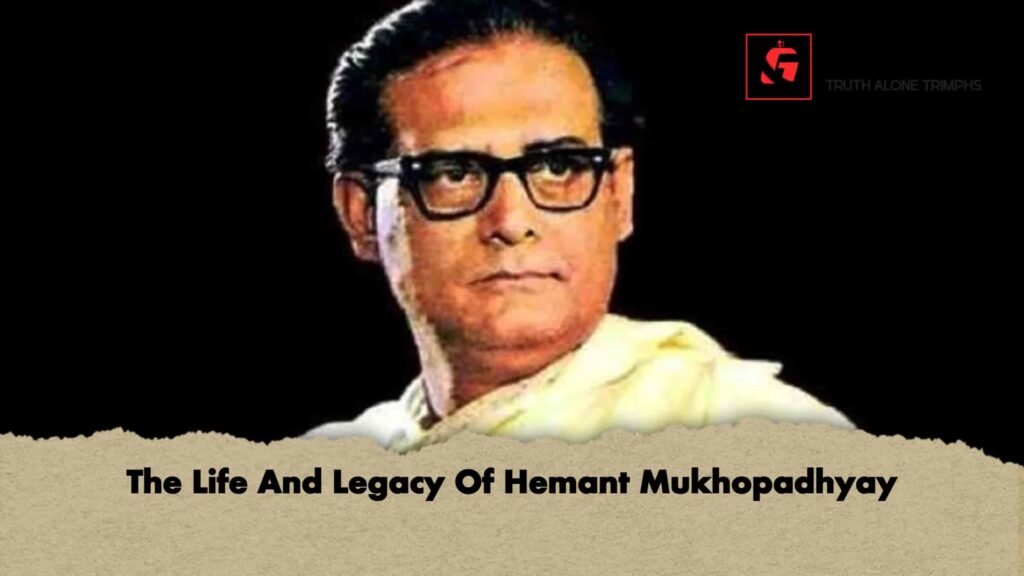
Hemant Mukhopadhyay, born on 16 June 1920, remains one of the most influential musical personalities in the Indian subcontinent. As a singer, composer, and music director, his extensive work spanned multiple regional languages, most notably Bengali and Hindi. Beyond his artistic contributions to cinema and traditional music, Mukhopadhyay is historically recognised in Bangladesh as a dedicated humanitarian ally during the 1971 Liberation War.
Table of Contents
Humanitarian Mobilisation in 1971
During the 1971 independence conflict, Mukhopadhyay utilised his musical prominence to support the Bangladeshi democratic movement. His recorded rendition of the patriotic song became a staple of wartime broadcasting:
“Ma go, bhabna keno? Amra tomar shantipriyo shanto chhele, tobu shotru ele ostro hate dhorte jani…”
(O Mother, why worry? We are your peace-loving, quiet sons, yet we know how to take up arms when the enemy arrives…)
This track was regularly transmitted across the region by Swadhin Bangla Betar Kendra, the wartime radio station of the revolutionaries, serving as a significant morale booster for freedom fighters and displaced civilians.
In addition to radio broadcasts, Mukhopadhyay coordinated with various Indian artists to address the humanitarian crisis. He organised and performed in numerous live concerts and cultural programmes across refugee camps. The financial proceeds generated from these public events were systematically collected and handed over to assist in the relief and maintenance of Bangladeshi refugees who had crossed into India.
Cinematic Success and Rabindrasangeet
Mukhopadhyay’s vocal versatility allowed him to achieve parallel success in commercial playback singing and classical interpretations. In mainstream cinema, his tracks achieved immense popularity, with songs like the Hindi composition “Hai Apna Dil To Aawara” and the Bengali cinematic track “Ei Poth Jodi Na Sesh Hoy” becoming widely recognised across the subcontinent.
Concurrently, Mukhopadhyay established himself as a definitive voice for Rabindrasangeet (the musical compositions of Nobel Laureate Rabindranath Tagore). His distinctive baritone delivery and precise modulation gave a distinct form to Tagore’s lyrics, making the genre accessible to a broader audience and cementing his academic and cultural reputation.
Institutional Recognition and Principles
Over his multi-decade career, Mukhopadhyay received widespread institutional recognition, including winning India’s National Film Award twice. However, his career was also defined by his strict independent principles regarding state-sponsored accolades. He officially declined both the Padma Shri and the Padma Bhushan—two of the highest civilian honours awarded by the Indian government.
The maestro passed away on 26 September 1989. On his birth anniversary, he continues to be remembered with formal tributes across Bangladesh and India for his dual legacy of musical brilliance and wartime solidarity.
Overview of Artistic and Humanitarian Contributions
The table below outlines the specific sectors of Hemant Mukhopadhyay’s career and his verified achievements within each domain:
| Sector of Contribution | Key Historical Details | Verified Outcomes and Legacy |
| Wartime Broadcasting | Rendition of “Ma go, bhabna keno?” | Transmitted via Swadhin Bangla Betar Kendra to inspire fighters. |
| Refugee Relief | Live performances in regional camps. | Generated and donated critical financial funds for refugees. |
| Mainstream Playback | Vocals for “Hai Apna Dil To Aawara” and “Ei Poth”. | Established cross-linguistic popularity in Hindi and Bengali cinema. |
| Classical Preservation | Specialized execution of Rabindrasangeet. | Widely credited with expanding the listenership of Tagore’s works. |
| State Honours | Selection for National and Civilian Awards. | Won the National Film Award twice; declined both Padma awards. |