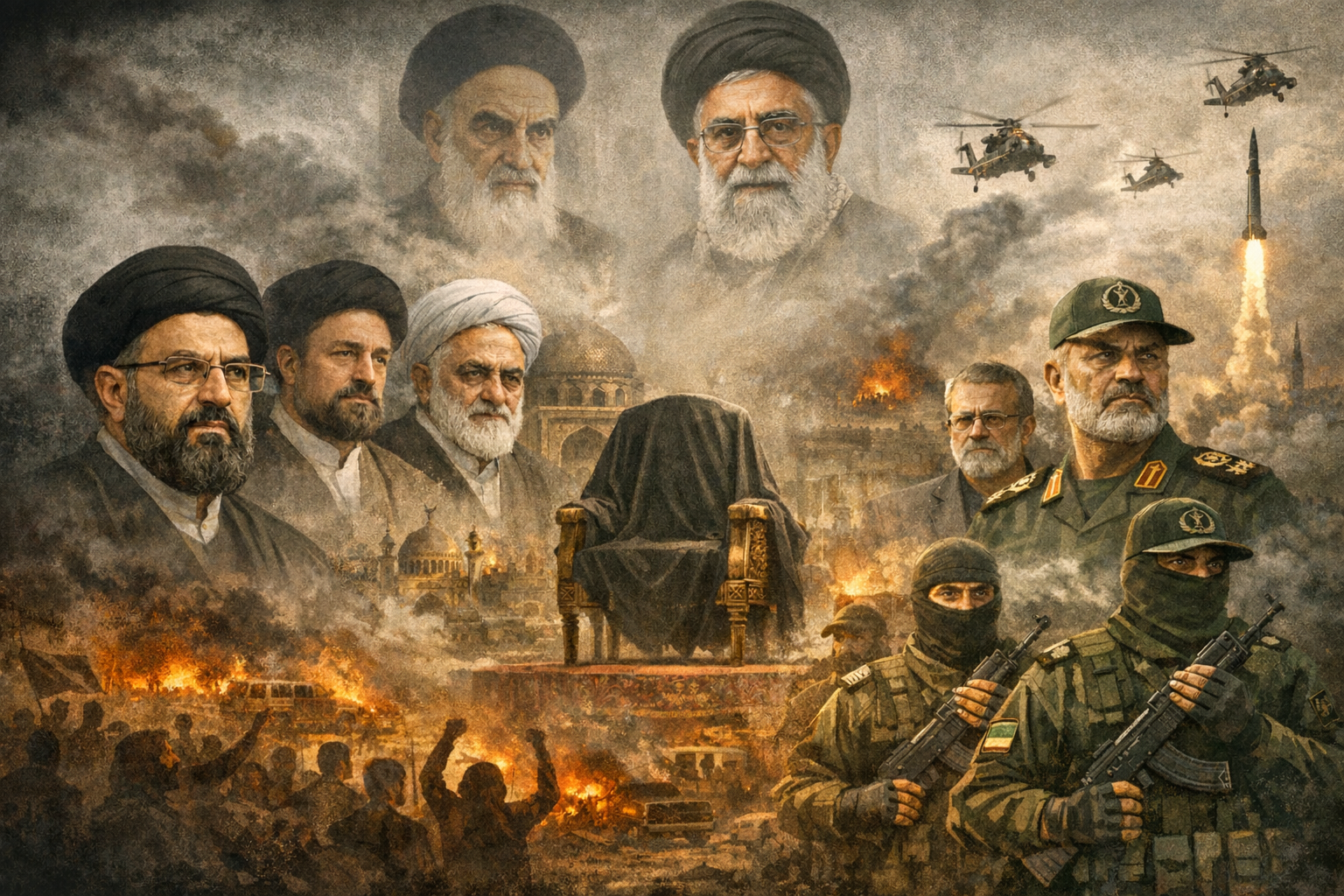
The office of Iran’s Supreme Leader (Rahbar) is a singular institution in Middle Eastern politics. It is not merely a state position; rather, it represents the confluence of religious authority, military command, political oversight and ideological guardianship of the state. From the Islamic Revolution of 1979 until 2 March 2026, Iran has been governed by only two Supreme Leaders—Ayatollah Ruhollah Khomeini and Ayatollah Ali Khamenei. Yet the processes by which they assumed office were markedly different. One emerged as the uncontested leader of a revolution; the other was selected through a constitutional mechanism. Today, in the vacuum following Khamenei’s death, that very mechanism faces its most severe test.
Table of Contents
The Historical Foundations of Leadership Selection
1. From Velayat-e Faqih to Constitutional Authority: The Birth of the Office
The conceptual foundation of Iran’s Supreme Leadership lies in the doctrine of Velayat-e Faqih—the “Guardianship of the Islamic Jurist”. Although rooted in Shia political thought, it was Ayatollah Khomeini who institutionalised the concept within a modern state framework. His argument was straightforward yet transformative: in the absence of the Hidden Imam, a qualified Islamic jurist (faqih) must assume responsibility for governing the state.
Following the fall of Shah Mohammad Reza Pahlavi in February 1979, Khomeini returned from exile. His arrival in Tehran on 1 February was not merely a political homecoming but the symbolic inauguration of a new political order. In March 1979, a national referendum saw 98.2 per cent of voters endorse the establishment of an “Islamic Republic”. This vote conferred indirect legal legitimacy upon Khomeini’s leadership.
In August 1979, a special assembly was elected to draft a new constitution. Comprising 73 members chosen by popular vote, this body enshrined the position of Supreme Leader within the constitutional framework and effectively established Khomeini in that role for life. In other words, Khomeini was not elected to the office through a formal ballot; rather, he was the undisputed leader of a revolution whose authority was subsequently codified in law.
2. Ayatollah Ruhollah Khomeini (1979–1989): The Era of Revolutionary Authority
Khomeini’s decade in power was a formative period of state-building. He was not merely a religious authority but the living symbol of the revolution itself. During his tenure:
- The Iran–Iraq War (1980–1988) reshaped the region and consolidated internal unity.
- The Islamic Revolutionary Guard Corps (IRGC) was strengthened as a parallel military institution.
- Political opposition was systematically curtailed.
- Religious oversight became deeply embedded within state institutions.
His authority was virtually unquestioned. The President, Parliament and judiciary ultimately operated under his overarching command. It was during this period that the Assembly of Experts (Majles-e Khobregan) was institutionalised as a permanent body tasked with selecting and supervising future Supreme Leaders.
Khomeini’s death on 3 June 1989 triggered the first true succession crisis in the Islamic Republic. The question loomed large: who could succeed the architect of the revolution?
3. The Assembly of Experts: Who They Are and How They Function
Under Iran’s constitution, the Supreme Leader is not elected by direct popular vote. Instead, he is chosen by the Assembly of Experts—an 88-member body composed primarily of mujtahids, or senior Islamic jurists.
Members of the Assembly are elected by the public for eight-year terms. However, candidates must first be vetted and approved by the Guardian Council, half of whose members are directly appointed by the Supreme Leader. Thus, while the Assembly is technically elected, the system forms a tightly regulated circle of clerical-political authority.
The Assembly’s core responsibilities are:
- Selecting the Supreme Leader.
- Supervising his performance.
- Removing him from office if deemed incapable of fulfilling his duties.
In theory, this structure ensures leadership selection through representatives chosen by the electorate. In practice, it has evolved into an internally managed religious-political system.
4. 1989: The Unexpected Rise of Ali Khamenei
Following Khomeini’s death, the Assembly of Experts convened in an emergency session on 4 June 1989. The atmosphere was tense. An initial proposal suggested forming a collective Leadership Council of three or five members. This idea was rejected in favour of appointing a single leader.
At the time, the constitution stipulated that the Supreme Leader must be a Marja’-e Taqlid—a Grand Ayatollah of the highest clerical rank. Ali Khamenei did not meet this requirement; he held the title of Hojjatoleslam and had just completed his term as President.
Hashemi Rafsanjani, a powerful political figure, asserted during the session that Khomeini had privately expressed confidence in Khamenei as a suitable successor. This claim altered the course of the debate. A vote was held. Of the 74 members present, 60 supported Khamenei—well over the required two-thirds majority.
Subsequently, the constitution was amended through a national referendum. The requirement of being a Marja’ was relaxed, allowing a “qualified jurist” (an Ayatollah-level cleric) to assume the position. Thus Khamenei’s leadership was granted full constitutional legitimacy.
5. Ayatollah Ali Khamenei (1989–2026): Consolidation of Power
Khamenei’s 36-year tenure is the longest in the Islamic Republic’s history. His era was marked by:
- The extraordinary expansion of IRGC influence.
- The growing dominance of military-linked institutions in the economy.
- The nuclear programme and successive waves of international sanctions.
- Persistent tensions between reformists and hardliners.
- Major public protests in 2009, 2019 and 2022.
Over time, Khamenei constructed a tightly aligned power structure. Key institutions—the Guardian Council, the judiciary, state broadcasting authorities and senior military leadership—remained deeply loyal to him.
6. 2026: The Moment of Vacuum
On 28 February 2026, reports indicated that Ali Khamenei had been killed in a joint Israeli–American air strike. For the first time, Iran faces a full constitutional vacuum at the apex of its political order.
Under Article 111 of the constitution:
The Assembly of Experts must convene immediately.
A new Supreme Leader must be elected by secret ballot.
Until that election is concluded, an interim council—comprising the President, the head of the judiciary and a clerical member of the Guardian Council—assumes temporary authority.
Yet the reality is far more complex. Ongoing military conflict, air strikes and security instability make it difficult for all 88 members of the Assembly to gather. In this environment, the IRGC has begun to position itself as a decisive “kingmaker”.
A New Balance of Power: Succession, the IRGC, and Iran’s Uncertain Future
Post-Khamenei Iran is not merely searching for a new religious figurehead; it is confronting a profound recalibration of power. In 1989, the succession process, though tense, unfolded within a relatively intact state structure. There was no active foreign assault on Iranian soil, and the revolutionary elite remained cohesive. By contrast, the circumstances of 2026 are dramatically different. External military pressure, internal unrest, generational change, and the unprecedented strength of the Islamic Revolutionary Guard Corps (IRGC) combine to create the most complex succession crisis in the Islamic Republic’s history.
1. Constitutional Procedure Versus Political Reality
Formally, the Assembly of Experts must elect the next Supreme Leader by secret ballot. However, the central question is whether such a vote can genuinely be independent. Although members of the Assembly are elected by the public, their candidacies are vetted by the Guardian Council—an institution partially appointed by the very office now vacant. The system is therefore self-regulating, designed to preserve ideological continuity.
In wartime conditions, the logistical challenge of convening all 88 members has become acute. Reports suggest that elements within the IRGC command structure have sought to accelerate the process, pressing for the swift endorsement of a preferred candidate. Should a consensus be engineered behind closed doors, the Assembly’s vote may amount to little more than formal ratification.
This marks a crucial distinction from 1989. Then, senior clerics steered the transition. In 2026, military power exerts a far more direct and visible influence.
2. The Contenders: Rivalries Within the Inner Circle
Mojtaba Khamenei
Mojtaba Khamenei is the second son of Iran’s Supreme Leader, Ali Khamenei. For many years he has consciously avoided frontline, public politics, instead exercising influence from behind the scenes. Although he holds no major formal political office, a number of analysts believe he maintains close connections with the very centre of the country’s power structure. In particular, his reported ties with the intelligence branch of the Islamic Revolutionary Guard Corps (IRGC) and with senior military commanders are frequently cited. For this reason, many observers regard him as a de facto component of Iran’s ruling establishment.
Among Mojtaba’s perceived strengths is the question of military backing. It is widely assumed that elements within the IRGC are sympathetic to him—an advantage that could prove decisive during any transition of power. He also enjoys direct access to his father’s long-established political and religious networks, a significant asset within Iran’s intricate and highly layered system of governance. Furthermore, his presence may be seen by certain influential factions as a symbol of continuity. In a post-Ali Khamenei era, those concerned with preserving policy consistency might view him as a comparatively safe and predictable choice.
Yet he also faces substantial challenges. The notion of hereditary rule is historically unpopular in Iran’s political culture, particularly given that the 1979 Revolution was directed against monarchical governance. The prospect of a son succeeding his father could therefore strike many as an uncomfortable echo of the very system the revolution sought to dismantle. Questions also surround his religious standing, as the role of Supreme Leader traditionally requires a high level of recognised clerical authority. Moreover, the risk of heightened public discontent or political opposition cannot be dismissed.
Taken together, if Mojtaba Khamenei were to be selected as Supreme Leader, Iran’s political system could drift towards a semi-hereditary theocratic model—an outcome likely to generate fresh controversy both within the country and in its international relations.
Alireza Arafi
Alireza Arafi is a senior figure within Iran’s religious education system and a member of the Assembly of Experts. For many years he has played a significant role in the administration and supervision of the hawza—the network of Shia seminaries that form the backbone of clerical training in Iran. His reputation for religious scholarship, institutional experience, and standing as an established cleric has made him broadly acceptable within conservative circles. At the same time, his loyalty to the current Supreme Leader, Ali Khamenei, has positioned him as a trusted figure within the existing power structure.
Arafi’s principal strength lies in his religious credibility. In the selection of Iran’s Supreme Leader, high clerical rank and recognised expertise in Islamic jurisprudence (fiqh) are critical considerations. In this respect, he occupies a comparatively strong position. Moreover, he is not directly associated with the military or security establishment, which allows him to be viewed as a “civil-religious” alternative rather than a representative of coercive power. Even within conservative politics, he is regarded as relatively less controversial than many of his peers.
According to a number of analysts, Alireza Arafi could emerge as a compromise candidate—particularly if the various factions within the ruling establishment find it necessary to reach an internal accommodation. He would be capable of maintaining religious continuity while also avoiding direct confrontation with the Islamic Revolutionary Guard Corps (IRGC) or other military actors. For those seeking to preserve institutional balance, his candidacy may therefore hold particular appeal.
That said, questions remain regarding the breadth of his influence and the extent of his public support. He is a comparatively low-profile figure in broader public discourse, which on the one hand keeps him free from major controversy, but on the other limits his visibility among the wider population. Taken together, Alireza Arafi may be regarded as a candidate likely to advance on the basis of elite consensus—one who could project both continuity and stability within Iran’s complex political order.
Gholam-Hossein Mohseni-Ejei
Gholam-Hossein Mohseni-Ejei currently serves as the Head of Iran’s Judiciary. Over the course of his career, he has been closely associated with the country’s security and intelligence apparatus, holding a number of senior and strategically significant posts. His professional trajectory has largely revolved around judicial, intelligence, and security institutions, enabling him to cultivate deep connections within the core structures of state power. Within hardline political and religious circles, he is widely regarded as a dependable and trusted figure.
Mohseni-Ejei’s principal strengths lie in his administrative experience and his reputation for firmness. His willingness to adopt uncompromising positions in matters of state order and national security has made him a symbol of reliability among conservative factions. During his tenure as head of the judiciary, a notably strict approach towards law enforcement and political dissent has been evident—an indication of his broader political outlook.
According to analysts, should he assume a higher leadership role, it could signal a further tightening of domestic policy in Iran. In particular, the space for political opposition, freedom of expression, and reformist activity may become even more restricted. There would likely be a renewed emphasis on state security and ideological steadfastness as guiding principles of governance.
Internationally, such a development could also carry implications. A more rigid, security-oriented domestic posture may complicate Iran’s engagement with the wider world and introduce new diplomatic challenges. Taken together, the potential rise of Gholam-Hossein Mohseni-Ejei would suggest a consolidation of a governance model grounded in strong central control, in which reformist forces might find their political room for manoeuvre increasingly constrained.
Hassan Khomeini
Hassan Khomeini is the grandson of Ayatollah Ruhollah Khomeini, the architect of Iran’s Islamic Revolution. Owing to his family lineage and revolutionary heritage, he carries considerable symbolic weight within Iran’s political sphere. Among reformist and centrist circles, he is regarded as a comparatively acceptable and even popular figure. For many, his name evokes a return to the ideological roots of the revolution—particularly its early emphasis on justice, public participation, and political engagement.
Hassan Khomeini’s principal strength lies in his familial legacy and religious identity. As a member of the Khomeini family, he enjoys a degree of historical and emotional legitimacy that holds significance in Iran’s political culture. At the same time, he is not directly associated with the hardline security establishment, which allows him to be perceived as a comparatively “softer” or more conciliatory leadership option. Reformist voices argue that his leadership could introduce a measure of openness and balance into Iran’s domestic political environment.
However, the central obstacle facing him concerns institutional approval. The key question remains how far the Guardian Council and the hardline political establishment would be prepared to accept his candidacy. In the past, controversy has surrounded his potential political roles, suggesting that more conservative elements of the power structure have not fully embraced him.
Should he ever be nominated or approved for higher leadership, it would likely be interpreted as a comparatively moderate shift in Iran’s political direction. Such a development might signal a move away from an overtly security-driven posture towards a more conciliatory and reform-oriented tone—although the extent of any substantive change would ultimately depend on the broader balance of power within Iran’s governing structure.
Ali Larijani
Ali Larijani is a seasoned Iranian politician who, earlier in his career, was associated with the Islamic Revolutionary Guard Corps (IRGC) and has since held a range of senior and influential posts. He served for many years as Speaker of Parliament and has played significant roles in sensitive areas such as national security and foreign policy. His extensive political experience, administrative competence, and ability to operate across multiple layers of the state structure present him as a comparatively balanced and measured figure within Iran’s political landscape.
Larijani’s strength lies in his multidimensional acceptability. He is not viewed as an uncompromising hardliner, yet neither is he aligned fully with reformist currents. Rather, he is often described as a pragmatic conservative. He possesses prior connections with military and security institutions, while also having accumulated long experience within civilian administration and the legislature. As a result, many analysts believe he could serve as a bridge between these two spheres of power.
It is for this reason that he is sometimes regarded as a “stability” option. Within Iran’s complex power structure—where clerical authority, military influence, and elected institutions intersect—an experienced and conciliatory figure such as Larijani could help maintain internal equilibrium. In particular, his approach may prove effective in preserving policy continuity while avoiding unnecessary confrontation.
Nonetheless, his prospects would depend heavily on the backing of the most influential factions within the establishment. Taken together, Ali Larijani represents a potential candidate capable of mediating between Iran’s military and civilian domains, symbolising a comparatively stable and managed transition of leadership.
3. The IRGC: From Guardian to Kingmaker
By March 2026, the IRGC stands as the most organised and powerful institution in Iran. It is not merely a military force but an economic conglomerate, a political network, and a regional strategic actor. Its influence spans infrastructure, energy, construction, and proxy operations across the Middle East.
In the immediate aftermath of Khamenei’s reported death, the IRGC:
- Conducted retaliatory drone and missile strikes on American bases in the Gulf.
- Deployed Basij militia units across major cities.
- Assumed de facto control over national security coordination.
These actions signal a decisive reality: military authority is operating in advance of formal political succession.
The IRGC’s motivations are clear. First, institutional preservation. A reformist Supreme Leader might curtail its economic empire and strategic autonomy. Second, strategic continuity. In the midst of conflict, commanders favour a leader committed to an uncompromising posture towards the United States and Israel. Third, domestic stability. Sustained unrest in recent years has heightened the military’s sensitivity to regime security.
Many analysts now argue that Iran may be entering a de facto military-dominated phase: a cleric may occupy the apex formally, but strategic decisions could increasingly emanate from uniformed leadership.
4. Three Possible Trajectories
Continuity of Theocracy
The Assembly swiftly selects a hardline cleric. Institutional architecture remains intact. The IRGC continues to wield significant influence behind the scenes, but the appearance of clerical supremacy is preserved. This is the most stabilising yet rigid scenario.
Military Pre-eminence
A clerical figurehead is appointed, but real authority shifts towards senior IRGC commanders. Iran evolves into a hybrid religious-military state. Such a transition would represent the most profound structural change since 1979.
Political Fracture
Should the Assembly fail to achieve consensus—or if public unrest escalates—the regime could face severe internal divisions. Elite rivalries, coupled with economic strain and external conflict, might produce instability unprecedented in the Islamic Republic’s history.
5. The Questions Ahead
- Can Iran sustain the legitimacy of clerical governance under mounting pressure?
- Will the IRGC emerge openly as a political actor rather than a guardian of the system?
- Will the public remain passive observers, or could a new cycle of mass mobilisation reshape the landscape?
- To what extent will international actors influence the succession calculus?
The selection of Iran’s Supreme Leader is far more than a constitutional exercise. It is a moment of profound power redistribution. After Khomeini’s revolutionary charisma and Khamenei’s long consolidation of institutional control, Iran stands at a crossroads where religious authority, military power and political pragmatism intersect in uncertain ways.
The coming weeks and months will determine whether the Islamic Republic preserves its clerical framework or evolves into a new form of religious-military governance. The outcome will not only define Iran’s domestic order but reshape the strategic equilibrium of the wider region.