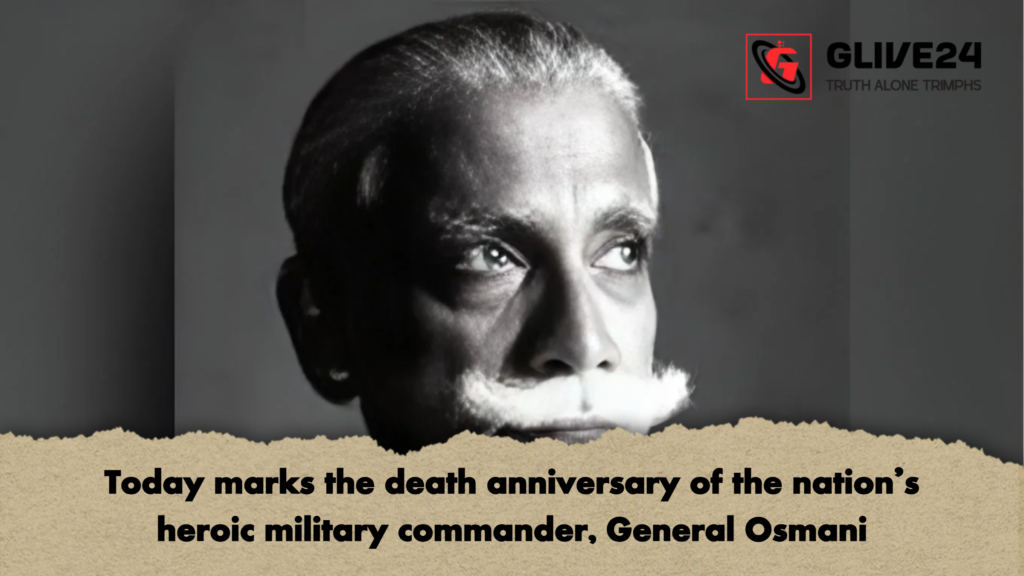
Today marks the 42nd death anniversary of Bongobir General Muhammad Ataul Gani Osmani, the supreme commander of the Mukti Bahini during Bangladesh’s Liberation War. General Osmani passed away on 16 February 1984 at the age of 65 and was laid to rest near the revered Hazrat Shahjalal (R.) shrine in Sylhet, his birthplace. To honour his monumental contribution to the nation, commemorative events, including discussion sessions and prayers, are being held across Sylhet, Dhaka, and other regions. A formal programme will take place at 11:00 am at the Rauwar Helmet, featuring tributes and du’a ceremonies.
Early Life and Education
Born on 1 September 1918 in Dayamir, Balaganj, Sylhet, General Osmani was the second child of Khan Bahadur Mafizur Rahman and Jobeda Khatun, with one elder brother, a younger brother, and a sister. His initial education was home-based, reflecting his family’s emphasis on learning. In 1929, at the age of 11, he was admitted to Cotton School, Guwahati, Assam. Following his mother’s wish, he joined Sylhet Government Pilot School in 1932, passing his matriculation in 1934 with first division honours and receiving the prestigious Pretoria Award for excellence in English.
Osmani enrolled at Aligarh Muslim University in 1934, completing his Intermediate in Arts (IA) in 1936 and a Bachelor of Arts in 1938. While pursuing an MA in Geography in 1939, he joined the British Indian Army, demonstrating leadership early on as a sergeant in the University Officers’ Training Corps (UOTC).
Military Career
Graduating from Dera–Naus Academy on 5 October 1940, Osmani earned a King’s Commission. He became a captain on 17 February 1941 and, remarkably, in February 1942, at just 23, became the youngest major in the British Army, commanding a full battalion. During World War II (1943–1945), he led a significant mechanised unit in the Burma Campaign.
Following the war, he successfully passed the ICS examination in 1945. With the independence and partition of India in 1947, Osmani joined the Pakistan Army as a Lieutenant Colonel on 7 October 1947. He earned his PSC degree from Quetta Staff College in 1948 and served in key operations and international missions representing Pakistan in SEATO and CENTO. He was promoted to Colonel in 1956 and served as Deputy Director of Operations.
Osmani participated in the 1965 Indo-Pak war as Deputy Director of Military Operations, gaining recognition as a principled and independent Bengali officer. He retired on 16 February 1967 but soon entered politics, joining the Awami League in 1970 and being elected MNA for the Fenchuganj-Balaganj-Bishwanath constituency. With the outbreak of the Liberation War of 1971, he led the Mukti Bahini with unparalleled skill, later serving in key ministerial roles in the independent Bangladesh government.
Key Milestones
| Year | Event | Position / Achievement |
|---|---|---|
| 1918 | Birth | Dayamir, Balaganj, Sylhet |
| 1934 | Matriculation | First Division, Pretoria Award |
| 1934–1938 | Aligarh Muslim University | IA & BA completed |
| 1939 | Joined British Indian Army | UOTC Sergeant |
| 1940 | Commission | King’s Commission from Dera–Naus Academy |
| 1942 | Major | Youngest battalion commander in British Army |
| 1943–45 | WWII Burma Campaign | Mechanised unit commander |
| 1947 | Joined Pakistan Army | Lieutenant Colonel |
| 1956 | Promotion | Colonel, Deputy Director of Operations |
| 1965 | Indo-Pak War | Deputy Director of Military Operations |
| 1970 | Politics | Elected MNA, Awami League |
| 1971 | Liberation War | Supreme Commander of Mukti Bahini |
| 1984 | Death | Age 65, Sylhet |
General Osmani’s legacy continues to inspire the nation, epitomising courage, leadership, and unwavering dedication to Bangladesh’s freedom.